A Report on Webinar: Financial Acumen in the Boardroom for Good Corporate Governance
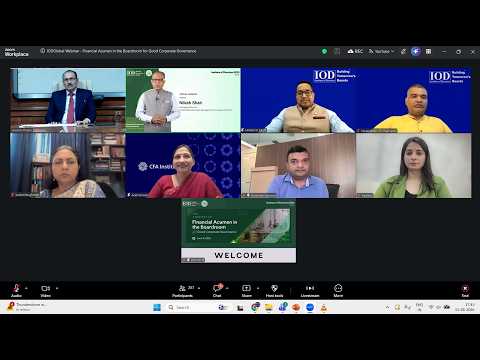
The Institute of Directors (IOD), India hosted its Global Webinar on June 11, 2026, convened under the theme: Financial Acumen in the Boardroom for Good Corporate Governance.
What unfolded over the webinar was less a conference and more a reckoning. A reckoning with the uncomfortable distance between the boardroom and the balance sheet. Between procedural compliance and purposeful oversight. Between knowing the numbers and crucially reading the story they tell.
The setting was deliberate. At a time when corporate collapses continue to surface despite regulators, auditors, and boards all being present and functioning, the Institute of Directors convened this forum to ask not just what boards need to know about finance, but why so many still fail to see the warning signs until the horses have already run. The distinguished panel and the moderator did not stop at diagnosing the gaps between financial literacy and financial acumen. It probed deeper into the culture of boardrooms, the psychology of deference to dominant personalities, the appeal of seemingly strong growth stories, and the quiet erosion of governance that precedes every crisis.
The 'Welcome Address' was delivered by:
Mr. Manoj K. Raut
CEO & Secretary General
Institute of Directors (IOD), India
Mr. Raut set the tone for a compelling discussion on the critical role of financial acumen in boardroom effectiveness and corporate governance. Emphasising that governance excellence is founded not merely on compliance but on competence, he posed a compelling question: “Can a board truly govern what it does not fully understand?”, and cautioned that many of the world's most respected corporations did not fail because of a lack of strategy, talent, technology, or ambition, but because boards failed to ask the right questions, warning signals were overlooked, and governance became “procedural rather than purposeful.”


He noted that in an age where corporate reputations can be built over decades and damaged within minutes, financial acumen has become a boardroom necessity rather than a desirable skill. Mr. Raut further stressed that modern directors must go beyond reading financial statements to understanding what lies beneath them. Their role, he noted, is not simply to approve budgets and reports, but to challenge assumptions, strengthen accountability, and safeguard stakeholder trust. Quoting Warren Buffett's observation that “risk comes from not knowing what you are doing,” he underscored the importance of continuous learning and informed oversight. Concluding his address, he left the audience with a memorable reminder: “Good governance is not built in times of crisis; it is built long before the crisis arrives.”
The 'Opening Theme Address' was presented by:
Mr. Gautam Thakur
Chairman
Saraswat Bank
Mr. Thakur pointed out that while financial literacy enables directors to understand balance sheets and financial statements, financial acumen is about interpreting the story behind the numbers and questioning assumptions, identifying emerging risks, and exercising sound judgment before problems become crises.
“Can a director read the numbers yet still miss the story?” This thought-provoking question laid at the heart of his address as he explored the distinction between financial literacy and the far more critical attribute of financial acumen in today's boardrooms. Drawing on examples from banking, infrastructure, manufacturing, healthcare, and pharmaceuticals, he highlighted how governance failures, liquidity crises, excessive leverage, and delayed decision-making often stem not from a lack of data but from an inability to interpret warning signals effectively. He stressed that regulatory compliance establishes only the minimum threshold for governance; true board effectiveness demands continuous learning and informed decision-making. Advocating for diverse and multidisciplinary boards, Mr. Thakur observed that modern directors must be “all-rounders” capable of understanding the financial implications of decisions relating to technology, sustainability, acquisitions, capital allocation, and risk management. Reflecting on professional development, he remarked that “old school is good school”, noting that while traditional approaches may not always explain every technical detail, they often instill a clear understanding of expectations, discipline, and purpose.
The 'Special Address' was delivered by:
Mr. Nilesh Shah
Managing Director
Kotak Mahindra Asset Management Company Limited
Mr. Shah emphasized that effective boards are not built solely on financial expertise but on a collective willingness to ask probing questions and exercise independent judgment.
“Who defines the boundaries of risk within an organisation and who ensures they are not crossed?” This central question underpinned his address as he explored the board's critical role in strengthening governance and long-term organisational resilience. He also observed that common sense and judgments are often as important as technical expertise, arguing that the board's primary responsibility is to establish clear guardrails within which management can operate while preventing excessive risktaking. He stressed that governance is strengthened when boards continuously engage with management and create an environment where difficult conversations are welcomed rather than avoided. On risk management, Mr. Shah acknowledged that not every crisis can be predicted, but organisations can prepare by fostering a culture that encourages the early identification and transparent disclosure of risks. Rather than assigning blame during challenging periods, he advocated for collaboration and pre-defined crisis management frameworks that enable swift and effective responses. Reflecting on performance management, he endorsed the philosophy of “under-promising and over-delivering,” cautioning against unrealistic projections while encouraging adaptability in the face of changing market conditions. Looking ahead, Mr. Shah highlighted the transformative potential of artificial intelligence, predicting that AI-enabled tools would increasingly handle compliance and analytical tasks, allowing boards to focus on strategic judgment.
A SPECIAL PANEL SESSION:
Financial Acumen in the Boardroom for Good Corporate Governance
The Panel Session was moderated by:
CA Jayaprakash Rajangam
Independent Director on Multiple Boards, and Professional Mentor & Advisor on Finance, Risk Management and Governance
Mr. Rajangam, through a series of incisive questions steered the discussion beyond financial literacy into the broader realm of board effectiveness, governance, and strategic oversight:
• Is it a skill gap or a mindset gap?
• Was it an information failure or a culture problem?
• What should boards really be looking at when everything appears to be going right?
He crafted a conversation that explored the evolving expectations from modern boards. Rather than focusing on compliance alone, he repeatedly challenged the panel to examine the deeper drivers of governance failures, stakeholder conflicts, and long-term value creation. Drawing attention to corporate collapses he posed a critical question: “Financial literacy might not be the issue. So, was it an information failure, or was it a culture problem?” Mr. Rajangam also highlighted the growing complexity of balancing competing stakeholder interests, asking whether shareholder returns, employee welfare, customer interests, or regulatory expectations should take precedence. In doing so, he brought the conversation back to the board's central responsibility which is ensuring sustainable value creation. Addressing emerging trends, he encouraged panellists to decode the latest AI and fintech buzzwords, while cautioning against becoming distracted by jargon and metrics detached from business fundamentals.
The panel session had the following Distinguished Speakers:
1. Ms. Sushmita Ghatak
Independent Director on several boards, and Former MD & CEO, ICRA Analytics
2. Dr. Abhishek Agarwal
Managing Partner, Accion
Board Member on Annapurna Finance, IKF Finance, Dvara Solutions, et al.
3. Ms. Arati Porwal
Senior Country Head
CFA Institute
Ms. Ghatak, in her thought-provoking address highlighted that effective board oversight demands curiosity, courage, and the ability to connect disparate pieces of information into a coherent strategic narrative. Drawing from her extensive experiences she highlighted a fundamental shift that occurs when one moves from the executive suite to the boardroom. While executives operate with real-time information, directors must piece together fragmented insights from multiple committees and reports. “The challenge is to look at the story behind the numbers,” she remarked, emphasising that effective governance requires connecting seemingly unrelated data points to arrive at informed judgments. She further argued that governance breakdowns often stem not from a lack of information but from a reluctance to challenge assumptions and ask uncomfortable questions. “If your internal judgment wants you to ask something that may seem contrarian, go ahead and ask it,” she advised, stressing that independent thinking and constructive dissent are indispensable boardroom virtues. She also observed that larger-than-life promoters and dominant personalities can unintentionally discourage scrutiny, making a culture of inquiry even more critical. Looking ahead, she urged directors to examine the assumptions and validation frameworks behind AI-driven models rather than merely embracing technological buzzwords.
Dr. Agarwal, framed his address around a compelling question: “Why do governance failures continue to recur despite regulators, auditors, and boards being in place?”
Reflecting on his transition from CFO to board member, Dr. Agarwal candidly acknowledged that the shift was far from easy. While executives have access to real-time information, directors must rely on interpretation, judgment, and a deeper understanding of business fundamentals. “The story has to stitch together,” he remarked, emphasising that financial performance alone is insufficient unless viewed alongside operational realities and business context. Dr. Agarwal emphasised the growing importance of evaluating Customer Acquisition Cost (CAC) against long-term revenue potential. Boards, he argued, must move beyond celebrating growth metrics and ask whether customer acquisition strategies are creating sustainable value or merely “burning money” without a clear path to profitability. He also emphasised the need for self-imposed guardrails and client-protection principles, particularly in sectors serving vulnerable communities. Addressing IDs directly, he advised, “Do not get intimidated by larger-than-life personalities.” Instead, directors must remain objective, ask difficult questions, and maintain a long-term perspective. Concluding with a call for vigilance, he warned that governance failures are often systemic rather than individual, reminding boards that “questions are not being asked enough” when success appears effortless.
Ms. Porwal set the tone for an insightful address with this powerful assertion: “Conflict is not a bad thing.” Building on the distinction between management and board responsibilities, she observed that boards today are expected to do far more than provide oversight. Drawing from her work with start-ups and the innovation ecosystem, Ms. Porwal emphasized that many entrepreneurial failures stem not from weak ideas but from inadequate governance and financial acumen. “Any idea or organization can only sustain if there is a strong foundation of financial governance and governance in general,” she noted, advocating for governance frameworks to be embedded early in an organization's growth journey. Addressing boardroom dynamics, she described diversity of thought as a strategic advantage, arguing that robust decisions emerge when differing perspectives are encouraged. “Conflict can actually help to collaborate,” she observed, provided there is a common commitment to business sustainability and integrity. On the growing influence of artificial intelligence, Ms. Porwal urged boards to move beyond the hype and focus on capital allocation, data clarity, data confidentiality, and data privacy. Concluding her remarks, she challenged boards to look beyond financial statements and ask deeper questions. “There's no point in bolting the doors when the horses have run,” she remarked, advocating the use of non-financial indicators such as employee retention, customer satisfaction, diversity metrics, and stakeholder sentiment as critical early warning signals for sustainable business success.
The webinar was seamlessly emceed by Ms. Kashish Grover, Manager - Strategy, Institute of Directors (IOD), who skilfully guided the proceedings and ensured the smooth conduct of the sessions throughout the event.
This report has been compiled by:
Ms. Violina Das
Assistant Editor-Director Today, and Assistant Manager- Communications
Board Research & Advisory
Institute of Directors (IOD), India
Author
Institute of Directors India
Bringing a Silent Revolution through the Boardroom
Institute of Directors (IOD) is an apex national association of Corporate Directors under the India's 'Societies Registration Act XXI of 1860'. Currently it is associated with over 31,000 senior executives from Govt, PSU and Private organizations of India and abroad.
Owned by: Institute of Directors, India
Disclaimer: The opinions expressed in the articles/ stories are the personal opinions of the author. IOD/ Editor is not responsible for the accuracy, completeness, suitability, or validity of any information in those articles. The information, facts or opinions expressed in the articles/ speeches do not reflect the views of IOD/ Editor and IOD/ Editor does not assume any responsibility or liability for the same.
Quick Links
Connect us

Back to Home