iod preloader logo
IOD Quick Links Quick Links IOD Contact US Connect us

Connect with us Close

Cancel

Board Diversity Gaps

The Global Modern Leadership Report | 2022

IN COLLABORATION WITH

Diligent Institute


Co-Authors:

Dottie Schindlinger, Executive Director, Diligent Institute.

Edna Twumwaa Frimpong, Director of International Research, Diligent Institute.

Kira Ciccarelli, Lead Research Specialist, Diligent Institute.
Download Full Report
KMP Evaluation

Includes a deeper dive into each of the following regions:

  • The Americas: United States, Canada and Latin America
  • Continental Europe and the United Kingdom
  • Australia
  • Asia: India, Japan, Malaysia and Singapore
  • Middle East (United Arab Emirates, Kingdom of Saudi Arabia) and Africa (Nigeria)

Through the contributions of 22 partner organizations, we seek to answer the following questions:
  • What is the global state of boardroom diversity beyond gender?
  • How does progress on boardroom diversity differ by region and company classification?
  • Which elements of diversity are prioritized around the world?
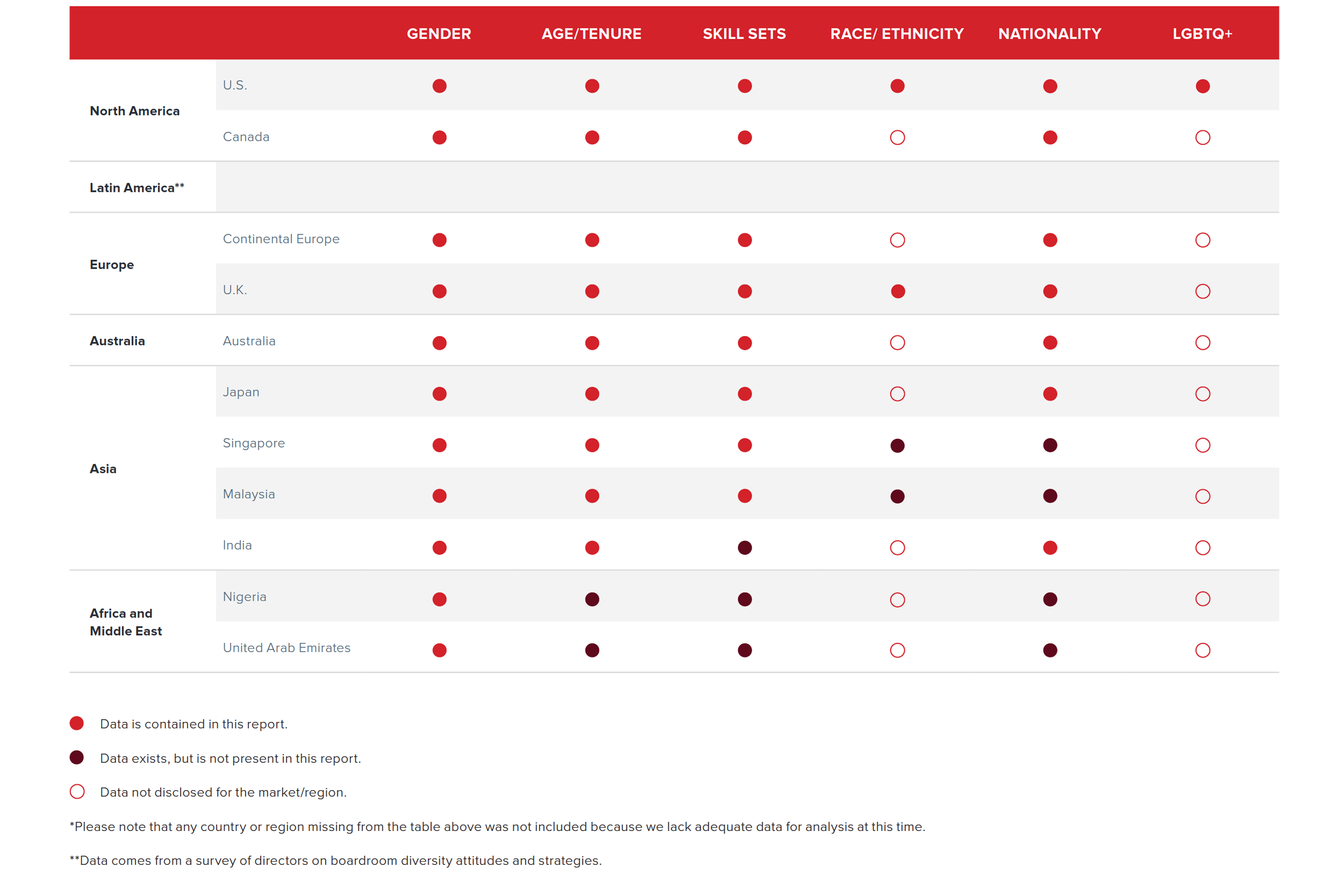
  • Where is data on boardroom composition and diversity lacking, and why?
  • What has been the impact of diversity-related regulation around the world?
  • What are board members themselves saying about boardroom composition and diversity? What are their
alt
alt

RACIAL DIVERSITY

22%

of seats in the S&P 500 are held by racial/ ethnic minority directors

21%

of seats in the Fortune 100 are held by racial/ethnic minority directors

18%

of seats in the Fortune 500 are held by racial/ethnic minority directors

24%

of seats in the Russell 3000 are held by racial/ethnic minority directors

Sources: ABD, Deloitte, Diligent and Spencer Stuart

Boardroom Diversity by Region

Asia

alt

BOARDROOM DIVERSITY SNAPSHOT

Among the regions covered in our report, Asian companies have the fewest female directors. Women hold, on average, only

14%

of board seats, a little more than half the global average of 27%.
alt

WHAT STANDS OUT IN THIS REGION

Boardroom diversity is still at the beginning stages for the Asian countries we analyzed. Gender and nationality diversity are particularly low compared with other regions.

The United States

alt

BOARDROOM DIVERSITY SNAPSHOT

Female directors hold

24%

of board seats, 3 percentage points lower than the global average of 27% and representing 4-percentage-point growth since 2019. The utilities sector has the highest percentage of board seats held by women members at 30%, while the energy sector has the lowest at 18%.
alt

WHAT STANDS OUT IN THIS REGION

The U.S. is the only region that provides data on members of the LGBTQ+ community in boardrooms across all the regions that we analyzed. According to this data, members of the LGBTQ+ community hold only 0.5% of board seats on the Fortune 500. Again, despite increased attention on improving racial and ethnic diversity, the country’s racial diversity in the boardroom lags gender diversity.
Approximately eight out of 10 board seats on the Fortune 500 are held by white directors.

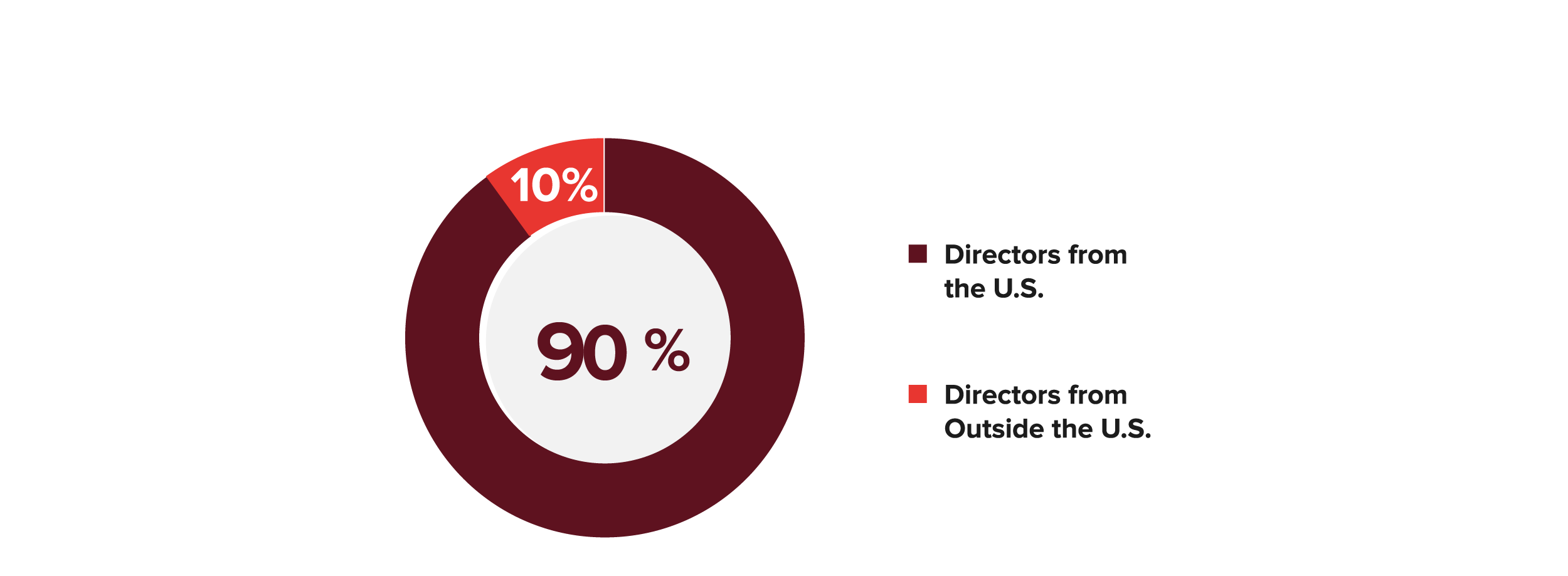
U.S. Company Director Nationality Split

alt

Canada

alt

BOARDROOM DIVERSITY SNAPSHOT

Female directors occupy

29%

of Canadian board seats as of May 2022, 2 percentage points higher than the global average of 27%. The percentage of board seats occupied by women has risen 3 percentage points since 2019.
alt

WHAT STANDS OUT IN THIS REGION

In Canada, director appointments are closer to gender parity than in our overall global sample, according to Diligent data. In Canada through May 2022, 41% of new director appointments

were female, and this rate has held steady since 2019, with a slight uptick in 2021 at 45%.
alt

Continental Europe and the United Kingdom

alt

BOARDROOM DIVERSITY SNAPSHOT

Female directors hold approximately 29% of board seats in continental Europe. Including companies in the U.K. increases the average percentage of female directors to 31%, in both cases beating the global average of 27% and a 4-percentage-point increase since 2019. The highest percentage of female board members is in the communications sector at 33%, while the energy sector has the lowest level of female representation at 25%.23
alt

WHAT STANDS OUT IN THIS REGION

Europe leads the way in using quotas and targets to increase gender diversity. France has the highest proportion of board seats held by female directors, fueled by the country’s mandated quota of 40%. However, at the current growth rate, it would take European boards another 10 years to be 40% female, as directed by the European Commission.

Australia

alt

BOARDROOM DIVERSITY SNAPSHOT

Female directors hold approximately

30%

of board seats in Australia (a 5-percentage- point increase since 2019), beating the global average of 27%.
alt

WHAT STANDS OUT IN THIS REGION

Female directors in this region are very likely to be younger than their male counterparts and to bring domain expertise in areas like technology and sustainability. However, Australian boards are likely tapping the same women for open board roles: 42% of female directors hold three or more board seats compared to 18% of male directors.
alt

Africa and the Middle East

alt

BOARDROOM DIVERSITY SNAPSHOT

16%

significantly lower than the global average of 27%.
Of the companies analyzed in Nigeria, about 17% of board chairs were female.
alt

WHAT STANDS OUT IN THIS REGION

Gender diversity is the most prominent element of boardroom diversity discussed and disclosed in the region. Other aspects of diversity such as race and ethnicity and LGBTQ+ status are not disclosed.