 Quick Links
 Connect us

 Directors Databank (Empannel Yourself)
 Become a
  Become a
  Blog
Blog
 Become an Awards Assessor
 Publications
 Contact Us







Boards in India and Beyond - Strengthening Corporate Governance for a Future-Ready World


Insights from the
Institute of Directors (IOD), India
Introduction: Governance at a Defining Moment
Corporate governance today stands at a defining inflection point both in India and globally.
Boards are navigating unprecedented complexity shaped by geopolitical realignments, climate risk, technological disruption, heightened regulatory scrutiny, and growing stakeholder expectations. In this environment, governance is no longer a back-office compliance function; it is a strategic leadership imperative.
India's corporate ecosystem offers a particularly compelling lens through which to view this transformation. Rapid economic expansion, regulatory reform, digital acceleration, and shifting geopolitical realities have collectively reshaped the context in which Indian boards operate. At the same time, the entry of Gen Z into the workforce, with its emphasis on transparency, inclusion, agility, and ethical leadership, is recalibrating expectations across organisations and boardrooms alike.
India's diversity across industries, ownership structures, markets, and demographics calls for governance systems that are adaptive rather than prescriptive, and strategic rather than reactive. This responsibility is further amplified by the stewardship of one of the world's youngest populations, positioning India not only as a participant, but as a potential global standard-setter in future-ready governance.
As IPOs accelerate and companies scale globally, diverse boards are essential for balanced decisionmaking and innovation.
Tomorrow's directors must be equipped to govern amid disruption, heightened regulatory scrutiny, and expanding notions of accountability. Policy foresight, ethical leadership, and institutional resilience are no longer optional; but consequential.
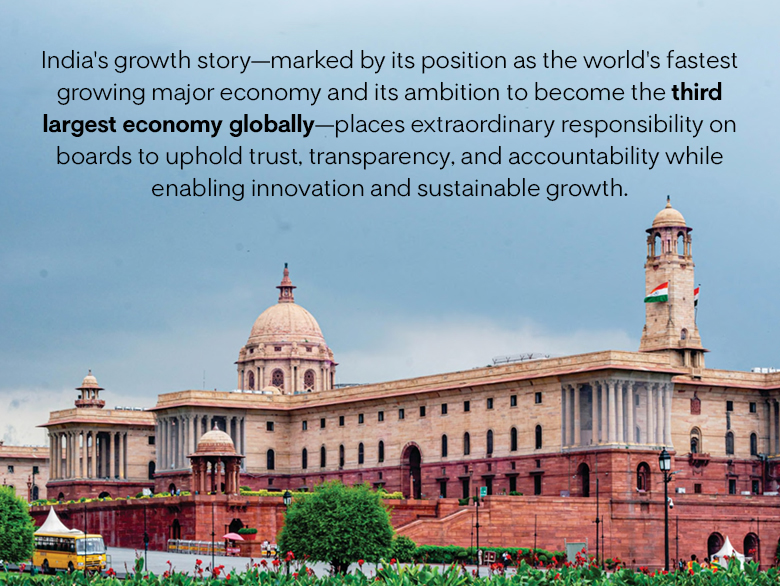
India's growth story marked by its position as the world's fastest growing major economy and its ambition to become the third largest economy globally places extraordinary responsibility on boards to uphold trust, transparency, and accountability while enabling innovation and sustainable growth.
India's Corporate Governance Framework: A Global Reference Point
India today possesses one of the most comprehensive corporate governance regimes among emerging markets. India's corporate governance landscape has now become more dynamic and regulatory institutions respond with sharper oversight and stronger enforcement. Recent reforms reflect a decisive shift towards clarity, consolidation, and enhanced investor confidence.
Anchored by the Companies Act, 2013 and strengthened by SEBI Listing Obligations and Disclosure Requirements (LODR), Regulations, 2015 the framework has progressively aligned Indian boardrooms with global best practices.
Key governance pillars include:
• Enhanced board independence
• Mandatory board committees (Audit, NRC, CSR, Stakeholder, and Risk)
• Robust Related Party Transaction (RPT) oversight
• Increased disclosure standards
• Greater accountability of promoters and management
SEBI's continuous regulatory evolution especially post major corporate governance lapses has reinforced the principle that boards must act as guardians of stakeholder trust, not silent spectators.
Directors and senior management face heightened scrutiny in relation to disclosures, related-party transactions, and market conduct, with an increasing willingness by regulators to assign responsibility at the highest level. So, therefore, Directors are increasingly expected to demonstrate care, diligence, and independent judgment, and may be examined not only for acts of commission, but also for lapses in vigilance.
As such, Securities regulation has firmly become a governance imperative.
Alongside securities reform, the Ministry of Corporate Affairs (MCA) has reasserted its role as a vigilant custodian of corporate governance. Through enhanced investigative and enforcement action, particularly via the Serious Fraud Investigation Office (SFIO), the Ministry has signalled that governance failures will invite close scrutiny irrespective of a company's size, sector, or prominence.
Independent Directors: From Symbolism to Stewardship
High-profile corporate failures in India and abroad have clearly demonstrated one truth: independent directors are not ornamental they are fundamental to institutional credibility.
The evolving role of independent directors today demands:
• Courage to challenge management
• Deep understanding of business, finance, and risk
• Independence of thought and action
• Commitment to long-term value creation
Independent directors must move beyond box-ticking compliance to become active stewards of ethics, risk, culture, and sustainability. Their effectiveness is directly linked to the strength of board processes, quality of information flows, and empowerment through continuous learning.
Board Committees: The Real Engines of Oversight
Strong boards are built on strong committees. In India, the effectiveness of the Audit Committee, Nomination & Remuneration Committee (NRC), and CSR Committee has become central to governance excellence.
• Audit Committees must now oversee not just financial integrity, but also cyber risk, internal controls, fraud prevention, and ESG disclosures.
• NRCs play a vital role in board composition, succession planning, leadership remuneration, and diversity.
• CSR Committees are transitioning from chequewriting bodies to strategic enablers of shared value.
Globally, these committees mirror best practices seen in jurisdictions influenced by the UK Corporate Governance Code, OECD Principles, and King IV Report (South Africa) all of which emphasise ethical leadership and integrated thinking.
Financial Literacy: A Non-Negotiable Boardroom Skill
In an era of market volatility, complex capital structures, and global supply chain disruptions, financial literacy in the boardroom is no longer optional.
Boards must:
• Understand balance sheets, cash flows, and capital allocation
• Evaluate financial risks amid cyber threats and geopolitical uncertainty
• Ensure transparency in disclosures and audit quality
• Strengthen oversight of IPO-bound and newly listed entities
With IPOs surging in India, the responsibility of boards especially in newly listed companies to protect minority shareholders has never been greater.
Related Party Transactions (RPTs): Strengthening Trust
RPTs remain one of the most sensitive areas of governance in promoter-driven economies. Transparent evaluation, independent scrutiny, and shareholder communication are critical to preventing conflicts of interest and preserving credibility.
Boards must ensure RPTs are:
• At arm's length
• In the best interest of the company
• Fully disclosed and justified
Effective RPT governance is a litmus test of board independence.
CSR and ESG: From Compliance to Competitive Advantage
India was among the first countries to mandate CSR, but the real challenge now is making CSR work.
Boards must integrate CSR and ESG into core business strategy, aligning social impact with long term value creation. ESG today is not about reporting it is about resilience, reputation, and responsible growth.
Globally, investors increasingly assess companies on:
• Climate action
• Social responsibility
• Governance integrity
Boards that fail to embed ESG into decision-making risk losing investor confidence, talent, and market relevance.
Diversity and Women on Boards: From Aspiration to Action
India has made measurable progress on board gender diversity, yet the journey is far from complete. As IPOs accelerate and companies scale globally, diverse boards are essential for balanced decision-making and innovation.
At the Institute of Directors (IOD), we have placed special emphasis on:
• Preparing women executives for board roles
• Leadership development and mentoring
• Certification programmes to build boardroom readiness
Diversity is not a quota it is a governance strength.
Boards in the AI Era: Preparing for the Unpredictable
The emergence of artificial intelligence is reshaping governance globally. Boards must now oversee:
• Ethical use of AI
• Data privacy and cybersecurity
• Regulatory compliance
• Workforce transformation
While we cannot predict the future in the future, boards must remain anchored in Trust, Quality, and Transparency (TQT) principles that transcend technology cycles.
Looking Ahead to 2026: A New Chapter for Indian Boardrooms
As India looks towards 2026, boardrooms must prepare for an environment shaped by liberalised Foreign Direct Investment regimes, ongoing ease-of-doing-business reforms, expanding Digital Public Infrastructure, and deepening Capital Markets. These initiatives are attracting global capital, increasing organisational complexity, and integrating Indian enterprises more deeply into international value chains.
The coming years will witness a sustained emphasis on the professionalisation of directorship in India. Continuous learning, periodic board and director evaluations, and a deliberate focus on diversity of skills, experience, and perspective will become essential components of effective governance. Regulatory expectations, investor scrutiny, and judicial interpretation are converging to reinforce the view that directorship is a professional responsibility demanding time, competence, and ethical leadership.

In this evolving landscape, institutions such as the Institute of Directors, India, have an important role to play in supporting boards through education, dialogue, and the dissemination of global best practices. As governance expectations rise alongside economic opportunity, the ability of directors to remain informed, prepared, and principled will be central to sustaining trust and strengthening India's position as a credible destination for global enterprise.
India Beyond Borders: Governance in a Globalised Economy
India's historic CEPA (Comprehensive Economic Partnership Agreement) and FTA (Free Trade Agreement) agreements with the UAE, Australia, UK, and others, along with emerging bilateral partnerships, demand globally competent boards.
Indian directors today must:
• Understand cross-border regulations
• Navigate international stakeholder expectations
• Adopt global governance benchmarks
IOD's Role: Nurturing Boardroom Leadership for Over Three Decades
For more than 35 years, the Institute of Directors (IOD), India, has played a pioneering role in building India's boardroom community, through:
• Board certifications and masterclasses
• Global conventions in the UK, UAE, Europe, and Asia
• Policy dialogues and leadership forums
• Focused programmes for women directors
IOD has consistently worked to ensure that Indian boards are not just compliant but competent, confident, and future-ready.
Conclusion: Governance as the Foundation of Growth
As India aspires to become a $10 trillion economy, governance will determine whether growth is sustainable, inclusive, and trusted.
India's current governance moment is both demanding and transformative.
For directors in India and beyond, the message is clear. Governance excellence is no longer defined by intent alone, but by evidence, engagement, and outcomes. Those who recognise this shift and adapt accordingly will not only meet regulatory expectations, but will strengthen the long-term resilience and credibility of the organisations they serve.
At the Institute of Directors, India, we view this evolution not as a constraint, but as an opportunity for boards to reaffirm their central role as stewards of trust, value, and sustainable enterprise in an increasingly complex global economy.
The future belongs to boards that are independent yet engaged, diverse yet aligned, innovative yet ethical.
 Back to Home
Author
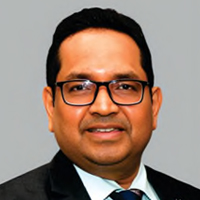
Mr. Manoj K. Raut
Secretary General & Chief Executive Officer Institute of Directors (IOD), India
Owned by: Institute of Directors, India
Disclaimer: The opinions expressed in the articles/ stories are the personal opinions of the author. IOD/ Editor is not responsible for the accuracy, completeness, suitability, or validity of any information in those articles. The information, facts or opinions expressed in the articles/ speeches do not reflect the views of IOD/ Editor and IOD/ Editor does not assume any responsibility or liability for the same.