 Quick Links
 Connect us

 Directors Databank (Empannel Yourself)
 Become a
  Become a
  Blog
Blog
 Become an Awards Assessor
 Publications
 Contact Us







Leveraging Engagement for Greater Effectiveness of Boards: Six Factors to Strengthen Sustainable Leadership


The relationship between the board and the management is of vision-oriented respect and trust, and works with conscience and commitment to appreciate the trusteeship role of governance.
The metamorphosis in the global business environment and the emerging new expectations from the business corporations, are making it necessary that we re-christen the definition of business to continuously reform the system of regenerative empowerment not only in terms of capital but in terms of inner strengths to shape an inspiring future and lead the way for action. Corporate entities, therefore, need visionary and strongly vibrant boards to lead, guide and steer the journey of performance excellence. Boards that are aspiring, daring and gearing up to set the highest standards of effectiveness, would appreciate the insideout approach to empower the dynamic internal system of high performance. While most of the boards are actively learning and reformulating their strategies to rebalance their growing responsibilities towards various stakeholders, their engagement with the major determinants of growing success in the unpredictable future would ensure greater effectiveness.
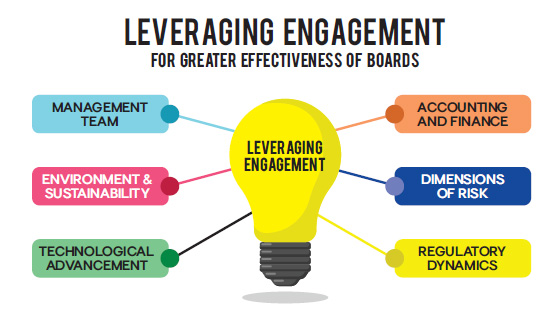
After studying the major factors that have facilitated the functioning of the boards of some of the leading Indian companies, the author finds that engagement of boards with such factors will not only strengthen for sustainable business leadership but will also prepare for future. The study enables the author to recommend Engagement of the boards with the following six factors:
1 Management Team
2 Environment & Sustainability
3 Technological Advancements
4 Accounts and Finance
5 Dimensions of Risk
6 Regulatory Dynamics
Engagement with Management Team:
Boards that aim to lead for excellence today and like to remain relevant in future, would strive to build and nurture vibrant relationships with the top management. Directors are people of wisdom and foresight, and they appreciate the unique beauty of their role. Any disregard to this unique beauty may cause irreparable damage. The relationship between the board and the management is of vision-oriented respect and trust, and works with conscience and commitment to appreciate the trusteeship role of governance.
It's imperative to appreciate that the directors, in their role of beacon, guide and monitor, take the lead in maintaining the relationship and ensure that it is continuously nurtured for responsive engagement. They must be strongly sensitive to the situations to decide as when to rise as an effective leader to take charge, when to partner as a friend, mentor and guide and when to stay out of the way with an appreciative observation. In several board meetings, the opportunities to appreciate the intelligence and perseverance of the management are missed because of the dominance of the reported and projected data. Such opportunities are the occasions of spotting innovative thinking, uniquely high-potential perspectives and cross-functional collaborations.
Engagement with Environment and Sustainability:
Company directors must be sensitive to the environmental changes happening around. The VUCA environment is generated from the dynamics of human evolution and growth, and fast changes in climatic, socioeconomic, and geo-political conditions. Having appreciated the paramount importance of sustainability, the corporate boards have recognized that the company's promising future can be ensured through the passionate execution of well-designed strategies for sustainability. Companies that aspire to lead on all parameters of excellence have expert groups to monitor (i) economic sustainability, (ii) environmental sustainability, and (iii) social sustainability. The boards have to make sure that at all three levels of governance, board committees, management teams, and expert working groups, the imperatives of sustainability are followed in spirit and actions.
Jason Jay, Kate Isaacs, and Hong Linh Nguyen, in their article 'Getting Strategic About Sustainability' published in the Jan-Feb 2025 issue of HBR, have recommended a Four Lenses Framework comprising - Business Value Lens, Stakeholder Influence Lens, Science & Technology Lens, and Purpose Lens.
This framework is very useful in leveraging engagement with Sustainability.
Engagement with Technological Advancements:
All technologies involved in business are advancing at a fast pace under the revolutionary influence of digital transformation. Sustainable business leadership needs digital excellence, and there is no option. Boards, therefore, must facilitate the company's rewarding engagement with technological advancements. They must ensure that their people and technology work well together.
Many companies are still facing people's resistance in embracing the AI-driven transformation. Conscious and excellence-driven boards support the management to develop the mindset for excellence which calls for questioning, innovating, learning, adapting and transforming. Directors should encourage and guide the management heads to streamline operations and spur innovation with the active involvement of their inspired teams.
Corporate entities, therefore, need visionary and strongly vibrant boards to lead, guide and steer the journey of performance excellence.
Engagement with Accounting & Finance:
The board's engagement with 'why?' and 'how?' of the details of accounts and the sources and the uses of the funds, to arrive at the financial results, is essential not only to prevent financial scams and frauds but also to guide the management team from the perspective of responsibility towards various stakeholders.
This engagement is unavoidable and can be leveraged for maintaining transparency, responsibility, image and above all, the prospects of attracting investment for growth, expansion, and diversification. Leaving the Accounting and Financial issues to the sole responsibility of the Audit Committee, Finance Committee and/or Risk Committee, is not a wiser approach. Even some unobvious questions emerging from common intelligence have the potential to guard against wrong financial decisions.
Engagement with The Dimensions of Risk:
Engagement with The Dimensions of Risk:
Boards appreciate their engagement with common business risks like financial risk, operational risk, compliance and regulatory risk and reputational risk etc. With the disproportionate expansion of human ambitions and amazing possibilities being offered by technological advancements, many new types of risks, like cybersecurity risk, hardware/software failures, data losses etc. are arising and need advanced care by the management and monitoring by the boards.
Boards should be sensitive to the hidden causes of the risks. Human intentions can be guessed by observing behaviors and communications. Appreciative enquiry is a wonderful tool to peek into something driven by ulterior motives. Regarding technology-related risks, the directors need to be tech-savvy to the extent that they can guide through the entire digital transformation in the best alignment with the strategic goals and can quickly spot the loopholes, from the user's angle.
Engagement with Regulatory Dynamics:
The conscious flow of laws, rules, and regulations is aimed at ensuring that companies take adequate care of the interests of stakeholders and maintain high standards of transparency, accountability, and ethics. Directors must be learning leaders to remain well abreast of the latest regulations and must guide the management team to develop systems, databases, and procedures to ensure timely and flawless compliance.
Under the pressure of environmental factors and due to the emergence of new threats to degenerate the standards, the regulations are reformed very frequently. Directors cannot afford to dilute their responsive engagement with regulatory dynamics. This requires regular updating of regulatory knowledge with its correct interpretation and methods of flawless implementation. As conscious guardians of the management, directors should make sure that all functions follow the regulations in spirit and action.
Conclusion:
Engagement is all about a passionate appreciation of and proactive response to the factors that influence the survival and growth of business entities. This article is a modest attempt to bring out the major areas of engagement and to recommend some ways to make this engagement an instrument of organizational empowerment.
 Back to Home
Author

Prof. Rajendra P Bharti
He is a freelance Facilitator of Excellence. He was Professor & Director (CEO) of a Management Institute for two decades. An alumnus of IIMA, trained by WWQN London and Harvard University, Prof. Bharti is a thought leader, author, executive coach and a transformational leader. He has trained corporate leaders from approximately fifty countries.
Owned by: Institute of Directors, India
Disclaimer: The opinions expressed in the articles/ stories are the personal opinions of the author. IOD/ Editor is not responsible for the accuracy, completeness, suitability, or validity of any information in those articles. The information, facts or opinions expressed in the articles/ speeches do not reflect the views of IOD/ Editor and IOD/ Editor does not assume any responsibility or liability for the same.