 Quick Links
 Connect us

 Directors Databank (Empannel Yourself)
 Become a
  Become a
  Blog
Blog
 Become an Awards Assessor
 Publications
 Contact Us





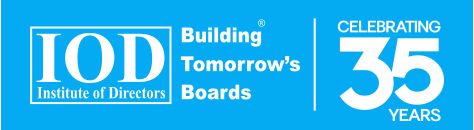

IOD Special Talk - Who is Holding the Compass? Reimagining Corporate Governance in an Era of Disruption
By- Institute of Directors | Authored by- Mr. Tuhin Kanta Pandey, IAS (Retd.)
Sep 13, 2025

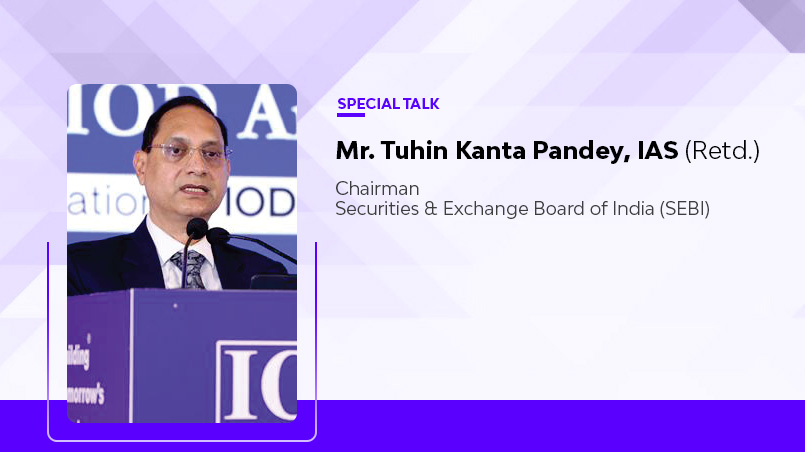
It is a pleasure to be here at the 2025 Annual Directors' Conclave hosted by the IOD. At this moment, I would congratulate the Institute on completing its 35 years of enduring commitment to promoting good governance.
The Institute of Directors has been playing an important role in promoting leadership excellence and strengthening the effectiveness of boardrooms across the corporate landscape.
Today, we are living in a time of rapidly changing geopolitical dynamics and rising uncertainty. The emergence of disruptive new technologies and growing geo-economic fragmentation are reshaping how businesses operate and how they survive. In this evolving landscape, company boards are facing challenges that are complex, fast-moving, and often without precedent. It is, therefore, more critical than ever that the boards remain alert, agile, and equipped with the right tools, insights, and support to navigate this new reality.
I am confident that the deliberations today, among such an experienced group of board leaders, will not just share knowledge but shape perspectives.
So, the first question I raise is:
“Who is holding the Compass?”
Now, when I was thinking about the board leaders, I found myself asking a simple question:
What image best describes a company today?
And I kept coming back to this - Imagine a company as a Ship. The CEO is at the helm, confidently steering toward quarterly targets. The engines are roaring, the markets are shifting, the weather's unpredictable. But here's the question:
Who's watching the compass?
Who's scanning the horizon for ethical fog, for reputational storms, for regulatory icebergs?
Because it's not enough to move fast. We have to move in right direction. And that is the very purpose of corporate governance.
Now imagine that ship is not steered by just one captain, but a team of navigators - each with different instruments, different vantage points, but a shared responsibility, to keep the journey safe, legal, and honourable. That team is the board.
Today, we are not here to revisit what corporate governance has been. We are here to ask - with urgency and honesty - what it must become.
A board that never disagrees is not aligned — it's asleep. Divergent views when rooted in purpose and mutual respect strengthens the board.
Where We Stand – Achievements & Gaps
Let's begin with where we stand.
India has made remarkable progress in governance. In the listed space, SEBI has progressively deepened the framework for corporate governance over the past two decades. With the revision in the Companies Act, 2013, and the codification of listing obligations under the SEBI LODR Regulations, we have laid down detailed requirements regarding the composition, independence, and responsibilities of boards and their committees, including audit, nomination and remuneration, and risk management committees.
Beyond structural mandates, this framework also conveys core principles that capture the spirit of effective board conduct. It calls upon directors to act with integrity and purpose, to question and engage with management without bias or hesitation, and to offer thoughtful scrutiny of strategy and risk. Boards are encouraged to think independently, apply sound judgment, and uphold the broader interests of stakeholders through transparent and principled decision-making.
The foundation is strong, thanks to the robust regulatory evolution, improved transparency, and the formalisation of board structures.
But a foundation is not a fortress.
Boards often devote significant time to reviewing detailed compliance packs, while important signals about organisational culture are barely discussed. Independent directors sit at the table — but are they being heard, or simply counted? We have diversity on paper - but do we have diversity of thought?
And most importantly: Are we treating governance as a breathing value? Or just a checklist? Because too often, form overshadows intent. And this gap between structure and spirit is becoming harder to ignore.
The world we are operating in has fundamentally changed. We are not merely in Boardroom 2.0. We are in Boardroom Reimagined. Let me explain.
Markets are no longer driven purely by financials. Stakeholders now ask: What do you stand for? What are you doing for the planet, for your people and for the public trust?
Start-ups go public with soaring valuations but no profit history. AI models make pricing and hiring decisions. Reputational damage spreads faster than we can respond. Boards, however, have not evolved at the same pace. We are still equipping ourselves with analog tools in a digital, decentralized, high-stakes environment. The boardroom of tomorrow will need different instincts, different questions, and different courage.
Key shifts for Shaping Tomorrow's Board
Let me offer some important shifts that we must make for shaping tomorrows' board.
a) From Compliance to Culture
First - We must shift from compliance to culture.
Governance is no longer just about policies. It's about tone, about behaviour and about values in action.
Does the board talk about succession planning - or only CEO compensation?

Does it probe culture - or leave that to HR?
Does it review whistle-blower trends with curiosity - or with defensiveness?
Because what gets discussed signals what gets valued.
We must begin treating culture as a board-level responsibility - just like financials, risk, or strategy.
b) Redefining Role of Independent Directors
Second - We need to redefine the role of independent directors.
We cannot continue to view them as honorary appointees, or friendly critics.
They must be viewed - and treated - as stewards of accountability.
This requires change on three fronts:
(i) Selection: Let's move beyond familiar networks and known circles. Let's draw from diverse experiences, different sectors, younger professionals, regional voices.
(ii) Orientation: Many directors are highly qualified, but unfamiliar with emerging risks - whether that's AI governance, cyber threats, or ESG disclosures. Orientation should be ongoing, not just a one-time induction.
(iii) Perhaps most important: Psychological safety: Independent directors must feel free to dissent. To question, if the information is not robust.
Because a board that never disagrees is not aligned - it's asleep. Divergent views, when rooted in purpose and mutual respect, strengthen the board. They test assumptions, lead to deeper discussions and a constructive decision-making.
c) Embracing Technology for Smarter Governance
Third - We must embrace governance technology.
Let's stop viewing digital tools as burdens or threats. Today's boards can and should demand real-time dashboards that provide meaningful insights - not just volumes of PDF reports.
Imagine dashboards that track red-flag employee exits, whistle-blower complaints, ESG trends, or vendor concentration risks — and bring them to the board's attention before they hit the news.
Governance intelligence must become as routine as financial intelligence.
d) Diversity beyond Demographics
Fourth - we need diversity that goes beyond demography.
Gender diversity, regional representation, and generational diversity — all matter deeply. But what we need more of is cognitive diversity. We must ask - Do we have enough contrarian thinkers in the room? Do we have people who see risk differently - not more fearfully, but more perceptively?
Because true board strength may not necessarily come from agreement. It may instead come from friction - respectfully managed, optimal and constructive.
Reimagine the Future Boardroom
Now let's take a moment to re-imagine the boardrooms of the future. It's not a ceremonial forum, but a learning organization.
It doesn't just protect company value - it creates long-term stakeholder trust. It doesn't avoid the uncomfortable questions - it insists on them to open up the blind spots.
And it understands that its duty is not just to the promoter or the quarterly target - but to the integrity of the institution.
The truth is, Regulators can mandate structures, but they cannot mandate courage. Only Boards can do that.
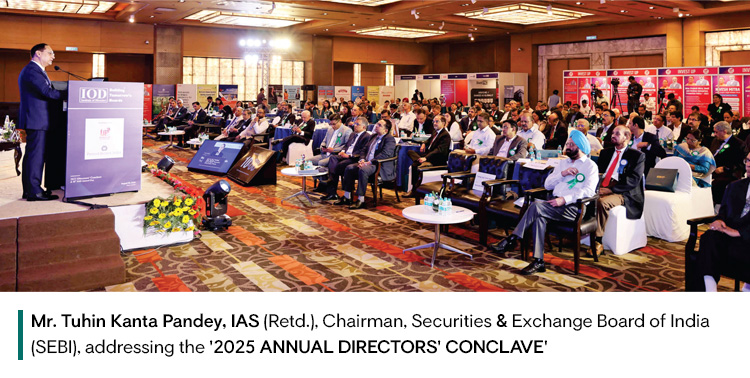
So, where does that leave us, as directors, independent voices, and as stewards?
It leaves us with opportunity and responsibility. Because the truth is, Regulators can mandate structures, but they cannot mandate courage. Only Boards can do that. Only directors can shape the quality of questions that get asked and the clarity of answers that are demanded. This is not just about risk avoidance but a strategic edge. Boards that reflect challenge and learn can outperform, boards that listen carefully retain trust during crisis, and boards that govern with integrity don't just survive - they lead.
Let me end with this thought: The real test of governance is not during steady growth; it's when something goes wrong. When a whistleblower email lands, when a social media campaign questions your ethics, when performance dips and pressure rises, that's when your governance model speaks loudest. And what it reveals depends not on the policies, but on the people. So let's invest in shaping those people for the boardrooms of tomorrow, not because regulators expect to but because the future deserves it.
Thankyou!
Jai Hind!
 Back to Home
Author

Mr. Tuhin Kanta Pandey, IAS (Retd.)
Chairman of Securities & Exchange Board of India (SEBI)
Owned by: Institute of Directors, India
Disclaimer: The opinions expressed in the articles/ stories are the personal opinions of the author. IOD/ Editor is not responsible for the accuracy, completeness, suitability, or validity of any information in those articles. The information, facts or opinions expressed in the articles/ speeches do not reflect the views of IOD/ Editor and IOD/ Editor does not assume any responsibility or liability for the same.