 Quick Links
 Connect us

 Directors Databank (Empannel Yourself)
 Become a
  Become a
  Blog
Blog
 Become an Awards Assessor
 Publications
 Contact Us







Navigating the New Abnormal


Boardroom Leadership in an Era of Fragmentation and Technological Acceleration
As 2025 concludes, one truth has become increasingly evident: the global business landscape is not merely in flux, it is being fundamentally Reshaped. According to a 2025 Global Boardroom Survey, geopolitical risk is now a permanent, top-tier agenda item, moving from the periphery to the core of strategic planning. Geopolitical fragmentation, emerging pockets of economic isolation, volatile capital flows, supply chain vulnerabilities, and the rapid advances in artificial intelligence are converging to reshape the strategic realities facing enterprises worldwide. For boardrooms in India and across international markets, these dynamics have shifted from peripheral concerns to the central determinants of longterm business success.
A Fragmented Global Order and the Return of Economic Isolation
A defining feature of the current environment is the quiet but unmistakable rise of Economic Isolation. Driven by sanctions, trade retaliation, protectionism, and technology de-coupling, the once interconnected global market is breaking into distinct and competing economic spheres. Critical maritime corridors, from the Red Sea to the broader Indo-Pacific, have now become increasingly exposed to geopolitical tension, forcing firms to re-route shipments, absorb higher costs, and adopt new risk frameworks. Parallel to this, national pushes for technological self-reliance in fields such as artificial intelligence, semiconductors, defence systems, and critical minerals are redrawing global innovation boundaries. What once functioned as a seamless, interdependent trading system is rapidly evolving into a complex landscape where organisations must navigate diverse regulatory, technological, and political regimes. Multi-track strategies are becoming an operational necessity.
Supply Chains Under Pressure: Resilience Over Efficiency
Supply Chain Redesign has emerged as one of the most visible manifestations of the 'new abnormal'. Once engineered primarily for cost efficiency, global supply chains are now assessed through the lens of resilience, transparency, and flexibility. Board oversight in this domain has intensified sharply, driven by maritime disruptions, climate-related risks, rising cyber threats, regulatory divergence, and growing ESG expectations. The longestablished China+1 approach has expanded into a comprehensive resilience framework encompassing nearshoring, reshoring, multi-sourcing, and strategic inventory buffers. Increasingly, resilience is being recognised not merely as a risk mitigation but as a source of competitive advantage.
Artificial Intelligence: The Strategic Catalyst of the Decade
Simultaneously, the AI disruption is transitioning from promise to pervasive reality. Artificial intelligence now forms the connective tissue linking many of today's most pressing governance challenges. Generative AI and automation are revolutionising business models, talent needs, and competitive dynamics. From forecasting supply chain shocks and ensuring regulatory compliance to modelling geopolitical scenarios, optimising capital allocation, and enhancing cybersecurity, AI is increasingly indispensable to organisational resilience and competitive strength.
PwC's 2025 AI Predictions stress that AI is no longer just an IT discussion but a full-board imperative on ethics, governance, and capital allocation. Indian boards must lead in framing robust AI governance frameworks to ensure responsible deployment, mitigating bias, and safeguarding data integrity while capitalising on productivity gains and innovation. For boards, the question is no longer one of adoption but of responsible, transparent, and strategic integration.
FDI Crosswinds and India's Strategic Positioning
These global shifts are also reflected in patterns of capital movement. While global FDI trends have shown a gradual moderation through mid-2025, India recorded an 18 per cent rise in FDI to USD 35.18 billion during April-September of the current fiscal year. Strong gross inflows continue to signal international confidence in its market potential, digital progress, and expanding manufacturing base. In parallel, India's growing focus on developing in-house technological capabilities under the Make in India initiative is further reinforcing its position as one of the fastest-growing major economies, enhancing ecosystem resilience and long-term competitiveness.
Taken together, these developments indicate that India is at a pivotal moment as it works to advance a stable, predictable, and enabling investment environment. Additionally, initiatives such as Production-Linked Incentives (PLIs) and Broader Supply-Chain Diversification efforts have strengthened its investment appeal. Sustaining this momentum, however, will require continued policy stability and a thoughtful balance between strategic autonomy and global integration.
So, What Must Define the Changing Boardroom Priority Agenda for 2026 and Beyond?
In this environment, the role of the Board has broadened considerably. Governance today requires an ability to anticipate risk, recognise interdependencies, and guide organisations through unprecedented complexity.
1. Strategic Foresight over Rear-View Analysis: Boards must institutionalise mechanisms for continuous environmental scanning, using war-gaming and scenario analysis to stress-test strategies against geopolitical and technological shocks.
2. Resilience as a KPI: Supply chain robustness, cyber defence capabilities, and financial buffers must be measured and reported with the same rigour as quarterly earnings.
3. Governance of Technology: Establishing dedicated board-level committees or expertise for overseeing AI ethics, digital transformation investments, and data governance is no longer optional.
4. Talent & Culture Revolution: Redefining talent strategies for an AI-augmented workplace, fostering a culture of continuous learning, and ensuring leadership pipeline resilience are critical.
5. Authentic ESG Integration: Moving from reporting to embedding sustainability into core business strategy, recognising it as a driver of long-term value and risk mitigation.
Conclusion:
The convergence of geopolitical realignment, supplychain reconfiguration, and AI-led transformation places India at a pivotal moment in its economic evolution. With its scale, talent pool, and strengthening technological capacity, India is well positioned not only to benefit from the emerging global realignment but to contribute meaningfully to its direction. Realising this potential will depend on the quality of decisions taken in India's boardrooms. Decisions that must be informed, anticipatory, and anchored in long-term value creation. As we enter 2026, boards will be assessed by their ability to remain geopolitically attuned, technologically equipped, ethically grounded, operationally resilient, and strategically bold. In this context, the Institute of Directors remains steadfast in its mission to equip leaders with the insights and governance frameworks needed to navigate uncertainty with confidence and purpose.
We sincerely thank our members for their unwavering support throughout the year and for their continued contributions toward advancing the IOD vision. With this shared commitment in mind, we extend our warm regards to all IOD Members as we welcome the new year.
May the Year 2026 inspire sharper foresight, stronger governance, and courageous leadership in shaping resilient and responsible organisations.
 Back to Home
Author

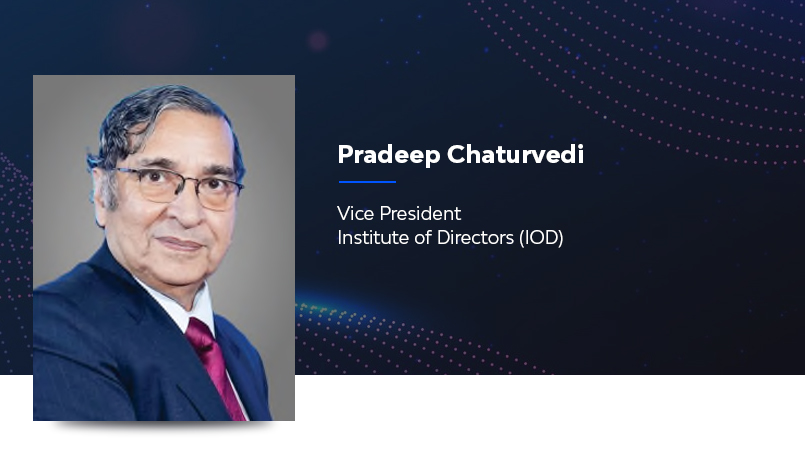
Pradeep Chaturvedi
Vice President - Institute of Directors
He is former Advisor FAO & former Chairman, Institution of Engineers, Delhi. He is a Mechanical Engineer & has been involved with Environment & Energy Policy (planning & implementation) of energy projects under the UN Agencies for over three decades in India & other Asian and Pacific countries. He is Vice-President, World Environment Foundation & Institute of Directors, India.
Owned by: Institute of Directors, India
Disclaimer: The opinions expressed in the articles/ stories are the personal opinions of the author. IOD/ Editor is not responsible for the accuracy, completeness, suitability, or validity of any information in those articles. The information, facts or opinions expressed in the articles/ speeches do not reflect the views of IOD/ Editor and IOD/ Editor does not assume any responsibility or liability for the same.