 Quick Links
 Connect us

 Directors Databank (Empannel Yourself)
 Become a
  Become a
  Blog
Blog
 Become an Awards Assessor
 Publications
 Contact Us






The Age of Borrowed Everything


Inside the modern marketplace where capital owns nothing and capabilities own everything
Our theme for this session, Redefining Board Priorities for Resilience and Agility in a Transforming World, is a broad title that gives us ample space to explore the forces reshaping business today, and I intend to do exactly that. My hope is that, in doing so, we can identify the issues that boards must genuinely confront in a world undergoing rapid transformation. Let me begin with an observation about this room. Many of you arrived here by aeroplane. Yet the modern aircraft industry provides an extraordinary example of how the world of business has changed. The largest owner of civil aircraft globally is Aercap, based in Dublin. However, you might be surprised to learn that the airlines operating those aircraft do not typically own the engines. They simply contract for 'Engine Services,' long-term agreements with companies such as Rolls-Royce, General Electric, or Pratt Whitney, who supply, maintain, and even replace the engines as needed.
But typically neither the manufacturer nor the airline, or aircraft owner, own the engines themselves. In the case of Rolls-Royce, for example, the largest owner of its engines is GATX, a company better known as one of the world's leading railcar lessors. This is not the Marxist world of old, where the capitalist owned the factory, the machinery, and the means of production. Today, the means of production, at least in this example, are owned by financial entities that have no operational involvement with customers or the business itself. Had we met a century ago, we would likely have been admiring Henry Ford's River Rouge Plant, at the time the largest industrial facility in the world. Ford was so determined to control every element of production that he even acquired land in Brazil, Fordlândia, to grow the rubber for his tyres. That world has disappeared entirely.
Judgment is the ability to combine personal qualities with relevant knowledge and experience to form opinions or take decisions.
Capital ownership today is fragmented, opaque, and often irrelevant to the functioning of the firm. Think of Amazon. You may drive past vast Amazon warehouses and assume Amazon owns them. In fact, the largest owner of Amazon's facilities is Prologis, a San Francisco-based real-estate giant. The biggest Amazon warehouse in Scotland, built fifteen years ago, has changed ownership several times and is now held by an offshore entity with undisclosed beneficiaries. This is the norm in today's economy.
Modern firms are not defined by capital and labour, but by the capabilities they assemble. The “means of production” in this era are the workers themselves, the knowledge, skill, and creativity they bring. The entrepreneur, in the truest sense of the original French word, is the one who assembles these capabilities. And that is how economic progress is generated today.
The same is true for Apple, the archetype of a 21st century company. Apple owns remarkably little. Even its flagship Regent Street store is jointly owned by the Crown Estate and Norway's Sovereign Wealth Fund. Apple is, quite simply, a “hollow corporation”: a curated collection of capabilities. Its value lies not in physical assets but in coders, designers, and the distinctive retail experience it has created. Amazon, too, is essentially a bundle of capabilities, with Amazon Web Services serving as a profitable capability offered to the world.
This brings me to a central idea: modern firms are not defined by capital and labour, but by the capabilities they assemble. The “means of production” in this era are the workers themselves, the knowledge, skill, and creativity they bring. The entrepreneur, in the truest sense of the original French word, is the one who assembles these capabilities. And that is how economic progress is generated today.
Modern products mirror this reality. A smartphone does nothing that we could not previously do with separate devices, yet it unites all those capabilities in a single unit that fits in your pocket. The product is a combination of capabilities; the firm is the same. Yet we continue to speak in outdated language: capital and labour, capitalists and workers, as if the world remains locked in the framework described by Marx. It does not. The economic structure has shifted profoundly, and our understanding of business must shift with it.
As we begin this session, I encourage us to rethink not only board priorities, but the very nature of the modern enterprise. Only then can we truly understand what resilience and agility look like in a transforming world.
 Back to Home
Author
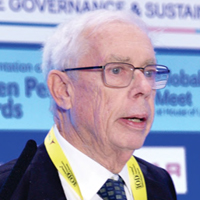
Sir John Anderson Kay, CBE
Author, Columnist and Britain's leading Management Thinker & Economist, UK
Owned by: Institute of Directors, India
Disclaimer: The opinions expressed in the articles/ stories are the personal opinions of the author. IOD/ Editor is not responsible for the accuracy, completeness, suitability, or validity of any information in those articles. The information, facts or opinions expressed in the articles/ speeches do not reflect the views of IOD/ Editor and IOD/ Editor does not assume any responsibility or liability for the same.