 Quick Links
 Connect us

 Directors Databank (Empannel Yourself)
 Become a
  Become a
  Blog
Blog
 Become an Awards Assessor
 Publications
 Contact Us







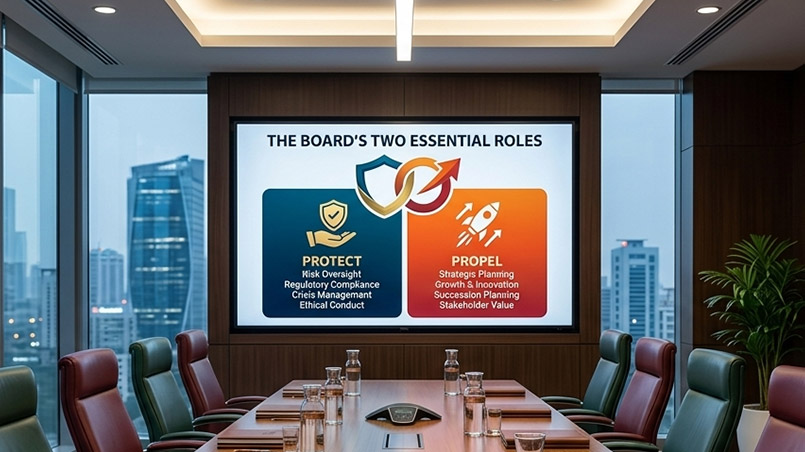
The Board’s Two Essential Roles: Protect and Propel

What do many conversations in boardrooms begin with?
Governance. Compliance. Policies.
Undoubtedly, these are important. A board must safeguard the integrity of the organisation, ensure accountability, and uphold the trust placed in it by shareholders and other stakeholders.
But that is only part of the story.
The other part, often less discussed but equally critical, is the board’s role in shaping the organisation’s future through thoughtful engagement with strategy and its execution.
The most effective boards recognise that their responsibility goes beyond protecting the organisation. They must also help propel it forward.
In essence, every board carries two essential roles. To protect and to propel.
Protecting the organisation is the board’s foundational duty. It involves ensuring sound governance, ethical conduct, and prudent risk management. Directors are custodians of trust. They must ask difficult questions, challenge assumptions, and ensure that decisions are taken with transparency and accountability.
In today’s environment, which is marked by increasing regulatory scrutiny, stakeholder activism, uncertainty, war, crises, disruption, etc, this protective role has never been more critical.
However, boards that focus only on protection risk become overly cautious.
That is where the second role becomes equally important.
Propelling the organisation requires directors to lift their gaze beyond governance and compliance and to engage with the future. Strategy, innovation, technology, long-term value creation, and organisational resilience all require thoughtful board engagement.
Directors bring diverse experiences and perspectives that can help management think differently, identify opportunities earlier, and navigate uncertainty with greater confidence. A board that propels the organisation expands the quality of strategic thinking.
Great boards create space for both responsibilities to coexist. They ensure that governance does not become a box-ticking exercise and that strategy discussions are not rushed to the final part of a meeting agenda. They foster a culture where constructive challenge is welcomed, and long-term thinking is encouraged.
Perhaps the real question for every director is this:
How effectively are we protecting the organisation while also helping it move forward?
Because when boards strike that balance, something powerful happens. The organisation not only remains secure and accountable, but it also gains the confidence to grow, innovate, and create sustainable value.
And ultimately, that is where board leadership makes the greatest difference.
To conclude, I urge you to think about this.
How actively is your board contributing to shaping the future while safeguarding the present?
 Back to Home
Author

Dr. CA Sangeeta Shankaran Sumesh
CFO turned Business & Leadership Coach | Bestselling Author | Global Speaker | Independent Director
Owned by: Institute of Directors, India
Disclaimer: The opinions expressed in the articles/ stories are the personal opinions of the author. IOD/ Editor is not responsible for the accuracy, completeness, suitability, or validity of any information in those articles. The information, facts or opinions expressed in the articles/ speeches do not reflect the views of IOD/ Editor and IOD/ Editor does not assume any responsibility or liability for the same.