 Quick Links
 Connect us

 Directors Databank (Empannel Yourself)
 Become a
  Become a
  Blog
Blog
 Become an Awards Assessor
 Publications
 Contact Us







The Corporate Fever Theory of Risk Escalation: A Conceptual Framework for Early Organisational Response to Emerging Risks

1. Introduction
The contemporary global business environment is characterised by a high degree of uncertainty and systemic interconnectedness. Events such as geopolitical conflicts, global supply chain disruptions, pandemics, financial crises, and cyber threats have demonstrated how rapidly localized disturbances can propagate across economic systems.
Despite advancements in enterprise risk management (ERM) and corporate governance frameworks, many organisations continue to respond to risks only after they have already materialised. This reactive approach often results in significant financial losses, operational disruptions, and reputational damage.
This article proposes a conceptual framework called the Corporate Fever Theory of Risk Escalation, which emphasises early detection and internal escalation of risk awareness. The theory draws inspiration from the biological immune system, where fever functions as an early defense mechanism that signals the presence of infection and mobilizes the body's defensive capabilities.
2. Biological Analogy: Fever as an Adaptive Defense
In biological systems, the immune system constantly monitors the body for foreign pathogens such as bacteria and viruses. When these pathogens enter the body, immune cells detect their presence and trigger a series of responses.
One of the most recognizable responses is fever, an elevation of body temperature that serves several defensive purposes. Fever enhances immune system efficiency and inhibits the replication of certain pathogens.
Importantly, fever is not the disease itself; rather, it is a protective response designed to contain infection before it spreads further within the body.
This biological mechanism provides a useful analogy for organisational risk management. Just as the human body must detect and respond to pathogens early, organisations must detect and respond to emerging risks before they escalate into crises.
3. Conceptualizing Corporate Fever
The Corporate Fever Theory proposes that organisations should develop structured mechanisms for escalating internal awareness and defensive responses when early indicators of risk appear.
In this framework, corporate fever refers to an organisational increase in risk awareness triggered by weak signals that indicate potential disruption. Examples of such signals may include:
• geopolitical tensions affecting supply chains
• sudden volatility in commodity prices • regulatory developments affecting business operations
• emerging cybersecurity threats
• unusual market or financial indicators
When these signals reach a certain threshold, organizations should activate governance mechanisms that increase monitoring, strategic discussion, and contingency planning.
4. The Corporate Fever Escalation Model
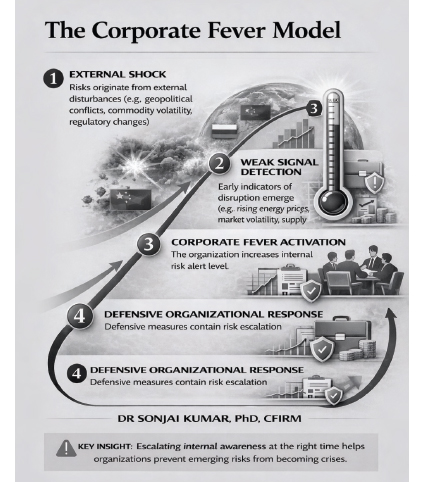
The theory proposes a four-stage model of risk escalation.
Stage 1: External Risk Entry
Risks originate from external disturbances in the broader economic or geopolitical environment. Examples include political instability, technological disruption, natural disasters, and financial shocks.
These disturbances are analogous to pathogens entering the human body.
Stage 2: Weak Signal Detection
At this stage, early indicators of disruption begin to emerge. These signals are often subtle and may appear in the form of small operational anomalies, market volatility, or regulatory developments.
Organisations that possess effective monitoring systems are able to detect these signals before they escalate.
Stage 3: Corporate Fever Activation
Once weak signals exceed a certain threshold, organisations should escalate internal risk awareness. This stage represents corporate fever, where the organisation increases its internal alert level.
Typical actions during this stage may include:
• activating risk committees or crisis monitoring teams
• increasing data monitoring and intelligence gathering
• conducting scenario analysis and stress testing
• initiating leadership-level strategic discussions The objective is to ensure that the organisation becomes proactively aware of emerging threats.
Stage 4: Defensive Organisational Response
In this stage, organisations implement defensive measures designed to mitigate the risk.
Examples include:
• hedging financial exposures
• diversifying suppliers and logistics networks
• increasing liquidity buffers
• adjusting operational or strategic plans
If implemented effectively, these responses can contain the risk before it develops into a full-scale crisis.
5. Implications for Corporate Governance
The Corporate Fever Theory highlights the importance of organisational responsiveness and governance structures.
Many organisations fail to escalate early risk signals due to factors such as:
• bureaucratic inertia
• hierarchical decision-making structures
• cognitive biases
• reluctance to trigger false alarms
However, suppressing early signals may allow risks to grow unnoticed until they become crises.
Effective governance frameworks should therefore encourage structured escalation rather than suppression of risk signals.
Boards, executive leadership teams, and risk committees must create organisational cultures that support early warning mechanisms and proactive response strategies.
6. Applications of the Theory
The Corporate Fever Theory has practical applications across multiple domains of organisational risk management.
• Enterprise Risk Management
Integrating early signal detection into ERM frameworks can improve organisational preparedness.
• Geopolitical Risk Monitoring
Organisations with global “ supply chains must monitor political developments that may affect trade routes or resource availability.
• Financial Risk Management
Market volatility, interest rate changes, and currency fluctuations often provide early indicators of systemic economic stress.
• Operational Risk
Supply chain disruptions, logistics delays, and technological failures can serve as early signals of broader operational risks.
7. Organisational Resilience and Learning
A key component of the theory is organisational learning.
Just as the immune system develops memory after exposure to pathogens, organisations should develop institutional knowledge after responding to risk events.
Post-event analysis allows organisations to refine their monitoring systems, improve governance structures, and strengthen resilience against future disruptions.
Fever is the body's early defense against infection. In the same way, organisations must develop a corporate fever-an internal escalation mechanism that activates when risks begin to crystallize.
8. Conclusion
The increasing complexity of global economic systems requires organisations to move beyond reactive crisis management toward proactive risk escalation.
The Corporate Fever Theory of Risk Escalation proposes that organisations should develop internal mechanisms that elevate risk awareness when early signals of disruption appear.
Just as fever enables the human body to contain infection before it spreads, corporate fever enables organisations to contain emerging risks before they develop into systemic crises.
In an era of geopolitical uncertainty, economic volatility, and systemic risk interdependence, the ability to detect weak signals and escalate organisational awareness may become one of the most critical capabilities for corporate resilience.
 Back to Home
Author

Dr. Sonjai Kumar, PhD, CFIRM
He is a PhD Thesis Award Winner, is a risk management scholar and thought leader specialising in systemic risk, corporate governance, and organisational resilience. He is the proponent of the "Corporate Fever Model, a conceptual framework explaining how organisations should escalate internal awareness when emerging risks begin to crystallize.
Owned by: Institute of Directors, India
Disclaimer: The opinions expressed in the articles/ stories are the personal opinions of the author. IOD/ Editor is not responsible for the accuracy, completeness, suitability, or validity of any information in those articles. The information, facts or opinions expressed in the articles/ speeches do not reflect the views of IOD/ Editor and IOD/ Editor does not assume any responsibility or liability for the same.