 Quick Links
 Connect us

 Directors Databank (Empannel Yourself)
 Become a
  Become a
  Blog
Blog
 Become an Awards Assessor
 Publications
 Contact Us







A Report on Hyderabad Regional Members' Meet - February, 2026

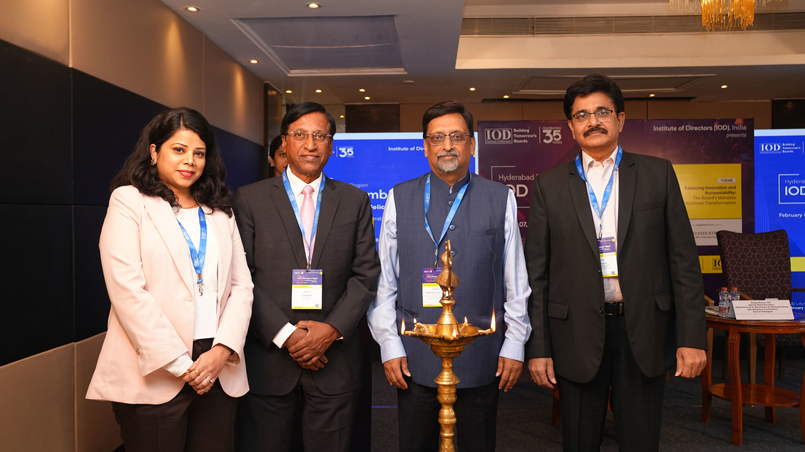
The Hyderabad Regional Members' Meet on February 07, 2026 was hosted by the Institute of Directors (IOD), Hyderabad Region, at Vivanta, Hyderabad on the theme, “Balancing Innovation and Accountability: The Board's Mandate in an AI-Driven Transformation”. The theme highlighted the critical role of boards in fostering innovation while upholding strong governance, navigating AI-led transformation, with expert insights and thoughtprovoking discussions underscoring the importance of responsible AI adoption, robust risk management, regulatory preparedness, and sustainable value creation to enabling resilient and future-ready governance.
The Members' Meet brought together eminent experts, leading industrial leaders, senior policy makers, distinguished thought leaders from across the country, and the IOD Members to deliberate on the evolving responsibilities of board leadership and in navigating AIled transformation, with expert insights and thoughtprovoking discussions underscoring the importance of responsible AI adoption, robust risk management, regulatory preparedness, and sustainable value creation to enabling resilient and future-ready governance.
The program also featured a special felicitation ceremony honouring IOD Life Members and recognizing their longstanding association with the Institute and acknowledging their invaluable contribution, continued commitment, and enduring support in advancing the mission of promoting exemplary board leadership.
The 'Welcome Address' was delivered by:
Mr. Neerabh Kumar Prasad, IAS (Retd.)
Honorary Chairman
Institute of Directors (IOD), Hyderabad Region
former Chief Secretary, Govt. of Andhra Pradesh
Mr. Prasad extended a warm welcome to all distinguished guests, IOD Members, and delegates, and emphasized the relevance of the theme of the meet and highlighted its significance in today's rapidly evolving digital landscape. He noted that as artificial intelligence reshapes organizational strategy, governance frameworks, and risk oversight, boards must embrace innovation while ensuring accountability, ethical conduct, and long-term sustainability as the cornerstone of resilient and futureready governance. Through his address, Mr. Prasad outlined the objectives of the program and was followed by an interactive panel discussion which aimed at fostering meaningful dialogue on strengthening board leadership in an AI-driven era.
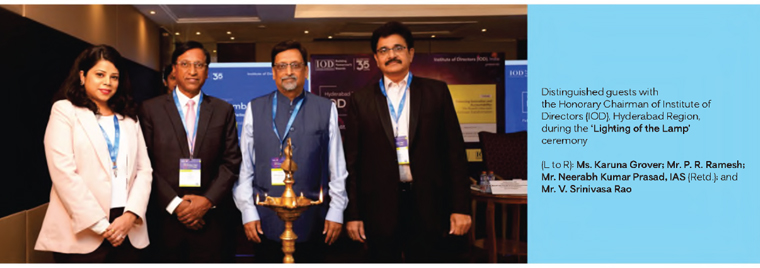

This was followed by the 'Keynote Address' delivered by:
Mr. P. R. Ramesh
former Chairman
Deloitte, India
Mr. Ramesh delivered a thought-provoking address on the evolving mandate of boards in an AI-driven and highly regulated business environment. Drawing upon his extensive board experience, he outlined the four foundational responsibilities of companies, economic performance, ethical conduct, legal compliance, and social responsibility, emphasizing that corporate governance has now moved to the centre stage in balancing these obligations.
He further highlighted the heightened oversight expectations placed on directors amid frequent regulatory changes, judicial and media scrutiny, and growing stakeholder activism, noting that boards today operate under constant visibility and accountability. Mr. Ramesh underscored the increasing complexity of risk management, ranging from reputational and regulatory risks to cybersecurity, ESG compliance, geopolitical volatility, and data privacy laws, observing that large corporate failures often trigger the fundamental question of board effectiveness.
This was followed by 'Theme Address' delivered by:
Mr. V. Srinivasa Rao
Chairman & Managing Director
BT & BT Management Consultancy Private Limited
Mr. Rao addressed the gathering by setting a forwardlooking context on the transition from Industry 4.0 to Industry 5.0. He emphasized that technology is no longer operating in silos but has evolved into a powerful convergence of information technology, operational technology, communication networks, collaboration platforms, and biotechnology. He observed that while boards earlier viewed technology as a support function, the current industrial revolution has integrated digital, physical, and biological systems, creating unprecedented capabilities that demand active board engagement. Drawing relatable examples to demonstrate how technology now permeates everyday life, he underscored that this convergence has fundamentally altered the strategic landscape for enterprises.
Mr. Rao outlined six transformative “superpowers” available to boards and leadership teams in this new era, beginning with predictive foresight, which enables organizations to identify emerging market shifts early and respond proactively rather than reactively. He also underscored accelerated innovation, with AI significantly compressing product and service development cycles. Finally, he pointed to dynamic margin protection, enabling organizations to optimize pricing, discounts, and supply chain decisions in real time to safeguard profitability.
The 'Chief Guest Address' of the event was delivered by:
Mr. Sanjay Kumar, IAS
Special Chief Secretary
Department of IT, Electronics & Communications (ITE&C) and Industries & Commerce, Government of Telangana
Mr. Kumar emphasized on the State's commitment to building a competitive and future-ready innovation ecosystem, while remaining mindful of developments across neighboring states and global technology hubs. He observed that the steady growth of Global Capability Centres (GCCs) reflects strong investor confidence and validates the strategic direction adopted by the State in strengthening digital infrastructure, policy frameworks, and talent ecosystems. He highlighted key forward-looking policies and initiatives such as the AI-focused frameworks, the Life Sciences policy, and the One Bio initiative, all designed to position the State as a hub for research, biotechnology, advanced analytics, and AI-driven innovation.
Concluding his address, Mr. Kumar remarked that the conference was both timely and relevant, and expressed confidence that the deliberations would equip participants with actionable insights to responsibly advance AI adoption and governance in their respective organizations.
This was followed by IOD Life Members' felicitation in recognition of their contributions.
INTERACTIVE PANEL DISCUSSION
Board Oversight of AI: Strategy, Risk, and Sustainability
This session was moderated by:
Mr. Shujath Bin Ali
Chief Legal Officer
Fourth Partner Energy Limited, Hyderabad
Mr. Ali delivered a contextual and thought-provoking address synthesizing the wide spectrum of issues discussed through the day. Reflecting on the evolution from Artificial Narrow Intelligence to Artificial General Intelligence and the possibilities surrounding advanced AI systems, he noted that global discourse is now dominated by technological collaborations, innovation breakthroughs, and cross-industry AI investments. He observed that AI is no longer confined to experimentation or proof-of-concept initiatives, but is increasingly influencing core organizational decision-making, capital allocation, and long-term strategic direction.
Concluding his remarks, Mr. Shujath Bin Ali encouraged directors to deepen their engagement with AI discussions, ensuring that governance frameworks evolve in parallel with technological disruption and that boards remain proactive rather than reactive in guiding organizational transformation.
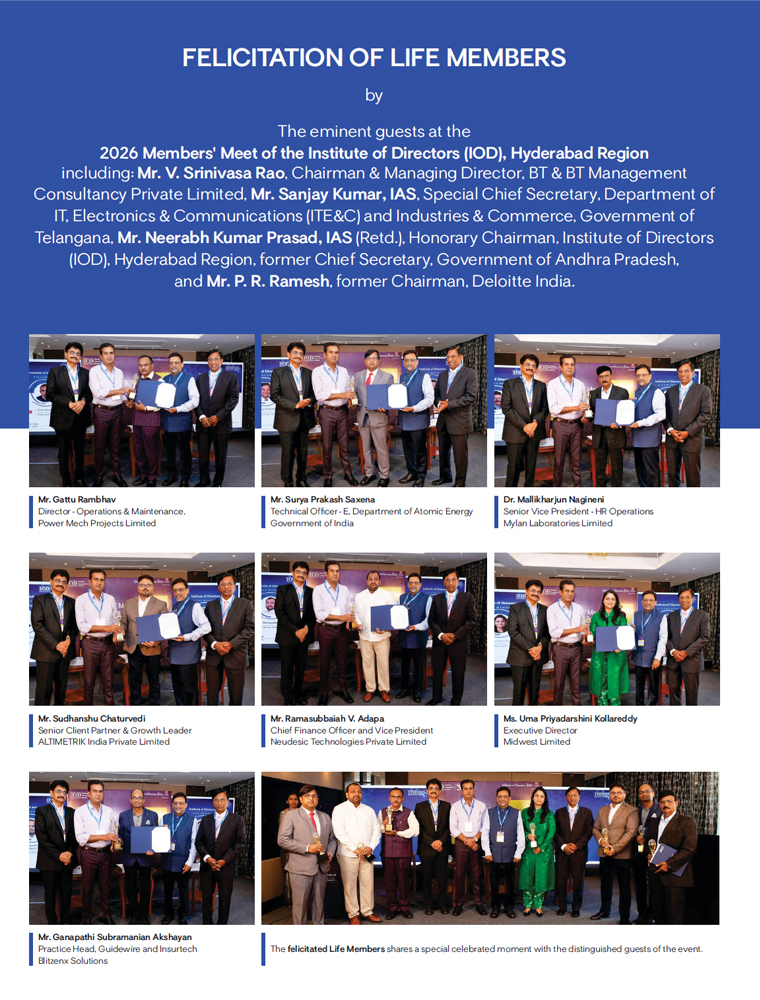
The session had the following distinguished speakers:
1. Mr. V. Srinivasulu
Director - Finance, Commercial & HRD
Transmission Corporation of Telangana Limited
2. Mr. Garimella Chandrasekhar Sarma
Director – Compliance
CtrlS Datacenters Limited
3. Mr. Naresh Kumar
Chief Executive Officer
Dynamatix Analytics Private Limited
4. Dr. K. Hemachandran
Director - AI Research Centre
Woxsen University
Mr. Srinivasulu delivered a governance-focused address emphasizing that AI literacy is the foundational pillar of effective AI oversight at the board level. He stated that unless directors clearly understand what AI is and its implications, they cannot discharge their governance responsibilities effectively. He outlined three essential steps.
• First, assessing the board's current level of AI awareness.
• Second, designing structured and tailored learning pathways covering AI fundamentals, frameworks, and governance implications.
• Third, engaging independent experts and domain specialists to provide strategic insights and ongoing advisory support.
Addressing cybersecurity and third-party dependencies, Mr. Srinivasulu noted that AI systems, driven by data aggregation and continuous learning, are inherently exposed to cyber vulnerabilities, requiring boards to prioritize awareness, risk assessment, regulatory understanding, and employee capability building, with risks mitigated through structured oversight, ERM integration, prioritization frameworks, and strong cybersecurity programs.
On ESG, he highlighted the paradox of AI enabling sustainability while data centers consume significant energy, noting infrastructure expansion through grid strengthening, dedicated corridors, renewable integration, green energy adoption, water recycling, and alignment with global standards.
He concluded that boards must balance innovation with environmental responsibility to ensure AI-driven growth supports long-term sustainability and enterprise value.
Mr. Sarma delivered a governance-centric perspective on AI investments, emphasizing that board oversight must balance strategic ambition with disciplined risk management. He noted that investment decisions cannot be technology-driven alone, boards must assess whether AI integration genuinely enhances efficiency, revenue, customer experience, or resilience before allocating capital. Particularly in infrastructure-heavy environments such as data centers, where public and private cloud adoption, hardware expansion, and connectivity layers are involved, structured evaluation and phased oversight are essential. Mr. Sarma cautioned that AI-driven automation and agent-based systems introduce new threat vectors, including zero-click attacks, identity takeovers, and malicious QR-code exploitation. He also illustrated how seemingly simple digital interactions can compromise systems if vigilance is lacking.
He concluded by reiterating that boards must ask the right questions, appoint competent technology and security leadership, and support sustained investment in cybersecurity, data protection, and risk governance frameworks. AI strategy, according to him must be embedded within enterprise risk management, with continuous monitoring, accountability clarity, and cultural awareness forming the foundation of resilient digital transformation.
Mr. Kumar emphasized that while profitability and financial performance traditionally dominated boardroom discussions, risk and compliance were often treated as secondary or operational concerns. However, with AI now influencing strategic, operational, and execution-level decisions, governance can no longer view technology as an overhead or optional add-on. Instead, AI must be treated as a core priority, embedded within enterprise decision-making frameworks.
He underscored that AI risk can no longer be categorized merely as an IT risk. It must be integrated into the Enterprise Risk Management framework, with clearly defined Key Risk Indicators, periodic reporting mechanisms, bias monitoring, model validation processes, and third-party oversight controls. Concluding his remarks, Mr. Kumar emphasized that effective AI governance demands structured oversight, clear ownership, disciplined investment decisions, and proactive risk monitoring to ensure that innovation enhances enterprise value without compromising accountability.
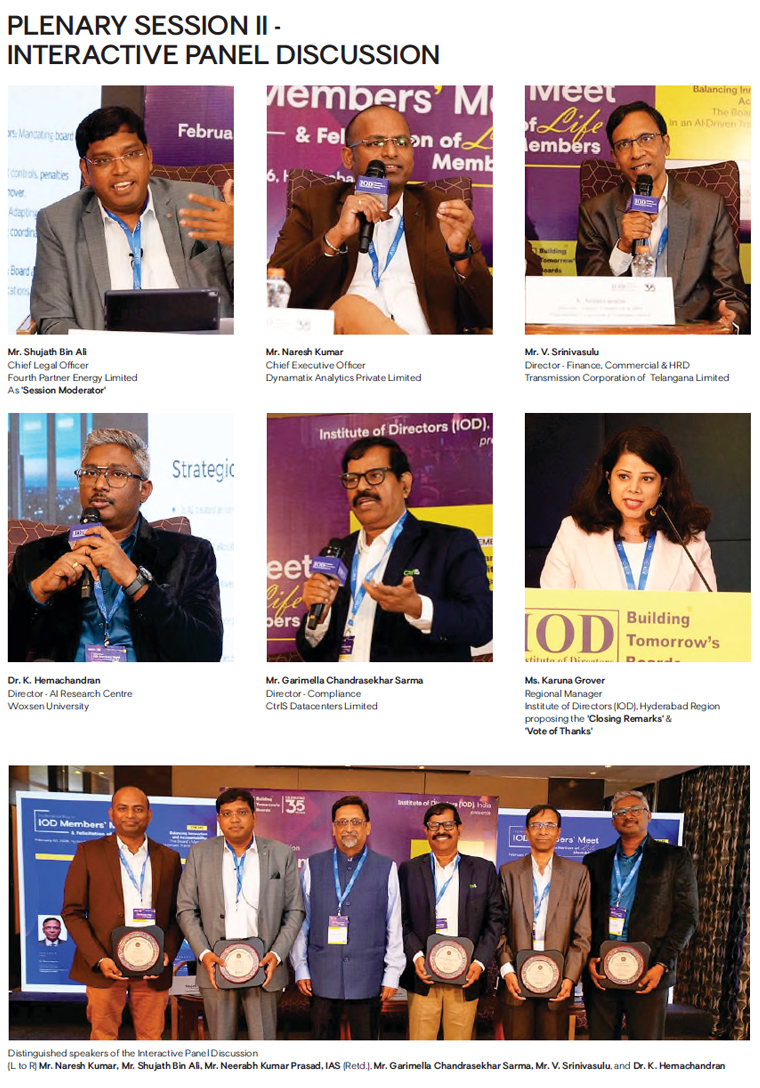
Dr. Hemachandran delivered a candid, experience-driven address where he stated that technology investment is no longer optional, but must be purposeful, with boards carefully evaluating allocations toward AI tools, employee training, and capability building within a defined strategic horizon rather than pursuing trend-driven initiatives. He stressed collaboration with research institutions, universities, and innovation ecosystems to strengthen research depth and credibility, while underscoring accountability, noting that AI failures often stem from bias, weak data validation, model dilution, and unclear ownership. Pilot labels, he cautioned, cannot become excuses for failure, and governance policies must clearly define model ownership, validation responsibility, and consequence accountability. On strategic adoption, he cautioned against deploying AI or quantum AI merely for competitive signaling, urging organizations to assess real value creation, particularly in repetitive and data-intensive workflows, while maintaining human oversight in sectors like finance and healthcare. He also advocated a human-AI collaboration model where AI supports decisions but leadership retains the final accountability. He concluded by emphasizing the importance of localized deployment, ethical AI practices, cybersecurity vigilance, and controlled access mechanisms.
Conclusion
The session concluded with a clear consensus that Artificial Intelligence is redefining the role of boards, transforming them from traditional oversight bodies into proactive strategic stewards in a rapidly evolving digital landscape. The discussions emphasized that successful AI adoption requires board-level literacy, disciplined investment decisions, clearly defined accountability structures, and integration within enterprise risk and governance frameworks.
While AI offers powerful capabilities in predictive analytics, compliance automation, operational efficiency, and strategic foresight, its effectiveness ultimately depends on data integrity, ethical safeguards, cybersecurity resilience, and continuous human oversight. Directors must ensure that AI initiatives are aligned with long-term value creation, sustainability commitments, and regulatory expectations, while actively monitoring risks such as bias, reputational exposure, and third-party dependencies.
Ultimately, AI is not a replacement for board judgment, but a strategic enabler that strengthens decision-making, enhances organizational agility, and supports the creation of resilient, responsible, and future-ready organizations.
This was followed by an interactive Q&A session with the audience.
The 'Closing Remarks' & 'Vote of Thanks' were proposed by:
Ms. Karuna Grover
Regional Manager
Institute of Directors (IOD), Hyderabad Region
Ms. Grover expressed her sincere gratitude to the sponsor, speakers, and the panellists for their exceptional contributions in making the event a resounding success. She acknowledged the valuable insights and expertise shared throughout the program and thanked all attendees for their active participation and thoughtful engagement, which helped create a dynamic and productive platform for meaningful discussion. In her closing remarks, she highlighted the collective learning achieved during the day's proceedings and reaffirmed IOD's dedication to strengthen boardroom effectiveness.
The Institute of Directors (IOD), Hyderabad Region extends its sincere gratitude to its event
Supporting Partner:

This report is compiled by:
Ms. Karuna Grover
Regional Manager
Institute of Directors (IOD), Hyderabad Region
&
Mr. Subham Chakraborty
Management Trainee
Institute of Directors (IOD), Hyderabad Region
 Back to Home
Author
Institute of Directors India
Bringing a Silent Revolution through the Boardroom
Institute of Directors (IOD) is an apex national association of Corporate Directors under the India's 'Societies Registration Act XXI of 1860'. Currently it is associated with over 31,000 senior executives from Govt, PSU and Private organizations of India and abroad.
Owned by: Institute of Directors, India
Disclaimer: The opinions expressed in the articles/ stories are the personal opinions of the author. IOD/ Editor is not responsible for the accuracy, completeness, suitability, or validity of any information in those articles. The information, facts or opinions expressed in the articles/ speeches do not reflect the views of IOD/ Editor and IOD/ Editor does not assume any responsibility or liability for the same.