 Quick Links
 Connect us

 Directors Databank (Empannel Yourself)
 Become a
  Become a
  Blog
Blog
 Become an Awards Assessor
 Publications
 Contact Us







A Report on Western Region Conclave 2026

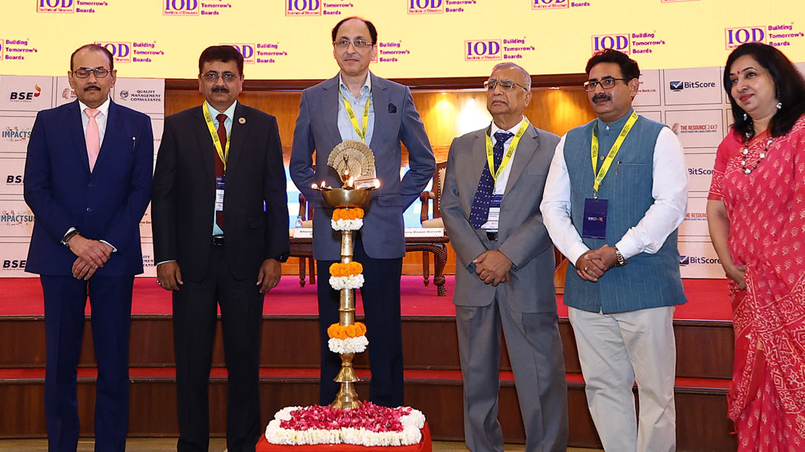
The Institute of Directors (IOD) Western Region Conclave 2026, themed, 'The Directors' Dialogue: Redefining Responsibility in 2026', on April 18, 2026 at the BSE International Convention Hall, Mumbai, convened senior directors, policymakers, regulators, financial experts, and industry leaders to examine the evolving role of boards in a dynamic global landscape. The conclave emphasised on enhanced board accountability, robust financial stewardship, regulatory agility, digital resilience, and oversight of emerging technologies. Through focused deliberations, it aimed to strengthen governance standards, foster forward-looking leadership, and promote fiduciary excellence. Overall, the programme seeked to advance governance practices that support sustainable growth, build institutional credibility, and drive long-term value creation.
PLENARY SESSION - I
INAUGURAL SESSION
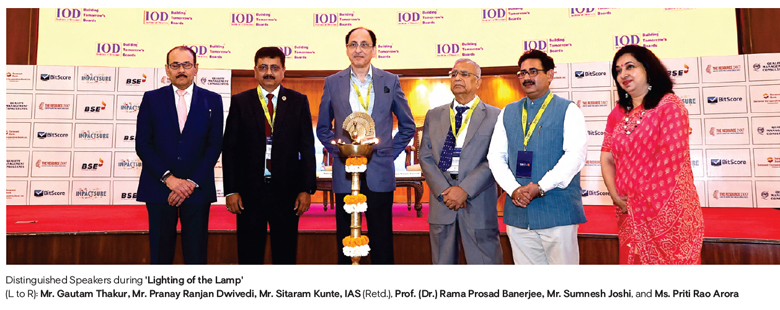
The 'Welcome Address' was presented by:
Ms. Priti Arora
Chief General Manager
Institute of Directors (IOD), Western Region
Ms. Priti noted that with rising governance expectations, the conclave was designed to foster forward-looking boardroom leadership, reinforce fiduciary excellence, and promote governance practices that enable sustainable growth, institutional credibility, and long-term value creation. Ms. Priti further highlighted the expanding responsibilities of directors in building future-ready boardrooms, stressing the importance of digital transformation, adoption of Artificial Intelligence, and the need for robust cybersecurity frameworks to effectively manage emerging risks in an increasingly technologydriven business landscape.
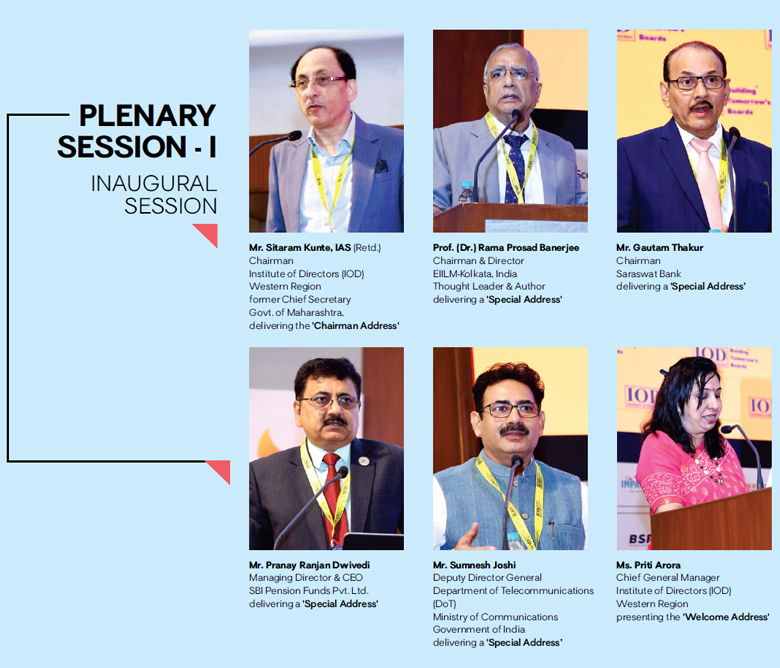
This was followed by the 'Chairman Address', delivered by:
Mr. Sitaram Kunte, IAS (Retd.)
Chairman, Institute of Directors (IOD), Western Region
former Chief Secretary of Maharashtra
Mr. Sitaram began by welcoming the participants and highlighting the importance of governance and leadership in advancing the vision of Viksit Bharat 2047. He further stressed the need for objectivity, diversity, and active participation in ensuring sound, long-term decisionmaking. Mr. Sitaram concluded by emphasising on strong financial governance, transparency, and long-term value creation, guided by sustainability and accountability principles, including the “triple bottom line.”
This was followed by a 'Special Address' delivered by:
Prof. (Dr.) Rama Prosad Banerjee
Chairman & Director
EIILM-Kolkata, India
Thought Leader, Author
Mr. Rama reflected on the evolving global landscape, and emphasising the need for businesses to adapt to an increasingly interconnected economy. He cited Japan's resilience as an example of recovery through strategic acknowledgment of challenges. Drawing examples from ancient Indian governance, he referred to Kautilya's principles, stressing leadership rooted in strategy, economic management, and public welfare. He further discussed the evolution of industries, noting the growing distinction between “value” and “values,” with knowledge emerging as a key driver in today's economy. Mr. Rama concluded by underscoring the importance of continuous technological upgradation, innovation, and a global outlook for sustained competitiveness.
This was followed by another 'Special Address' delivered by:
Mr. Gautam Thakur
Chairman
Saraswat Bank
Mr. Gautam traced the remarkable growth of Saraswat Co-operative Bank Ltd. and its journey from a small community credit society to a large institution, driven by a bold long-term vision supported by consistent governance practices, balanced business strategies, and timely course corrections. Today it stands as India's largest urban co-operative bank, crossing C1 lakh crore in total business as of March 31, 2026—an achievement reflecting strong governance and strategic vision. Noting that governance principles are universally applicable, he highlighted customer-centricity as a core priority, with a continued focus on personalised service to build enduring relationships. He concluded by affirming that sustainable growth rests on integrity, ethical conduct, sound governance, and collective decision-making.
This was followed by a 'Special Address' delivered by:
Mr. Pranay Ranjan Dwivedi
Managing Director & CEO
SBI Pension Funds Pvt. Ltd.
Mr. Ranjan began by introducing SBI Pension Funds Pvt. Ltd., a subsidiary of State Bank of India and its largest pension fund manager under the National Pension System, with a market share of around 34% as of March 31, 2026. He emphasised on cybersecurity and Artificial Intelligence, which are now central to boardroom discussions and requiring boards to actively guide organisations through technological transformation. Highlighting the financial sector, he stressed that governance is critical as trust remains its foundation, supported by strong audits, internal controls, and accountability. He also underlined the importance of financial literacy and entrepreneurial thinking, noting that money is built on trust and transparency. He advocated prioritising technology governance through continuous learning and adaptability and concluded by highlighting the expanded role of independent directors in ensuring credibility, ethical conduct, and informed decision-making.
This was followed by a 'Special Address' delivered by:
Mr. Sumnesh Joshi
Deputy Director General
Department of Telecommunications (DoT)
Ministry of Communications
Government of India
Mr. Joshi emphasised on the need for continuous policy refinement to support a dynamic trade and governance environment. He also stressed on the importance of robust SOPs and governance frameworks built on reliable data to ensure accountability and efficiency. Referring to sectoral disruptions, particularly in telecom, he underscored the need for clear vision, structured thinking, and strong team communication. Citing UPI as an example, he illustrated how trust can be built through digital ecosystems. He advocated for minimal data usage, consent-based systems, and strong cybersecurity and concluded by emphasising trusted digital platforms and the need for governance frameworks balancing innovation with data protection.
PLENARY SESSION - II
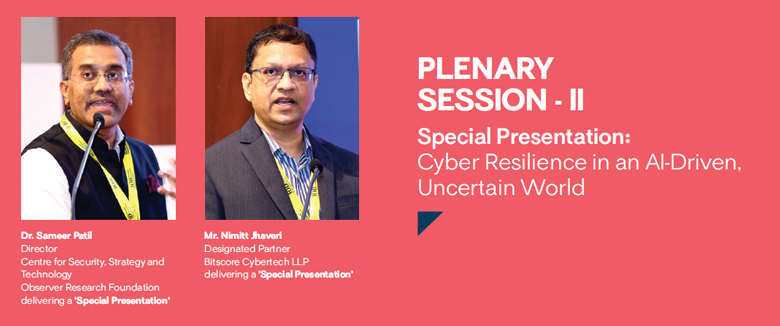
SPECIAL PRESENTATION: CYBER RESILIENCE IN AN AIDRIVEN, UNCERTAIN WORLD
The 'Special Presentation' was delivered by:
Dr. Sameer Patil
Director-Centre for Security
Strategy and Technology, Observer Research Foundation
&
Mr. Nimitt Jhaveri
Designated Partner
Bitscore Cybertech LLP
Mr. Patil highlighted cybersecurity as a critical global risk driven by rising geopolitical tensions. He noted that global conflicts increasingly impact India at the local level, with cyber warfare often targeting critical infrastructure and financial systems. He identified key risk areas, including AIdriven attacks that amplify the speed and scale of threats, supply chain vulnerabilities, and geopolitical fragmentation with state-sponsored cyber activities. He also pointed to the rise in cyber incidents in India, with over 29 lakh cases handled by CERT-In in 2025 and the average cost of a data breach reaching C22 crore. He concluded by underscoring that cybersecurity is a strategic governance priority essential for sustainable and secure growth.
Mr. Jhaveri highlighted India's growing cyber risk landscape, noting that the country is among the most targeted globally, with the average data breach cost reaching nearly C22 crore and increasing ransomware incidents. He pointed out that board-level visibility on cyber risks remains limited, making governance more critical. He also discussed India's evolving regulatory environment, citing mandates from authorities such as the Government of India, SEBI, RBI, IRDA, and CERT Introducing cybersecurity ratings, he explained platforms like BitSight as similar to credit scores, offering continuous, data-driven assessments of an organisation's cyber hygiene through external monitoring and benchmarking. He also noted their widespread global adoption and referenced the Moody's–BitSight partnership, linking cyber risk with financial risk evaluation.
PLENARY SESSION - III
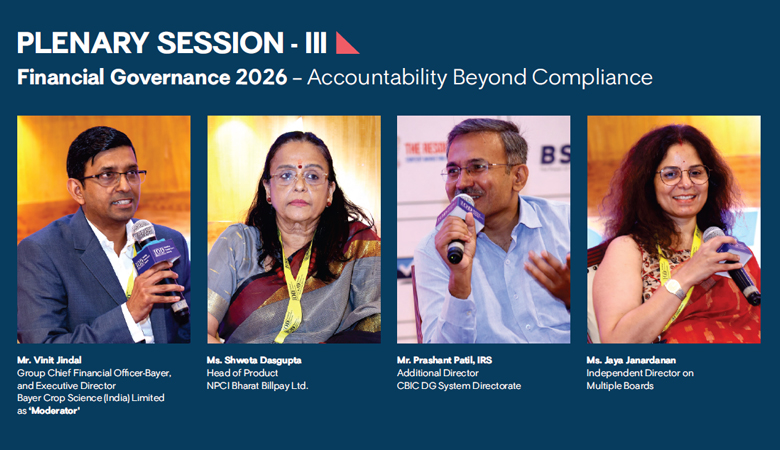
FINANCIAL GOVERNANCE 2026 – ACCOUNTABILITY BEYOND COMPLIANCE
The ‘Moderator’ of the session was:
Mr. Vinit Jindal
Group Chief Financial Officer
Bayer, and Executive Director
Bayer Crop Science (India) Limited
Mr. Jindal commenced his address by emphasising the critical importance of financial governance, highlighting that clarity in execution and accountability are fundamental to effective governance practices. He noted that while compliance is essential and is not sufficient on its own. Drawing an analogy with traffic rules, he explained that merely following regulations does not ensure responsible behaviour unless accompanied by awareness and accountability. He stressed that accountability in the boardroom is closely linked to the consequences of capital allocation decisions, which directly impact organisational outcomes. Mr. Jindal also underscored that governance should not be treated as a mere discussion point but must be embedded into actionable practices and highlighted that true governance extends beyond formal responsibilities to include individual accountability at all levels.
The session consisted of the following Panel of Distinguished Speakers:
1. Ms. Shweta Dasgupta
Head of Product
NPCI Bharat Billpay Ltd.
2. Mr. Prashant Patil, IRS
Additional Director
CBIC DG System Directorate
3. Ms. Jaya Janardanan
Independent Director on Multiple Boards
Ms. Dasgupta highlighted delay as a key frustration in boardroom discussions, noting that boards often dwell excessively on compliance while not paying adequate attention to systems. She cautioned against underjudgement, emphasising that the inability of boards to exercise informed judgement can erode trust. In her view, reputational risks—particularly adverse front-page coverage—pose a greater threat than regulatory notices. She underscored the primacy of data as the foundation for sound decision-making and remarked that effective governance is rooted in trust and transparency, rather than excessive controls. She further observed that increasingly voluminous board packs often lead to thinner insights, and stressed the importance of fostering a strong corporate and risk culture where formal mechanisms may fall short. She concluded by challenging the misconception that regulatory compliance impedes growth.
Mr. Patil identified compliance as a central concern in board discussions, while noting that boards tend to overemphasise operational matters and under-discuss intrusiveness. He expressed concern over overcompliance, describing it as a “back-office check-boxing” exercise that may dilute strategic focus. Like his copanellists, he viewed reputational risks as more consequential than regulatory scrutiny. He noted that governance, beyond controls, is fundamentally about selfregulation and self-discipline. Highlighting the importance of leadership integrity, he stressed the role of tone at the top in ensuring transparency and ethical conduct. He also pointed to the risk of hierarchical disconnects as board materials expand, and addressed the misconception that regulatory compliance is inherently a constraint, emphasising instead its role in strengthening governance frameworks.
Ms. Janardanan pointed to a transactional approach as a key limitation in boardroom discussions, observing that boards often focus excessively on data sanity while insufficient attention is given to capital. She cautioned that over-compliance can act as a barrier, potentially impacting business outcomes and profitability. Diverging slightly from her co-panellists, she noted that regulatory notices should not be underestimated, as they often signal serious underlying issues. She observed that as board packs grow, meaningful discussions on transactions tend to diminish. On trust, she highlighted the importance of real-time data and inclusive decision-making. She concluded by challenging the belief that greater control necessarily leads to better decision-making, advocating instead for a more balanced and thoughtful governance approach.
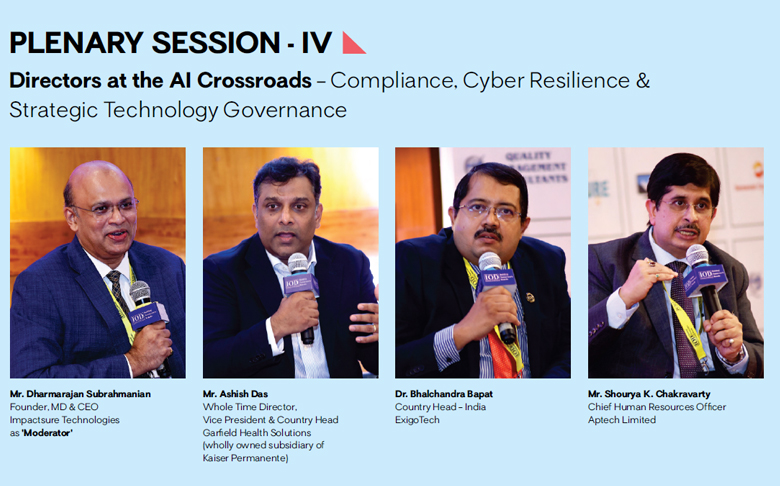
PLENARY SESSION - IV
DIRECTORS AT THE AI CROSSROADS – COMPLIANCE, CYBER RESILIENCE & STRATEGIC TECHNOLOGY GOVERNANCE
The ‘Moderator’ of the Session was:
Mr. Dharmarajan Subrahmanian
Founder, MD & CEO
Impactsure Technologies
Mr. Subramanyam commenced his address with a brief anecdote, recalling a discussion where a senior manager admitted a lack of understanding of Artificial Intelligence. This, he noted, created a moment of reflection, highlighting the urgent need for board members to equip themselves with adequate knowledge of AI in today's evolving business environment. He emphasised that in the current era, directors must be trained to ask the right and critical questions regarding AI. Rather than being a peripheral tool, AI is increasingly shaping boardroom discussions, influencing decision-making processes, and enabling faster and more data-driven outcomes. He concluded by posing a thought-provoking perspective: “Whether boards are effectively governing AI, or if, conversely, AI is beginning to influence and steer board decisions underscoring the need for strong oversight and informed leadership.”
The Session had the following Distinguished Speakers in the Panel:
1. Mr. Ashish Das
Whole Time Director
Vice President & Country Head
Garfield Health Solutions
(Wholly owned subsidiary of Kaiser Permanente)
2. Dr. Bhalchandra Bapat
Country Head – India
ExigoTech
3. Mr. Shourya K. Chakravarty
Chief Human Resources Officer
Aptech Limited
Mr. Das emphasised that trust remains the cornerstone of healthcare governance. While AI significantly enhances efficiency, accuracy, and quality of care, boards must ensure its ethical and transparent use to maintain patient confidence. On accountability, he clarified that responsibility ultimately rests with human decision-makers and healthcare institutions, not AI systems. Addressing global standards, he noted a gradual convergence around principles such as transparency and accountability, though differences persist due to varying regulatory environments. He highlighted the need for significant investment in digital infrastructure and urged boards to adopt a long-term, resilience-focused approach to AI integration.
Dr. Bapat highlighted the growing gap between the speed of cyber threats and organisational response, noting that AI has significantly amplified the sophistication of attacks. He cautioned against viewing cybersecurity as a compliance exercise, advocating instead for a resilience driven approach focused on preparedness and proactive risk management. He identified supply chain and vendorrelated vulnerabilities as one of the most underestimated risks, stressing the need for robust third-party risk frameworks embedded within governance structures. On transitioning from compliance to resilience, he emphasised continuous monitoring, protection of critical data, and the ability to detect, respond to, and recover from incidents swiftly. He further noted that compliance alone does not ensure security, as evolving threats often outpace static frameworks, making resilience the true measure of organisational preparedness.
Mr. Chakravarty observed that AI is not merely displacing jobs but also exposing leadership and capability gaps. He highlighted that while AI provides insights, effective decision-making still depends on human judgment, making upskilling and continuous learning essential. He emphasised that boards should prioritise mindsets over skills, as adaptability and openness to learning are critical in navigating technological change. On preparing leadership teams, he advocated “exposure before expectation,” suggesting that leaders must first engage with and understand AI to build confidence and reduce resistance. He concluded that AI, when combined with the right mindset and culture, serves as an enabler that augments leadership rather than threatens it.
PLENARY SESSION - V
CLOSING ADDRESS & VOTE OF THANKS
The 'Closing Address' & 'Vote of Thanks' was presented by:
Ms. Priti Arora
Chief General Manager
Institute of Directors (IOD), Western Region
Ms. Priti underscored that in today's environment, technology and cybersecurity are no longer optional but essential components of governance. Directors are expected not only to ask the right questions but also to guide organisations toward resilience, while adapting to increasing regulatory expectations and evolving frameworks. She concluded by expressing her gratitude to the speakers, partners, and participants for their valuable contributions. She encouraged attendees to carry forward the insights and discussions into their respective boardrooms and decision-making processes, thereby shaping stronger and more responsible institutions.
The Institute of Directors (IOD), Western Region expresses its sincere gratitude to its valued partners:
Our Gold Partner: The Saraswat Bank Cooperative Bank Limited
Our Cybersecurity Partner: Bitscore Cybertech LLP
Our Silver Partner: Impactsure Technologies Private Limited
Our Venue Partner: BSE International
Our Supporting Partner: Quality Management Consultants
This report has been compiled by:
Institute of Directors (IOD)
Western Region
 Back to Home
Author

Institute of Directors India
Bringing a Silent Revolution through the Boardroom
Institute of Directors (IOD) is an apex national association of Corporate Directors under the India's 'Societies Registration Act XXI of 1860'. Currently it is associated with over 31,000 senior executives from Govt, PSU and Private organizations of India and abroad.
Owned by: Institute of Directors, India
Disclaimer: The opinions expressed in the articles/ stories are the personal opinions of the author. IOD/ Editor is not responsible for the accuracy, completeness, suitability, or validity of any information in those articles. The information, facts or opinions expressed in the articles/ speeches do not reflect the views of IOD/ Editor and IOD/ Editor does not assume any responsibility or liability for the same.