 Quick Links
 Connect us

 Directors Databank (Empannel Yourself)
 Become a
  Become a
  Blog
Blog
 Become an Awards Assessor
 Publications
 Contact Us







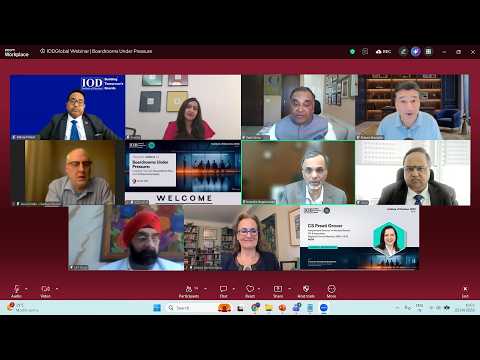
A Report on IODGlobal Webinar-“Boardrooms Under Pressure: Leading Through Geopolitical Flux and Global Uncertainty”


The Institute of Directors (IOD), India convened its first IODGlobal Webinar of the year, themed on: “Boardrooms Under Pressure: Leading Through Geopolitical Flux and Global Uncertainty”, on April 22, 2026. Hosted on Zoom platform the session brought together an exceptional global panel of diplomats, economists, technologists, industrial leaders and governance practitioners for a dialogue that was as urgent as it was directional. The timing of the webinar could not have been more deliberate. With the West Asia conflict disrupting energy flows through the Strait of Hormuz, trade fragmenting across a multipolar world, artificial intelligence rewriting the rules of corporate operation, and democratic institutions under strain globally, the webinar arrived at a moment when boardroom leadership faces pressures that traditional governance frameworks were simply never designed to handle.
The session drew on perspectives spanning macroeconomics, geopolitical intelligence, AI governance, energy logistics, and independent directorship, collectively mapping a new governance terrain for Indian and global boards alike. The conversation that followed was not merely insightful. It was directional because the world, as every speaker made clear, is no longer waiting for stability to return.
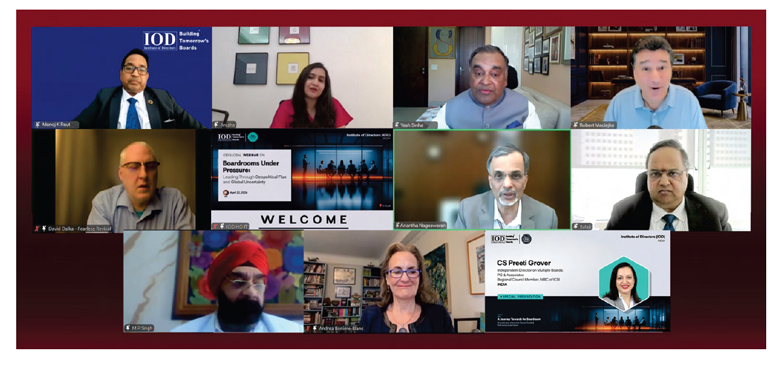
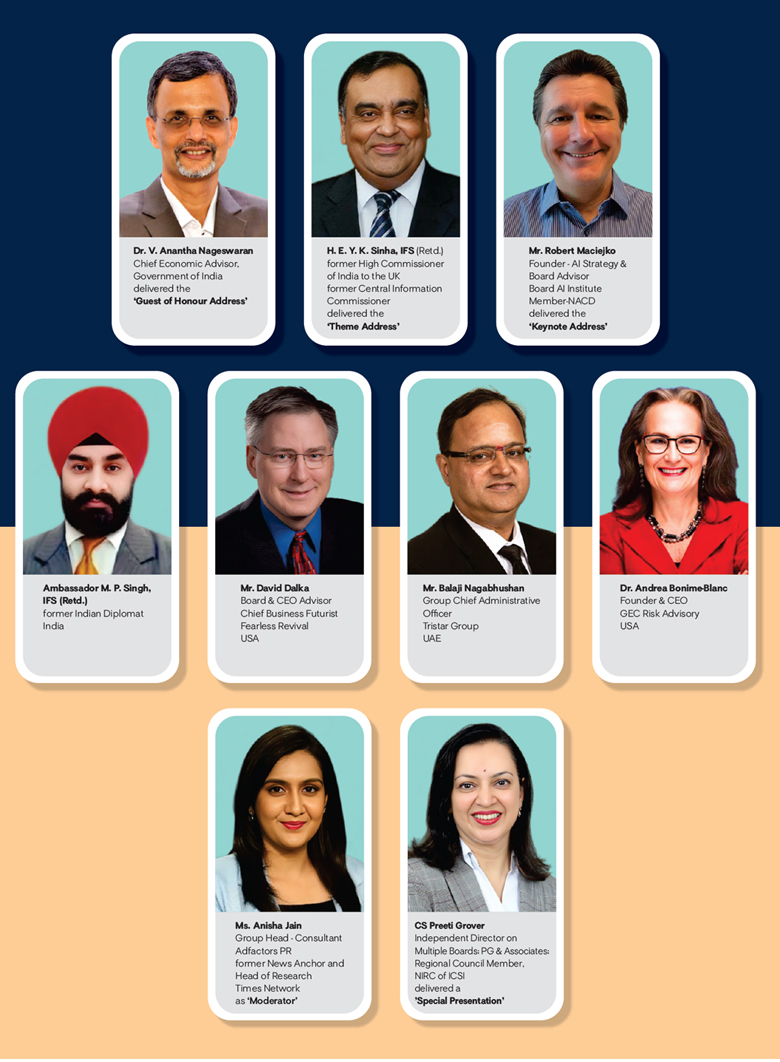
The 'Welcome Address' of the webinar was presented by:
Mr. Manoj K. Raut
CEO & Secretary General
Institute of Directors (IOD)
Mr. Raut delivered a sobering assessment of the global order, warning that the world has moved well beyond cyclical disruption into irreversible structural change, a distinction he stressed boards can no longer afford to ignore. He painted a vivid picture of a multipolar, fragmented landscape where trade is disintegrating rather than integrating, supply chains are being redesigned for security over efficiency, energy has become a geopolitical lever, and capital is increasingly driven by risk perception rather than returns. "Geopolitics is no longer an external variable," he asserted. "It is now a core strategic driver", shaping market access, cost structures, investment decisions, technology choices, and corporate reputation alike. Mr. Raut cautioned that traditional governance models are fundamentally illequipped for today's multi-dimensional risk convergence, spanning war, trade tensions, cyber threats, climate shocks, and artificial intelligence. He called on boards to evolve from oversight to foresight, from compliance to strategic judgment, and from risk management to active resilience building. Closing on a note of realistic optimism, he reminded directors that uncertainty, intelligently navigated, is also opportunity and that the world is no longer waiting for stability to return.
This was followed by the 'Theme Address' delivered by:
H.E. Mr. Yash Sinha, IFS (Retd.)
Former High Commissioner of India to the UK
H.E. Sinha argued that 2025 marked the definitive end of the old-world-order and that four months into 2026, no new order has yet emerged to replace it. He described the present moment as an "age of entanglements" where tariffs have hit the multilateral trading system, supply chains are weaponised, and long-standing alliances have been reduced to transactional arrangements. The ongoing West Asia conflict, he warned, has added a third and graver dimension: an age of war. H.E. Sinha was unequivocal that the silos separating geopolitics from corporate governance have been permanently demolished. The blockade of the Persian Gulf and the threatened closure of the Strait of Hormuz, he stressed, make energy diversification not a long-term aspiration but an immediate boardroom imperative. His most distinctive counsel was structural: boards with international exposure urgently need diplomatic and geopolitical intelligence embedded within their decision-making. Drawing on intimate knowledge of Gulf dynastic politics, he illustrated how nuanced regional insight can be decisive for investment strategy. He closed with a characteristic wit, "Jack be nimble, Jack be swift" urging boards above all to be quick on their feet.
This was followed by the 'Keynote Address' delivered by:
Mr. Robert Maciejko
Founder - AI Strategy & Board Advisor Board AI Institute, and NACD Member
Mr. Maciejko commenced his address with Sam Altman's dismissive 2023 remark to India, "It's totally hopeless to compete with us". He reframed the challenge: the real governance question is not whether India can build AI, but whether its boardrooms can govern it. He identified two endemic board failures:
• The clueless board, paralysed by technological illiteracy, and
• The FOMO board, recklessly chasing implementation without infrastructure.
Most organisations, he observed, suffer from "vibe governance." Mr. Maciejko noted that the regulatory landscape for AI is sharply divergent: the EU imposes penalties of up to 7% of revenue for failures, the US lacks a comprehensive federal framework, and India has adopted a principle-driven, sector-specific middle path—placing the onus of governance squarely on corporate boards. RBI data underscored the urgency: of 600 regulated financial institutions surveyed, only 20% use AI, and of those, just one-third have board-level oversight. His prescription was the STAR Framework, a four quarterly board questions covering Shareholder value, Threat parity, Ability, and Risk budget. It is designed to make AI governance proactive rather than reactive. His closing argument was clear: AI does not diminish the human leader; It demands more from them than ever.
This was followed by the 'Guest of Honours' address, delivered by:
Dr. V. Anantha Nageswaran
Chief Economic Advisor
Government of India
Dr. Nageswaran spoke against the backdrop of the West Asia conflict and offered a measured yet sobering macroeconomic assessment. India, he noted, entered 2026 with exceptional fundamentals, 7%-plus GDP growth, declining inflation, fiscal consolidation, and three sovereign credit rating upgrades in a single year. February 28th changed the calculus overnight. The Strait of Hormuz disruption, he argued, is not merely an energy shock, it elevates freight insurance costs, suppresses Gulf growth, and squeezes remittance flows, making its cumulative impact approach COVID-scale in certain dimensions. On AI, Dr. Nageswaran raised a pointed collective action warning: if all companies simultaneously eliminate entrylevel roles, no pipeline exists to produce the mid-senior talent they will inevitably still need. Short-term optimisation, pursued universally, becomes long-term systemic damage.
His prescription for boardrooms was four-fold:
i. Diversify energy and input sourcing immediately
ii. Factor supply chain weaponisation risk, not just invoice price into procurement decisions
iii. Invest urgently in indigenisation that is globally competitive, not merely domestically comfortable, and
iv. Build strategic buffers in critical materials from copper to aluminium.
His defining insight was that in the next 25 years, national interest and corporate interest will no longer be separable; Boards that fail to see this are optimising for a world that no longer exists.
PLENARY SESION: Boardrooms Under Pressure: Leading Through Geopolitical Flux and Global Uncertainty
The session was moderated by:
Ms. Anisha Jain
Group Head, Consultant
Adfactors PR, and former News Anchor and Head of Research Times Network
Ms. Jain positioned the session as a timely convergence of ideas at a moment of accelerating global complexity. She noted that institutions today are no longer assessed solely on performance, but on resilience, accountability, and their capacity to create enduring value amid deepening uncertainty. Ms. Jain outlined the session's ambition clearly, not merely to inform, but to provoke thought, encourage exchange, and surface actionable insights. The panel, she noted, had been curated to interrogate how geopolitics has moved decisively into the boardroom, reshaping strategic and operational decisions at every level. Her framing mapped the terrain ahead: the emergence of a new global risk order spanning trade, energy, supply chains, and capital flows; the imperative of organisational resilience; and the central governance challenge of making agile, informed decisions without sacrificing discipline. The stage, she made clear, was set for a directional conversation and not just a descriptive one.
The session had the following Distinguished Speakers:
1. Ambassador M.P. Singh, IFS (Retd.)
former Indian Diplomat
2. Mr. David Dalka
Board & CEO Advisor
Chief Business Futurist
Fearless Revival
3. Mr. Balaji Nagabhushan
Group Chief Administrative Officer
Tristar Group
4. Dr. Andrea Bonime-Blanc
Founder & CEO
GEC Risk Advisory
Ambassador Singh, commenced his address with a blunt reframing idea that today's boards are no longer preparing for shocks, they are absorbing one in real time. Modern conflict, he argued, is no longer a battle of weapons alone but a complex interplay of trade, technology, and institutional erosion but attacking the very multilateral architecture that took centuries to build. His prescriptions were pointed and practical. Boards must institutionalise geopolitical intelligence as a continuous discipline, not an episodic exercise establishing dedicated risk committees to monitor global flashpoints and embed foresight into corporate strategy. Scenario planning, including the Israeli "10th man rule" of structured devil's advocacy, must become a boardroom rhythm. On supply chains, he was unequivocal: just-in-time efficiency models have proven dangerously brittle. Geographic hedging, multi-source diversification, and near-shoring to allied nations are no longer optional. India's existing strategic petroleum reserves which have insulated domestic LPG prices while global markets spiked he cited as proof that bufferbuilding works.
He offered six concise strategic principles:
i. Anticipate multi-domain shocks;
ii. Abandon sunk costs when necessary;
iii. Exploit asymmetry;
iv. Delegate authority across geographies;
v. Control the corporate narrative; and above all,
vi. Treat strategy without adaptability as dogma, while invoking Blockbuster versus Netflix as his closing proof point
Mr. Nagabhushan brought rare operational credibility to the discussion, operating at the precise intersection of every geopolitical risk under discussion: sanctions, port blockades, maritime choke points, pipeline sabotage, and cyber threats. His central argument was elegantly simple: resilience is not crisis response; it is daily practice. Too many companies, he observed, wait for the first warning shot before assembling a crisis team. By then, it is too late. On crisis communication, he was emphatic: post-crisis reviews consistently reveal that the primary failure is not strategic but communicative. His prescription was a preagreed, tiered crisis protocol defining team composition, convening frequency, and information hierarchy at each escalation level that reflects hard-won operational experience. His closing formulation was memorable: the worst thing a board can do in uncertainty is nothing. The second worst is to overreact and break what is still working.
Dr. Andrea highlighted a critical yet under-recognised governance failure: boards often lack a true understanding of the moment they are operating in. She identified a threefold disruption: geopolitical, technological, and political. The United States, once a stabilising hegemon, is increasingly viewed as a disruptive force; democratic backsliding is elevating political risk even in traditionally stable economies; and exponential technologies are advancing faster than governance frameworks can keep pace. In her book Governing Pandora: Leading in the Age of Generative AI and Exponential Technology, she argued that boards remain over-reliant on financial and industry expertise while lacking polymathic, curious, and empathetic thinkers capable of interpreting systemic shifts. Her prescription was clear: conduct forward-looking skills audits and complement boards with advisory councils that bring deeper geopolitical and technological fluency to navigate an increasingly complex world.
Mr. David opened with an arresting image of cocainelaced salmon in the Great Lakes to make a disarmingly simple point: risk is omnipresent, even where it appears invisible. From crumbling water infrastructure to earthquake-blind building codes in Chicago, his examples illustrated how governance frameworks routinely fail to account for risks hiding in plain sight. His core indictment was of boardroom complacency. The post 9/11 rigour that saved companies with Y2K contingency plans has quietly evaporated. Boards today are drowning in thousand-page PDFs from advisors who misunderstand their needs, while missing the inflection points that actually matter which is cybersecurity vulnerabilities, AI-generated misinformation, and search disintermediation quietly destroying customer relationships. On AI, his provocation was sharp: business rules should precede technology, not follow it. A supervised, business-acumen-first approach to AI was practised at MIT three decades ago and still continues to outperform much of today's undisciplined deployment. Doing the wrong thing faster, he warned, is the greatest corporate danger of the moment. He challenged boards globally to ‘red-team’ their goingconcern frameworks urgently citing Iran's March 2026 threat against eighteen major technology companies as the moment most existing governance frameworks became instantly obsolete.
This was followed by a ‘Special Presentation’ on: A Journey Towards the Boardroom
The presentation was delivered by:
CS Preeti Grover
Independent Director on Multiple Boards;
PG & Associates;
Regional Council Member, NIRC of ICSI
CS Grover delivered an incisive and interactive guide to boardroom readiness, opening with a sharp observation: mere compliance with the Companies Act does not equate to true independence. What defines an effective director, she argued, is objective judgment and the courage to dissent when decisions do not serve stakeholder interests, irrespective of personal familiarity with promoters. She outlined the regulatory landscape covering board composition, committee mandates, and proficiency requirements before shifting to future readiness. This, she noted, demands digital fluency, a strong grasp of risk, rigorous reverse due diligence, and a clearly defined personal value proposition. Her due diligence checklist stood out, highlighting red flags such as frequent auditor changes, director resignations, relatedparty transactions, SEBI notices, and gaps in D&O insurance. She concluded by underscoring the oftenoverlooked importance of the Risk Management Committee, citing the IndiGo episode as a compelling reminder of its critical role.
This report has been compiled by:
Ms. Violina Das
Assistant Manager- Editor & Communications
Institute of Directors (IOD)
KEY INSIGHTS FROM IODGLOBAL WEBINAR
Boardrooms Under Pressure:
Leading through Geopolitical flux and Global Uncertainty
1. Convergence of Corporate Strategy with National and Systemic Interests
The boundaries between corporate objectives and national imperatives are dissolving, with economic security, technological sovereignty, and social stability becoming intertwined. Boards should align strategy with national and systemic resilience goals focusing on selective indigenisation, R&D investment, ESG integration, and building strategic buffers in critical resources.
2. From Predictable Globalisation to Geopolitical Centrality
With rising fragmentation and uncertainty, geopolitics is now central to business viability. Boards must reassess global exposure, diversify markets and supply chains, and embed geopolitical intelligence into governance to enable proactive, rather than reactive, strategic decision-making.
3. From Forecasting to Scenario-Based Strategy
Linear forecasting models are inadequate in a volatile, multi-risk environment. Boards ought to transition to dynamic, scenario intelligence frameworks, incorporating stress testing, tail-risk modelling, and dynamic strategy recalibration to make uncertainty measurable and actionable.
4. Resilience Over Efficiency in Supply Chains and Capital Allocation
Cost-optimised systems (e.g., “just-in-time”) are fragile under disruption; capital deployment is riskier amid uncertainty. An effective cushion for Boards is re-engineering for resilience-first models including supply chain diversification, strategic buffers, and flexible capital allocation with liquidity preservation and selective long-term investments.
5. Technology, AI, and the Human Capital Paradox
Artificial intelligence is increasingly shaped by geopolitical forces, while its indiscriminate adoption risks eroding the very talent pipelines organisations depend upon. Directors must adopt a balanced AI doctrine, ensuring ethical oversight, reducing over-dependence on geopolitically sensitive inputs, and investing in talent development to sustain long-term leadership pipelines.
Ms. Kashish Grover
Manager-Stragety
Office of the CEO
Institute of Directors (IOD)
 Back to Home
Author
Institute of Directors India
Bringing a Silent Revolution through the Boardroom
Institute of Directors (IOD) is an apex national association of Corporate Directors under the India's 'Societies Registration Act XXI of 1860'. Currently it is associated with over 31,000 senior executives from Govt, PSU and Private organizations of India and abroad.
Owned by: Institute of Directors, India
Disclaimer: The opinions expressed in the articles/ stories are the personal opinions of the author. IOD/ Editor is not responsible for the accuracy, completeness, suitability, or validity of any information in those articles. The information, facts or opinions expressed in the articles/ speeches do not reflect the views of IOD/ Editor and IOD/ Editor does not assume any responsibility or liability for the same.