 Quick Links
 Connect us

 Directors Databank (Empannel Yourself)
 Become a
  Become a
  Blog
Blog
 Become an Awards Assessor
 Publications
 Contact Us







'Best Interests' for Sustainable Growth


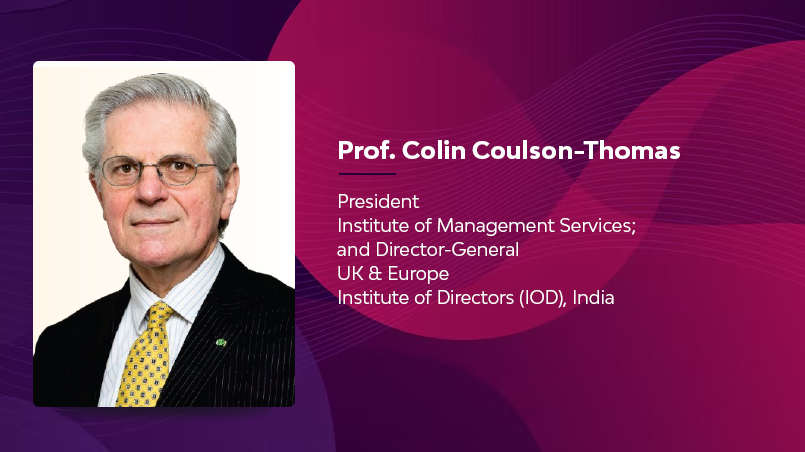
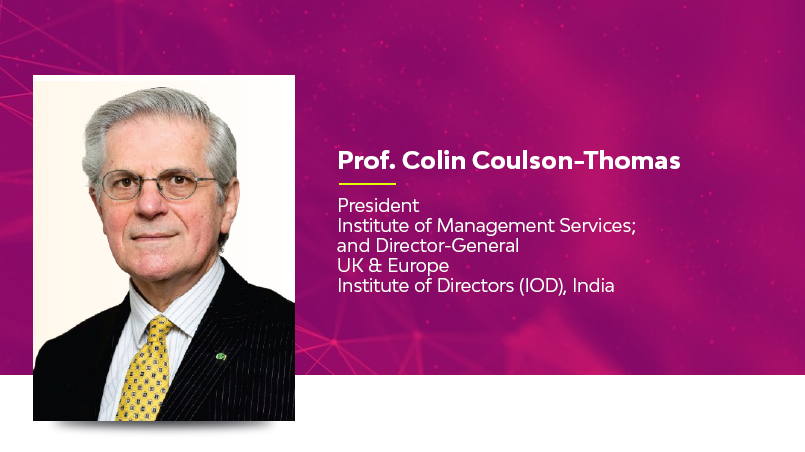
Prof. Colin Coulson-Thomas's article titled 'Board Leadership for the Environment and Climate Change' in August 2022 edition of the journal, Director Today, has some sobering message for Board Leadership. While each sub-header in the theme article has the potential for a wider discussion, the sub-header titled ‘Rethinking Enterprise and Entrepreneurship’ caught my attention. Discussions around 'best interest' of the company visà- vis shareholders/owners, which is now becoming increasingly ground-zero topic, has set a pathway to this opinion piece on Board Governance to ensure sustainable value creation.
There is no philosopher's stone in business and the board must strike a balance between being 'operationally involved' and staying in the 'strategic governance' lane.
Similar discussions have been taking place in other countries. As recent as July 2022, the Australian Institute of Company Directors felt the need to issue a legal opinion on Directors' duties. To quote a section of the opinion - "While the interests of shareholders are central, directors can and should, as a matter of practice, consider other stakeholders." Similar guidelines or even statutes have found their way into governance taxonomy in many other countries. In India too, the amended Companies Act and the rules & notifications issued by the Ministry of Corporate Affairs are aimed to contemporise the expectations of governance.
There are two critical components of Board Governance to facilitate sustainable growth. Firstly, the discretion of the time horizon in determining 'best interest' of the company. Secondly, adding interests of other stakeholders- namely, environment, employees, customers, creditors to those of shareholders/ owners. These might appear axiomatic but, very pivotal. It is summed up very aptly by Prof. Coulson-Thomas in his article, by asking a rhetorical question – “If carrying on as at present is unsustainable, how might reviews and a re-thinking of individual, corporate and collective aspirations, aims and ambitions, purposes and priorities and goals and objectives be triggered and undertaken?”
Clearly, governance must look at the forest and the trees and not either. As we stand at a pivotal moment, a reminder of what is right is especially important. The last governance crossroad moment was probably twenty years ago when the 'The Sarbanes Oxley Act' was introduced in the US and it had more than ripple effect around the world. That also brought the 'executive' and 'non-executive' under one tent. Today, what is at stake is way more serious than 'impropriety' in commercial domain. Available data, visuals and personal experiences on environmental metrics are so damning, that a fear of existential crisis is not out of place. It would appear we are at a critical juncture in corporate governance like never before.
Capital Allocation
Simplistically said, at the tip of the pyramid, it boils down to how much of profits to return to shareholders and how much to reinvest in the business. Underneath that, there are multiple gears and wheels – remarkably similar to a functioning of a mechanical watch. Directional decisions and capital allocation (or funding) on lateral (capacity) expansion and vertical expansion, R&D and product engineering spend, organic and/or inorganic growth to name a few – and these are not binary in nature. Add to these an overlay of Environmental Social and Governance (ESG) validation, and an overly complex web emerges. A 'sustainability-test' can alter the immediate trajectory of a business and thus, makes the capital-allocation decisions a springboard of 'sustainable-growth' choice.
There are enough pointers to indicate that the Covid pandemic and the lockdowns have triggered a re-look at value chain (or supply chain). Large volume-led horizontal supply chain and its cost efficiencies are being challenged from a risk management point of view. What was touted as a seamless, predictable, and inexpensive logistical manoeuvre has turned into full blown project just to avoid a 'stock-out' situation. In other words, the supply chain web that has been virtually perfected over the last thirty odd years is no longer on autopilot. Capacity expansion or even new capacity requires serious capital allocation. There are other aspects of business that will also call out for capital allocation. Digitization, a different go-to-market model, and the list can be a long one. These projects do not yield quick financial returns nor is perfect execution guaranteed. Capital is scarce and comes with a cost, therefore, appropriate allocation is a pre-requisite for a good shot at sustainable value creation.
Company's 'best interest' on a time horizon that is longer than the immediate fiscal year or the short term, is a skilful tight rope walk and capital allocation sits as the centre piece.
Incentivisation
At the risk of using a clichéd example of 2008 financial crisis and lessons from the housing mortgage bonds, it does not take too much of analysis to see how the 'bags of excrement' (valueless bonds) were passed on, fueled by incentives and bonuses with no effective circuit breaker of any sort. The fact that the mortgage bonds were being structured with no known underlaying assets was known (or should have been) to the decision-makers. Normally, the internal controls should have kicked-in, failing which the Board should have seen it. So, something that could have been a much smaller problem became a global crisis. It is almost predictable that any trendsetting event or innovation that sets the market ablaze with hype and aggressive new investments, has its run and then slows down for a maturity-break, forced by sobering experience of fraud or significant failures. We saw this in the 1990s in the technology sector after the Telecom/ dot-com peak, then again in late 2008 triggered by Housing mortgage bonds. 'Sustainability' or 'ESG' too, with its wide popularity, holds potential of creating a higher-than-normal tidal waves of investment decisions and capital allocation.
Incentive structures in India are relatively modest in comparison with the counterparts in the western markets. However, it is catching-up to ensure 'talent retention' as well as 'productivity improvement'. Incentive, in whatever form (short term, long-term etc.), is a time-tested productive enabler and has a high success rate. These are to inspire management success or even to signal commitment to those issues. On a balanced assessment, if one were to look at the pros and cons, the pros are a part of the constant buzz that drives 'better than good' in any business and then there are instances of the 'overdrive' taking the train off the track and over the safety rails.
Adding to the complexity are the reducing trend of employment tenure and a more forgiving market for skills. So, the challenge is, how do we avoid a bad outcome without sacrificing this timetested catalyst. The mechanism will vary from business to business and so must the circuit breaker.
The two levers noted above are intertwined and an appropriate oversight will facilitate sound execution and underpin sustainable growth. Of course, as a pre-requisite, the quality of engagement must be high to avoid making it a bootless initiative and avoidance of any feeling of diminution of the executives' remit.
 Back to Home
Author

Mr. Jyoti Lahiri
He is a senior executive with over 30 years in multinational companies, and most recently he was Chief Financial Officer- Asia Pacific Region, of Landis+ Gyr Group. He has served as a board member in India, Australia, and other countries. Currently based in Sydney, Australia, he is a Chartered Accountant, Fellow of IOD, India and also a member of the Australian Institute of Company Directors.
Owned by: Institute of Directors, India
Disclaimer: The opinions expressed in the articles/ stories are the personal opinions of the author. IOD/ Editor is not responsible for the accuracy, completeness, suitability, or validity of any information in those articles. The information, facts or opinions expressed in the articles/ speeches do not reflect the views of IOD/ Editor and IOD/ Editor does not assume any responsibility or liability for the same.