 Quick Links
 Connect us

 Directors Databank (Empannel Yourself)
 Become a
  Become a
  Blog
Blog
 Become an Awards Assessor
 Publications
 Contact Us







Corporate News - January 2026


ECONOMY
(1.) India and the European Union Finalise the Landmark Trade Deal 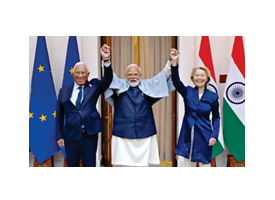
After nearly two decades of on-andoff negotiations, the deal signed by India and the EU will pave the way for India to open up its vast and guarded market, the world's most populous, to free trade with the 27-nation EU, its biggest trading partner. The agreement comes at a time when global trade flows have been disrupted by high US tariffs, fragile supply-chains and geopolitical tensions, including the Russia-Ukraine war.
The deal covers:
• 99.5% of the duties will be cut on the goods exported from India to the EU.
• India to reduce/eliminate tariffs on 96.9% of goods imported from the EU.
• Creation of a combined market of nearly 2 billion people, spanning the world's fourth-largest economy (India) and the second largest economy bloc (EU).
(2.) Union Budget 2026-27 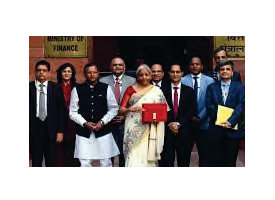
Finance Minister Nirmala Sitharaman presented her ninth consecutive Union Budget on 01 February. With the new Income Tax Act, 2025, coming into force from April 2026, clarity on transition provisions is keenly awaited, alongside possible incentives to nudge taxpayers towards the new regime.
Key Highlights:
• Expenditure: The government is estimated to spend Rs. 53,47,315 crore in 2026- 27, 7.7% higher than the revised estimate of 2025-26. Interest payments account for 26% of the total expenditure, and 40% of revenue receipts.
• Receipts: The receipts (other than borrowings) in 2026-27 are estimated to be Rs. 36,51,547 crore, about 7.2% higher than the revised estimate of 2025-26. Tax revenue which forms major part of the receipts is also expected to increase by 8% over the revised estimate for 2025-26.
• GDP: The government has estimated a nominal GDP growth rate of 10% in 2026-27 (i.e., real growth plus inflation).
• Deficits: Revenue deficit in 2026-27 is targeted at 1.5% of GDP. This is similar to the revised estimate of 1.5% in 2025- 26. Fiscal deficit in 2026-27 is targeted at 4.3% of GDP, lower than the revised estimate of 4.4% of GDP in 2025-26.
• Debt: The central government aims to reduce its outstanding liabilities to around 50% of GDP by March 2031. In 2026- 27, outstanding liabilities are estimated to be 55.6% of the GDP.
(3.) Canada, India pledge to grow oil, petroleum trade in energy reset 
Canada and India are moving to expand bilateral trade in oil, gas and critical minerals as both countries recalibrate economic ties following a period of diplomatic strain. Two-way goods trade reached C$13.3 billion in 2024, with energy now emerging as a key growth lever. Canada's commencement of LNG exports to Asia in mid-2025, combined with shorter shipping routes to India and expanded capacity on the Trans Mountain pipeline, enhances the commercial feasibility of crude and gas exports. For India, deeper engagement supports diversification of energy supplies and access to critical minerals essential for the clean energy transition, while for Canada, India represents a strategically significant market amid shifting global trade alignments and rising geopolitical sensitivities involving major powers.
ESG
(1.) Hong Kong Adds Climate Transition, Adaptation Categories to Sustainable Finance Taxonomy 
The Hong Kong Monetary Authority (HKMA), Hong Kong’s central banking institution, announced the release of the Hong Kong Taxonomy for Sustainable Finance Phase 2A, expanding its classification system for identifying environmentally sustainable economic activities to include transition activities, climate adaptation, and a significantly broader range of sectors and economic activities. Hong Kong has significantly broadened its Sustainable Finance Taxonomy by introducing Climate Transition and Climate Adaptation categories, marking a shift beyond a narrow Green-Only focus. Economic activities are now classified as Green, Transition or Exclusion, with transition activities required to follow time-bound decarbonisation pathways aligned with a 1.5°C trajectory and sectorspecific sunset dates. The introduction of a climate adaptation category initially through a whitelist of eligible measures adds clarity for issuers and investors seeking to finance resilience-building initiatives. The expanded framework strengthens Hong Kong’s position as a leading Asian hub for sustainable and transition finance while addressing concerns around credibility and greenwashing.
(2.) Singapore Scales High-Integrity Nature-Based Carbon Solutions 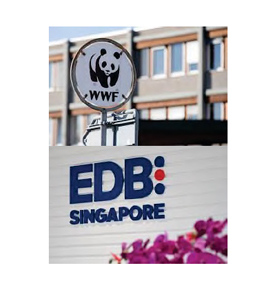
Singapore has launched new initiatives to accelerate the development of high-integrity Blue Carbon and Biomass projects across Asia, addressing long-standing measurement and verification challenges that have constrained market confidence. Led by World Wide Fund for Nature, Singapore and supported by the Economic Development Board, the programme integrates satellite imagery, geospatial analytics and digital MRV (Monitoring, Reporting and Verification) systems to improve transparency, scalability and investor trust. By linking scientific institutions, technology providers and conservation organisations with market-ready deployment, Singapore is positioning itself as a regional centre for credible nature-based climate solutions at a time when buyers are demanding stronger governance and methodological rigour.
TECHNOLOGY
(1.) Frances National Assembly approves banning children under-15 from social media 
France's National Assembly has approved legislation banning children under 15 from accessing social media platforms, citing rising concerns around mental health, online safety and youth violence. The bill, which now moves to the Senate, aligns France with similar regulatory approaches adopted in Australia and signals intensifying scrutiny of digital platforms. If enacted, it would impose stricter ageverification and compliance requirements, with potential ripple effects across global technology governance frameworks.
(2.) Microsoft reveals second generation of its AI chip in effort to bolster cloud business 
Microsoft has announced Maia 200, the second generation of its inhouse artificial intelligence chip, designed to deliver higher performance and energy efficiency while reducing reliance on external semiconductor suppliers. Deployed initially across US data centres, the chip will support internal AI teams as well as commercial Copilot and Foundry services. As demands for generative AI continues to surge, the move underscores Microsoft's strategy to control infrastructure economics, manage power consumption and strengthen its competitive position against rival cloud providers.
MERGERS & ACQUISITION
(1.) Netflix Strengthens Warner Bros Pursuit with All-Cash Offer 
Netflix has revised its bid for Warner Bros Discovery's streaming and film business to an all-cash offer valued at approximately USD 72 billion, seeking to provide greater certainty to shareholders amid competing interest from Paramount Skydance. The transaction would give Netflix ownership of a high-value content library including major franchises, while Warner Bros' remaining assets, such as CNN, are expected to be spun off. The proposed consolidation has sparked debate over market concentration and regulatory scrutiny, even as Netflix points to strong subscriber growth and profitability to justify the strategic rationale.
KEY HIGHLIGHTS OF DAVOS 2026
The World Economic Forum (WEF) 2026 Annual Meeting in Davos, Switzerland brought together nearly 3,000 global leaders, including heads of state, policymakers, CEOs, economists, and civil society representatives. Held under the theme “A Spirit of Dialogue,” the summit aimed to encourage cooperation in a time marked by geopolitical tensions, technological disruption, and economic uncertainty.
• Geopolitical Tensions Took Centre Stage
Global politics dominated discussions, with US foreign policy positions drawing particular attention and debates intensifying around tariffs, territorial issues and security alliances, reflecting growing unease over the resilience of the rules-based global order.
• Peace Through Diplomacy: The Board of Peace Initiative
The proposed “Board of Peace” gained prominence as an earlystage effort to institutionalise preventive diplomacy, highlighting rising global interest in negotiation and mediation as alternatives to military escalation.
• Trade Talks and Strategic Partnerships Accelerated
Leaders acknowledged structural shifts in global trade and stressed the need for resilient supply chains, with discussions pointing to deeper EU and India cooperation and a broader move toward strategic partnerships to reduce overdependence on single markets.
• Artificial Intelligence Shaped the Future Narrative
AI emerged as a central theme, with leaders balancing its potential to drive growth and productivity against concerns over job displacement, misinformation and ethics, reinforcing calls for regulatory frameworks that enable innovation while safeguarding society.
• Workforce Transformation Through Reskilling
Strong support emerged for the WEF's Reskilling Revolution, as leaders highlighted the urgent need to equip workers with digital, analytical and problem-solving skills in response to automation, AI and rapid technological change.
• High-Level Global Participation
Davos 2026 saw robust participation from heads of state, senior policymakers and business leaders, reinforcing its role as a premier platform for dialogue on investment, economic risk, development and global governance.
• Trade, Growth and Innovation Reinforced
Despite geopolitical strains, leaders maintained a focus on longterm growth, emphasising innovation, digital infrastructure and industrial transformation as critical to productivity and economic resilience.
• Diverging Views on Climate and Security
While climate change remained on the agenda, discussions | were overshadowed by immediate security and economic concerns, illustrating how global priorities shift during periods of heightened political and economic stress.
• Dialogue Over Division, But Challenges Remain
The summit reaffirmed global commitment to engagement and negotiation, even amid deep disagreements, while acknowledging that challenges such as conflict, inequality and technological disruption remain unresolved and require sustained dialogue.
 Back to Home
Author

Institute of Directors India
Bringing a Silent Revolution through the Boardroom
Institute of Directors (IOD) is an apex national association of Corporate Directors under the India's 'Societies Registration Act XXI of 1860'. Currently it is associated with over 31,000 senior executives from Govt, PSU and Private organizations of India and abroad.
Owned by: Institute of Directors, India
Disclaimer: The opinions expressed in the articles/ stories are the personal opinions of the author. IOD/ Editor is not responsible for the accuracy, completeness, suitability, or validity of any information in those articles. The information, facts or opinions expressed in the articles/ speeches do not reflect the views of IOD/ Editor and IOD/ Editor does not assume any responsibility or liability for the same.