 Quick Links
 Connect us

 Directors Databank (Empannel Yourself)
 Become a
  Become a
  Blog
Blog
 Become an Awards Assessor
 Publications
 Contact Us







Building a Culture of Excellence for Strategy Execution: The 4S Framework for Strategic Leaders


Introduction
In today's fast-paced business environment, successful strategy execution is more crucial than ever to sustain competitive advantage and drive organisational growth. Strategies thrive when supported by a strong, aligned corporate culture that reinforces strategic goals. Developing a culture of excellence where shared values, behaviours, and work practices are fully aligned with the company's strategy empowers organisations to translate vision into lasting results.
This article presents a practical framework designed to empower strategic leaders to actively shape and nurture a culture of excellence, unlocking their organisation's full potential and turning strategy into impactful, lasting results.
It is the company's foundational "operating system," quietly guiding daily choices and interactions.
Understanding Culture-Strategy Alignment
Corporate culture consists of the deeply ingrained values, beliefs, norms, and behaviours that shape how employees think, decide, and act. It is the company's foundational "operating system," quietly guiding daily choices and interactions.
When culture and strategy are aligned, culture acts as a powerful enabler for guiding decisions, fostering collaboration, and energizing employees to execute with excellence.
Misalignment occurs when cultural elements undermine strategic priorities, resulting in resistance, inconsistent behaviours, and poor performance. Hence, diagnosing and deliberately shaping culture to fit strategic requirements is a leadership imperative.
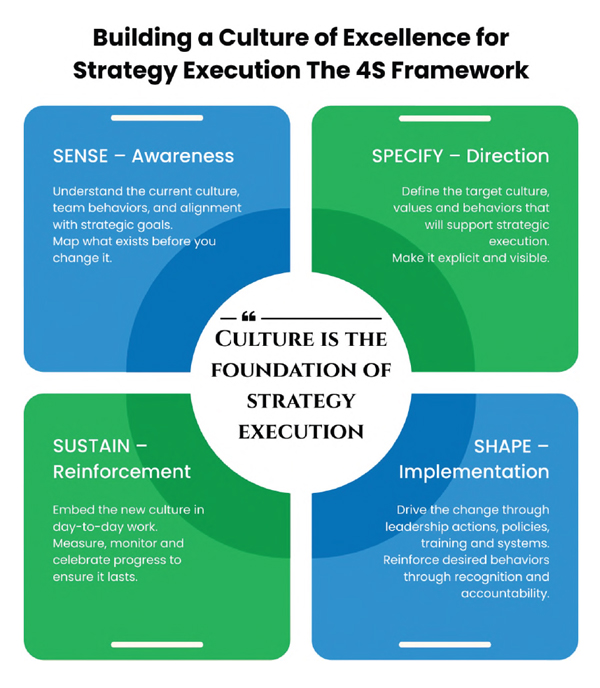
| Pillar | Core Formula | Purpose |
| Sense | Awareness + Diagnosis | Identify current culture and gaps |
| Specify | Values + Norms + Behaviours | Define target culture for strategic execution |
| Shape | Leadership + Communication + Systems | Embed and reinforce culture |
| Sustain | Measurement + Reinforcement + Adaptation | Ensure culture evolves and remains impactful |
“Leaders set the tone; Culture does the rest”
(1st S) Sense = Awareness + Diagnosis
Building an effective culture begins with sensing the current organizational environment. This entails developing deep awareness of existing values, behaviours, and norms and conducting a candid diagnosis of gaps between current culture and strategic requirements.
Leaders gather insights through surveys, interviews, and observation to identify cultural strengths to leverage and barriers needing change. Sensing culture also includes understanding informal networks of influence and peer dynamics that shape behaviours.
“Leaders cannot steer what they cannot see.”
By accurately sensing culture, leaders establish a solid foundation for targeted interventions.
(2nd S) Specify = Values + Norms + Behaviours
Once culture is sensed, leaders must specify the target cultural profile crucial for strategy success. This profile clearly defines:
• Values: Core beliefs guiding ethical and business decisions.
• Norms: Social expectations influencing how employees interact and collaborate.
• Behaviours: Observable actions and mindsets necessary to support strategic priorities.
“A clear compass of values and behaviours points the way.”
Specifying these components provides a clear vision of the culture required to execute strategy with excellence. It sets a purposeful direction for all subsequent culture-shaping efforts and aligns the organization around shared principles.
(3rd S) Shape = Leadership + Communication + Systems
The shaping phase involves translating cultural priorities into reality through:
• Leadership Role Modelling: Leaders visibly embody the desired values and behaviours consistently across interactions to set the tone at the top.
• Clear Communication: Consistent and compelling communication helps create shared understanding and buy-in, ensuring everyone knows what culture is expected and why it matters for strategy.
• Embedding in Systems: Organisational structures, policies, incentive programs, and processes must be aligned to reinforce and reward cultural priorities. This includes performance management, talent acquisition, and learning and development.
“Culture is shaped where leaders lead by example.”
By integrating leadership, communication, and organisational systems, culture is actively cultivated and reinforced at every level, rather than left to chance.
(4th S) Sustain = Measurement + Reinforcement + Adaptation
Cultural excellence is an evolving journey, requiring continuous sustaining through:
• Measurement: Keep a finger on the pulse of cultural health through surveys, audits, and performance indicators, turning insights into action.
• Reinforcement: Celebrating successes, recognizing cultural champions, and linking rewards to cultural adherence strengthen motivation and commitment.
• Adaptation: As strategy and business landscapes evolve, culture must evolve too. Leaders must be agile in updating cultural priorities and interventions to stay relevant and impactful.
“What gets measured and celebrated grows stronger.”
Sustained cultural excellence transforms culture into a living, breathing asset - one that drives strategy execution, inspires teams, and propels the organisation forward.
Leadership Imperatives
Strategic leaders are the architects of cultural excellence. To apply the 4S framework effectively, they must:
• Lead by example, demonstrating cultural consistency in behaviour and decisions.
• Communicate the connection between culture and strategy compellingly and frequently.
• Empower teams and hold them collectively accountable as cultural role models and change agents
• Build systems that embed culture into everyday workflows and reward structures.
• Maintain vigilance through feedback, measurement, and timely course correction.
Conclusion
Strategy execution is the linchpin of organisational success, and culture is its indispensable enabler. The 4S framework-Sense, Specify, Shape, and Sustain-offers a practical, formula-driven roadmap for leaders seeking to develop a culture of excellence aligned with strategic goals.
By embracing this framework, leaders unlock the latent power of culture, transforming it from a silent barrier into a dynamic accelerator of strategy execution. The result is an energised workforce, clear operating rhythms, and superior business outcomes-a culture that does not just support strategy but drives it forward with confidence and purpose.
 Back to Home
Author

Mr. Mohammed Riyazdheen A.
He is the Founder & Director of STANCE ENGINEERING PROJECTS PVT. LTD. and a Certified Independent Director. He is an Engineering graduate and has pursued Masters in Project Management with Executive Education in Strategic Management from IIM Kozhikode.
Owned by: Institute of Directors, India
Disclaimer: The opinions expressed in the articles/ stories are the personal opinions of the author. IOD/ Editor is not responsible for the accuracy, completeness, suitability, or validity of any information in those articles. The information, facts or opinions expressed in the articles/ speeches do not reflect the views of IOD/ Editor and IOD/ Editor does not assume any responsibility or liability for the same.