 Quick Links
 Connect us

 Directors Databank (Empannel Yourself)
 Become a
  Become a
  Blog
Blog
 Become an Awards Assessor
 Publications
 Contact Us






A New Global Trade Order: Reimagining Boardroom Excellence Models


India and the European Union on 27 January, signed the world's largest Free Trade Agreement (FTA), significantly lowering tariffs and opening markets on both sides, while carving out calibrated protections for three sensitive sectors: Automobiles, Steel and Agriculture. For India, the biggest gain is near-zero duty access to the EU for most of its exports over the next seven years. The EU will cut tariffs to zero in phases on almost all Indian goods, giving exporters long-term certainty in one of the world's largest consumer markets.
This deal will open new markets for India and EU countries – 27 in all – which will be rule-based and market-oriented. It is expected to shape a new global trade order, directly impacting nearly two billion people, or approximately one-quarter of the world's population. The EU–India FTA is scheduled to come into force in 2027. This is a tall order and calls for appropriate leadership for business promotion through new excellence models.
The significance of such landmark agreements extends far beyond trade and tariffs. They signal a reconfiguration of global economic relationships at a time marked by geopolitical shifts, supply-chain vulnerabilities, technological disruption and climate-related pressures. For Indian enterprises, this evolving environment demands leadership that combines strategic foresight with resilience, ethical clarity and governance maturity.
India today stands at a defining inflection point. Supported by demographic strength, expanding digital infrastructure and sustained policy reforms, the country is poised to assume a more influential role in the global economy. As India deepens its engagement with international markets, expectations from boards have evolved significantly. Boardrooms are now required not only to ensure compliance, but also to guide organisational purpose, anticipate emerging risks and steer long-term value creation in an increasingly complex world. Over the past decade, India's corporate governance landscape has evolved significantly, with regulatory reforms, stronger disclosure norms and digital compliance enhancing transparency and accountability. At the same time, boards are increasingly tasked with addressing cybersecurity, climate and market risks, while fostering integrity and responsible leadership.
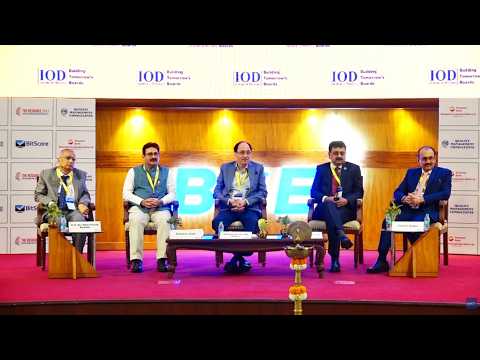
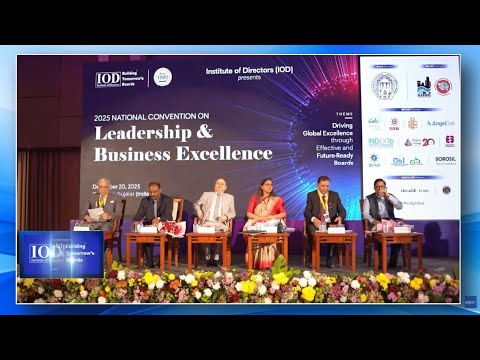
In this context, the role of structured leadership platforms has become increasingly important. The 2025 National Conclave on “Leadership and Business Excellence”, themed “Responsible Leadership and Board Governance: India's Journey towards Global Excellence”, was successfully organised on December 20, 2025 at GIFT City Club, Gujarat. The Conclave provided a valuable forum for dialogue on responsible leadership, ESG integration, digital governance, cyber resilience and innovationdriven competitiveness areas that are now central to boardroom deliberations.
Leadership of the future will be defined by the ability to integrate technological intelligence with human judgment, enabling organisations to navigate complexity, uphold trust and compete responsibly in a rapidly evolving global order. The Business Excellence Models is evolving and will be dominated by AI applications. It is left to human generosity to create an appropriate interactive man-machine environment.
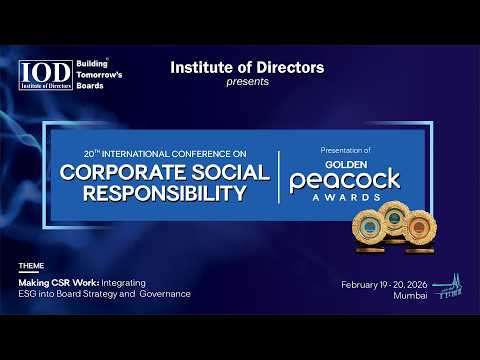
IOD is organising its 20th International CSR conference in Mumbai during February 19-20, 2026. It will be a good opportunity to explore how boards can strategically embed ESG priorities into corporate purpose, performance, and long-term value creation.
As India progresses towards its long-term economic aspirations, the convergence of global opportunities, national reforms and enlightened board leadership will determine success.
 Back to Home
Author

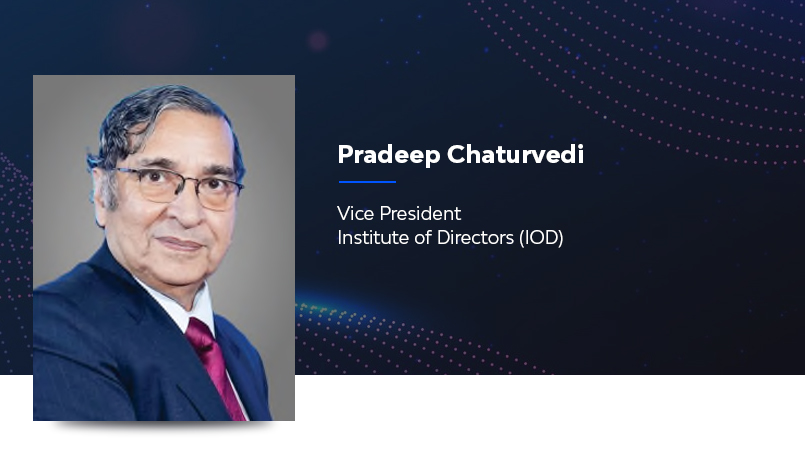
Pradeep Chaturvedi
Vice President - Institute of Directors
He is former Advisor FAO & former Chairman, Institution of Engineers, Delhi. He is a Mechanical Engineer & has been involved with Environment & Energy Policy (planning & implementation) of energy projects under the UN Agencies for over three decades in India & other Asian and Pacific countries. He is Vice-President, World Environment Foundation & Institute of Directors, India.
Owned by: Institute of Directors, India
Disclaimer: The opinions expressed in the articles/ stories are the personal opinions of the author. IOD/ Editor is not responsible for the accuracy, completeness, suitability, or validity of any information in those articles. The information, facts or opinions expressed in the articles/ speeches do not reflect the views of IOD/ Editor and IOD/ Editor does not assume any responsibility or liability for the same.