 Quick Links
 Connect us

 Directors Databank (Empannel Yourself)
 Become a
  Become a
  Blog
Blog
 Become an Awards Assessor
 Publications
 Contact Us






Disruptions, Demographics, and Diplomacy


Defining India's Industrial Trajectory
It is a pleasure to join you today and to speak on behalf of the Maharashtra Industrial Development Corporation. As I reflect on the world around us, I am reminded of a simple truth: uncertainty is the only real certainty we have. We live in interesting times, and these times demand clarity of thought, resilience, and cooperation
Throughout history, humanity has always faced disruptions. From time immemorial, the basic nature of human beings has been to explore, to innovate, and to seek new opportunities, even when the path ahead is unclear. Whether it was the journeys of Columbus or the ancient Silk Routes, the underlying motive was the same: to discover new markets and unlock new potential possibilities and profits.
Trade has shaped nations. It has cut across borders, created alliances, and influenced the rise and fall of economies. There have always been challenges in the form of tariffs, geopolitical tensions, crises, and wars. World War I and World War II themselves were extreme examples of global disruption. Yet, every disruption also became a turning point for innovation and renewal.
That is why I believe disruptions should not be seen pessimistically. They push us to evolve. They force us to rethink. They compel us to grow. This mindset has guided my work as a civil servant and now in leading our industrial development efforts.
Today, as we discuss major trade negotiations, including those between India and the United Kingdom, and India and the European Union, I am encouraged by the increasing sense of mutual understandings. Negotiators on all sides recognise that we are entering a new era of cooperation. Prime Minister Modi and global partners share a strong interest in concluding these agreements, understanding their significance for shared prosperity.
I believe disruptions should not be seen pessimistically. They push us to evolve. They force us to rethink. They compel us to grow.
Our relationship with the UK, for instance, dates back centuries and spans several centuries, long before 1612, long before the East India Company. Trade shaped our histories then, and it will continue to shape our futures now. But today, India stands in a very different place. We are no longer just a market to be discovered; we are an emerging global asset- young, dynamic, ambitious, and forward-looking.
While many nations face the pressures of ageing populations, India stands strong with a youthful demographic, rising per capita incomes, and new consumption-driven markets. This alone makes India one of the most significant growth frontiers of the coming decades.
In my current role overseeing industrial development, our mission at MIDC is to create the physical backbone of India's next growth phase, world-class industrial estates, robust infrastructure, and an enabling environment for international companies. We already host a strong presence of global firms, including several from the UK and the EU. And this is only the beginning.
As India move towards its vision of becoming a developed nation by 2047, we are looking at an economy that could reach $40 trillion, up from our current $4 trillion. This is not just an economic projection, it is a reflection of political will, demographic strength, and a collective national aspiration.
With mutual respect, shared interest, and strong economic diplomacy, I am confident that our partnerships with the UK, the EU, and nations across the world will deepen. Trade volumes will grow. Investments will expand. And the benefits will be mutual.
Yes, challenges will remain. But human optimism, combined with strategic action, has always carried us through. Disruptions will come, but they will also create new opportunities, new markets, and new possibilities for cooperation.
With that optimism, I thank you all for your attention. Let us continue working together towards a more prosperous, collaborative, and resilient future.
 Back to Home
Author
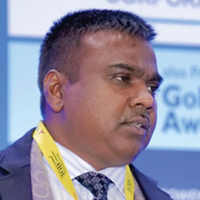
P. Velrasu, IAS
Chief Executive Officer, Maharashtra Industrial Development Corporation Ltd., India (MIDC)
Owned by: Institute of Directors, India
Disclaimer: The opinions expressed in the articles/ stories are the personal opinions of the author. IOD/ Editor is not responsible for the accuracy, completeness, suitability, or validity of any information in those articles. The information, facts or opinions expressed in the articles/ speeches do not reflect the views of IOD/ Editor and IOD/ Editor does not assume any responsibility or liability for the same.