 Quick Links
 Connect us

 Directors Databank (Empannel Yourself)
 Become a
  Become a
  Blog
Blog
 Become an Awards Assessor
 Publications
 Contact Us






IOD Interview - Guardians of Trust in an Age of Acceleration

CDSL's model of responsible innovation and investor-first stewardship
In a rapidly evolving market landscape, striking the right balance between fostering innovation and maintaining regulatory compliance is no small task for a critical market infrastructure institution like CDSL (Central Depository Services (India) Limited). As a leader, how do you prepare your organization to navigate this challenge effectively?
Our Culture makes this easy. For us, it is always INDIA FIRST!
We are committed to doing what's right for the long-term health of the country's securities market infrastructure, an essential platform for the wealth creation of a young, aspiring nation. This deep sense of responsibility is our purpose.
On one hand, we are deploying technology and innovation to achieve speed, transparency, and efficiency in our systems that will enhance adoption. India is still in the early stages of retail participation in capital markets with only about ~9% (around 13 million unique users) participating, while at the same time laying the foundations of meaningful investor education for responsible investment behaviour on a segregated account structure.
India's journey from paper-based settlements to dematerialisation in 1996, and now to T+1 and optional T+0 settlement cycles, reflects how regulatory foresight and technological advancement can converge to transform markets.
CDSL has consistently upheld SEBI's vision for a transparent and resilient market while also juxtaposing as a thought leader on the global stage. Initiatives like Direct Payout, System Driven Disclosures, and SMART (SMS Alerts Related to Transactions) have empowered investors within a segregated account framework-delivering real-time transparency and safeguarding them against potential insolvencies, all without compromising on operational sophistication. Our electronic Delivery Instruction Slip (eDIS) platform, a unique global-first feature, combines efficiency of a B2B model with the B2C authorisation via OTP, a true example of how innovation can coexist with investor protection.
As the trusted custodian of over 167 million demat accounts, we at CDSL remain deeply committed to safeguarding investor interests-an ethos that is embedded in the very DNA of our institution.
India's journey from paper-based settlements to dematerialisation in 1996, and now to T+1 and optional T+0 settlement cycles, reflects how regulatory foresight and technological advancement can converge to transform markets.
With increasing digitalisation of financial services, how do you ensure that technological advancements don't outpace the regulatory safeguards needed to protect investors and preserve market integrity?
Digitization, technological advancement, and regulatory safeguards run parallelly. In fact, the race is not between them. They are catching up to investor participation. The number of dematerialised accounts went from 40.9 million in 2020 to 210+ million today growing at a CAGR of 38-40%.
This rise in participation represents the belief of the Indian investor in the opportunity called India. India's Digital Public Infrastructure (DPI) stack has accelerated this surge in participation - comprising Aadhaar, UPI, DigiLocker, and Account Aggregators - which has laid the foundation for seamless onboarding, secure data sharing, and real-time financial access. These digital rails have institutionalized seamless onboarding, real-time access, and strengthened trust across the financial ecosystem.
It is therefore our responsibility as a Depository & a Market Infrastructure Institution (MII) to deliver to that belief. We, therefore, strive to innovate and see how we could make our systems fast and efficient while maintaining the highest standards of governance and transparency.
The will from the Government and SEBI also plays a very important role in pushing the seams of innovation. Being one of the first nations to adopt T+1 settlement is a testament to the forward-looking approach India is willing to take. All of this is underpinned by the fact that investor protection is embedded in the very architecture of India's securities market. An example is SEBI's early decision to adopt a segregated account structure, unlike the omnibus model used globally, ensures every investor has a uniquely mapped demat account - offering transparency, traceability, and accountability.
Based on SEBI's prescription, safeguards have been built into our systems to ensure a balance between scalability and compliance. Some examples of this includes:
At CDSL, safeguards are built into our platforms-not bolted on later. Key reforms include:
• Mandatory PAN for demat accounts, enabling robust surveillance through unique identifiers.
• e-DIS, a secure digital interface that replaces traditional trade execution, giving investors full control over their transactions
• Electronic Consolidated Account Statement (eCAS) ensures investors across geographies and literacy levels can monitor their holdings with ease. To further SEBI's initiative of inclusion, CDSL launched the eCAS in 23 languages, easing financial access and removing language barriers for investors across the country.
• Unified Investor App, MyEasi, offers a consolidated view of all holdings of the investor, across multiple investor demat accounts
• Margin Pledge system, where securities remain in the investor's account with pledge flags-enhancing liquidity while preserving ownership and regulatory clarity
• Direct Payout, a major shift in settlement practice, ensures securities are credited directly to investor accounts by clearing corporations-bypassing intermediary pool accounts. This reduces settlement risk and strengthens investor confidence.
• Beyond those mentioned above, CDSL also launched the CDSL Buddy Sahayta 24×7, a multilingual chatbot offering real-time assistance in four languages, making support more inclusive and accessible.
In your view, what role should market infrastructure institutions play in shaping the regulatory agenda while continuing to innovate responsibly?
India's financial architecture owes much to the foresight of its early reformers. The establishment of SEBI in the 1990s laid the foundation for a regulatory ecosystem that prioritizes investor protection, market integrity, and capital formation. As the first-line regulators, MIIs like CDSL partner with SEBI to execute this vision.
The role of MIIs is to uphold the fine balance between cooperation and competition. While healthy competition drives innovation, it is the spirit of collaboration that truly defines our ecosystem, a landmark example of which is the standardisation of file formats achieved across MIIs. This initiative, through the Unified Distilled File Formats (UDiFF) framework, harmonizes data structures across depositories, exchanges, and clearing corporationsenhancing interoperability, reducing operational complexity, and improving ease of doing business. Together, we work to ensure that the Indian securities market remains a beacon of trust, transparency, and global leadership.
At CDSL, we see ourselves as both stewards and catalysts - translating regulatory intent into scalable, secure, and inclusive solutions. Whether it's pioneering eVoting, digitizing AGMs, or streamlining corporate actions, we shape policy through practice, demonstrating what responsible innovation looks like in action.
Our adoption of RegTech and SupTech tools has strengthened compliance and risk management, while our investor education efforts ensure that growth is not just expansive, but equitable.
We believe regulation is not a boundary, but a foundation. Our goal is not merely to comply, but to co-create a market that is resilient, inclusive, and truly self-reliant (Atmanirbhar).
Today's investors are younger, digitally fluent, and increasingly self-reliant. With 80% of demat accounts from Tier 2 and beyond, and a 39% rise in women investors since 2019, 66% of whom are between 26 to 50 years old, the profile of the Indian investor is evolving rapidly.

With financial ecosystems becoming more interconnected, how do you collaborate with other institutions and regulators to ensure systemic resilience?
Like I said, synergies are driven by collaboration, rather than being within a silo; and within the capital markets, it is our shared responsibility, towards the investors, to build for them. Systemic resilience today goes beyond infrastructure - it's about trust, seamless investor experiences, and shared responsibility. At CDSL, collaboration is core to how we operate as a Market Infrastructure Institution.
A landmark example is the full interoperability achieved across MIIs. This structural reform enables investors to transact effortlessly across exchanges, clearing corporations, and depositories - enhancing efficiency, reducing risk, and simplifying their journey by eliminating redundancies and enabling smoother transitions between market entities.
We also upgraded the investor app, MyEasi, under SEBI's guidance. For the first time, investors can now access a consolidated view of their holdings, transactions, and open positions across multiple demat accounts through a single-login interface.
Beyond industry collaboration, we also partner with academia. Our MoU with IIM Mumbai is focused on data datadriven insights and research-led innovation. Together, these efforts reflect our belief that resilience is not just about withstanding shocks - it's about building a system that is inclusive, intelligent, and inherently trustworthy.
How is CDSL preparing its investors to remain resilient amid increasing corporate and cyber risks, growing data volumes, and ever-changing market dynamics?
At CDSL, investor education is at the heart of our resilience strategy. We believe that an informed investor becomes truly Atmanirbhar when knowledge is translated into action, supported by sound decision-making and trust in the system.
To this end, we have launched and scaled several impactful campaigns:
• Our campaigns, such as SEBI vs SCAM and Slam the SCAM, have achieved remarkable reach and engagement. The #SEBIvsSCAM campaign alone reached 105 million people, and generated more than 112 million views and 2 million engagements across digital platforms. Through engaging formats like explainer videos and collaborations with influencers like RJ Mallishka and RJ Naved, we've made complex topics accessible and actionable
• World Investor Week: During World Investor Week, our outreach recorded over 160 million impressions and reached more than 100 mn individuals, underscoring the scale and impact of our commitment to investor awareness and financial literacy. This global event amplifies our efforts to spread financial literacy and best practices among diverse investor groups.
Beyond these campaigns, we run year-long specialized programs to foster inclusion and protection:
• AtmanirbHER: Focused on women investors, this program encourages financial independence and participation, reflecting the changing demographics of India's investor base
• Empowering Our Protectors: Dedicated investor awareness programs for veterans, recognizing and supporting their unique needs as they engage with financial markets. This program has now been extended to all the protectors of the community, starting with doctors and police officals.
All our educational efforts are designed not just to inform, but to instill confidence-helping investors trust their present decisions so they can trust their financial future. By equipping investors with the knowledge to assess their own suitability and risk, CDSL is building a resilient investor community ready to navigate the complexities of modern markets.
What does institutional resilience mean in the context of a depository and how is that being operationalised at CDSL beyond just business continuity planning?
We approach institutional resilience through a three pronged lens: risk management, leadership, and culture. Each of these is deeply interwoven into our daily operations and long-term vision.
Risk management goes beyond identifying threats - we proactively anticipate them through regular audits and a strong governance framework, such that resilience is embedded in the decision-making. We foster an open culture where ideation is encouraged and accountability is not just expected, it's respected.
Leadership means showing up with intention, as seen in initiatives like the Reimagine Symposium, where we engage the industry in an open dialogue to shape responsible innovation. Our leaders don't just guide - they listen, they challenge, and they carry the weight of stewardship with quiet conviction.
And culture, though intangible, is our foundation. At CDSL, integrity is a lived value-reflected in our decisions, discussions, and direction. SEBI's oversight keeps us grounded, while our internal compass keeps us consistent. Because consistency, more than motivation, is what builds resilience over time.
As technologies like AI and predictive analytics become more integrated into financial services, how is CDSL leveraging these tools to empower the next generation of investors?
At CDSL, we believe that responsible adoption of AI and advanced technologies must be shaped through active industry dialogue and practical innovation. Earlier this year, we hosted the second edition of our flagship “Reimagine” symposium, focusing on the transformative potential of AI and CapTech in capital markets. These forums bring together regulators, industry leaders, and technology experts to discuss not just the opportunities, but also the responsibilities that come with integrating AI into financial infrastructure.
On the operational front, we are embedding AI and predictive analytics across our platforms to enhance investor experience and market integrity. Our multilingual chatbot, CDSL Buddy Sahayta, provides contextual, realtime support to investors in multiple languages, making assistance more accessible and inclusive. Additionally, we are exploring predictive tools to proactively identify risks and strengthen compliance, ensuring that investors are protected in an increasingly complex environment.
Through these combined efforts-industry leadership, technological innovation, and a commitment to responsible growth-CDSL is encouraging the next generation of investors to participate confidently and securely in India's capital markets.
In what ways is the Board actively engaging with issues related to AI governance, data ethics, and inclusive market access?
At CDSL, the Board's engagement with AI governance, data ethics, and inclusive market access is anchored in a forward-looking, adaptive approach. Technologies like AI and quantum computing are now central to boardroom discussions, and while not all Board members are technical specialists, a culture of curiosity and openness ensures thoughtful, responsible guidance through these shifts.
This commitment is reflected in three ways:
• Oversight with Empathy and Trust: The Board acts as a catalyst-accelerating innovation while maintaining strong, ethical oversight and empowering management.
• Inclusive Mindset and Constructive Dialogue: The Board's strength lies in its diversity, not only in terms of gender, but also in the wide range of professional expertise and backgrounds represented. This diversity ensures that decisions are tested through multiple lens, fostering an inclusive approach to governance and market access. Such a composition encourages open, constructive dialogue on emerging risks and opportunities, including those related to AI, data ethics, and responsible innovation. By valuing diverse perspectives and encouraging candid dialogue, the Board is better equipped to anticipate challenges, uphold ethics, and guide CDSL's inclusive and sustainable growth, all anchored in integrity and inclusivity.
• Continuous Learning: Ongoing training and learning for Board members is prioritized, covering governance, market shifts, legal responsibilities, and the evolving landscape of data and technology. This ensures the Board remains equipped to ask the right questions and provide effective stewardship in areas like AI governance and data privacy.
Ultimately, the Board's role is not just to manage external challenges, but to continually evolve internally; to lead with purpose, clarity, and courage to ensure that CDSL remains relevant, resilient, and trusted in an era defined by rapid technological and societal change.
What does the investor of tomorrow look like to you, and how is CDSL shaping its digital access platforms and education efforts to cater to this evolving profile?
The investor of tomorrow marks a generational shift-from joint family decisions to independent, data-driven investing. Today's investors are younger, digitally fluent, and increasingly self-reliant. With 80% of demat accounts from Tier 2 and beyond, and a 39% rise in women investors since 2019, 66% of whom are between 26 to 50 years old, the profile of the Indian investor is evolving rapidly. As of September 30, the youngest demat account holder in CDSL is a girl just 57 days old, a powerful symbol of how financial inclusion in India now begins at birth.
This shift is not just about access, it's about agency. Today's investor is a do-it-yourself (DIY) participant, seeking autonomy, transparency, and tools that enable informed decision-making. One of the most meaningful measures of success should not just be the number of demat accounts opened, but how many investors are truly brought into the fold of financial empowermentindividuals who can confidently lead their own financial journeys with knowledge, trust, and independence.
As we champion the Hon'ble Prime Minister's vision of an All-Inclusive Bharat, we believe that another form of 'AI'- the Atmanirbhar Investor must be at the heart of this transformation. This investor may not fit a single stereotype, but must be an endowed one: educated, ethical, and truly self-reliant. It is this investor who will lead the way in building an Akhand and Viksit Bharat, with confidence, clarity, and conviction.
Central Depository Services (India) Limited (“CDSL”) was found in 1999 to fulfil one goal: Convenient, Dependable and Secured Depository Services. Over two decades later, everything we have done – the values we have built on, dematerialisation of various asset classes, e-services – have all been in support of that singular goal, at an affordable cost. CDSL is a Market Infrastructure Institution (MII) and a crucial part of the Capital market structure, providing services to all Market participants - Exchanges, Clearing Corporations, Depository Participants (DPs), Issuers and Investors.
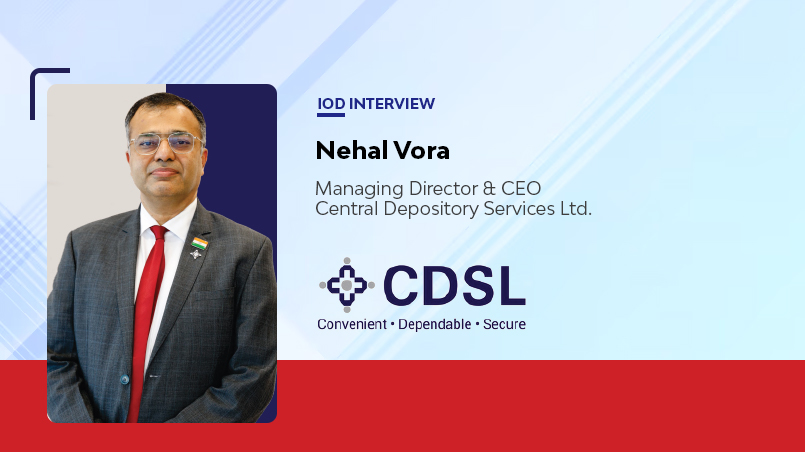
Mr. Nehal Vora, is the Managing Director and CEO of Central Depository Services (India) Limited (CDSL). With close to three decades of experience in significant roles at BSE, DSP Merrill Lynch, and SEBI, Nehal has driven transformative growth at CDSL since September 2019. Nehal's achievements have earned him numerous accolades, including the recent 'Global Custodian Legend Award, Asia', in May 2024, 'CEO of the Year Asia' by Asia Asset Management. Additionally, under his leadership, CDSL has received several prestigious awards such as the 'Central Securities Depository of the Year' at the Asset Servicing Times – Industry Excellence Award 2023, 'Best Market Infrastructure Institution of the Year, 2024', and the 'Highly Recommended Market Infrastructure Institution of the Year' in 2023 at the Regulation Asia Awards.
 Back to Home
Author
Institute of Directors India
Bringing a Silent Revolution through the Boardroom
Institute of Directors (IOD) is an apex national association of Corporate Directors under the India's 'Societies Registration Act XXI of 1860'. Currently it is associated with over 31,000 senior executives from Govt, PSU and Private organizations of India and abroad.
Owned by: Institute of Directors, India
Disclaimer: The opinions expressed in the articles/ stories are the personal opinions of the author. IOD/ Editor is not responsible for the accuracy, completeness, suitability, or validity of any information in those articles. The information, facts or opinions expressed in the articles/ speeches do not reflect the views of IOD/ Editor and IOD/ Editor does not assume any responsibility or liability for the same.