 Quick Links
 Connect us

 Directors Databank (Empannel Yourself)
 Become a
  Become a
  Blog
Blog
 Become an Awards Assessor
 Publications
 Contact Us







IOD Special Talk - From Compliance to Conscience: Embedding CSR into Institutional DNA

Government initiatives and corporate CSR efforts often operate in parallel, driven by similar objectives but rarely integrated in execution. This fragmentation limits the scale and sustainability of outcomes. If these efforts were aligned more closely, the results could be far more transformative.
Speaking from the vantage point of the public sector, I find it useful to revisit the philosophical foundations of corporate social responsibility before engaging with its contemporary evolution. The idea of CSR, as has been rightly alluded to, is deeply rooted in the principle of trusteeship, a concept most eloquently articulated by Mahatma Gandhi. It is a principle that views institutions not merely as economic entities, but as custodians of societal resources.
In many ways, this philosophy has long been intrinsic to the functioning of government. Historically, every action of the state, whether in infrastructure, welfare, or service delivery, has been an expression of social responsibility. Unlike the private sector, which was traditionally expected to focus on efficiency and profitability, the government's mandate has always been aligned with the broader public good.
Prior to the statutory mandate introduced under the Companies Act, CSR in the private sector was largely voluntary, shaped by the values and vision of individual enterprises. The introduction of a legal requirement, mandating eligible companies to allocate a percentage of their profits towards CSR, undoubtedly brought structure and scale to these efforts. At the same time, it also altered the character of CSR, in some cases reducing it to a matter of compliance.
Even today, when I reflect on my current role with Mumbai Metro Rail Corporation, I am reminded that the very nature of our work is inherently aligned with social responsibility. The creation of efficient public transport systems is not merely an infrastructure initiative; it is an environmental and societal intervention. By reducing congestion and emissions, such projects directly contribute to lowering the carbon footprint and improving quality of life. In that sense, the line between core activity and social responsibility becomes indistinguishable.
It is precisely this distinction that must be more deeply understood within the corporate sector. CSR cannot remain confined to a compliance driven framework. While regulatory structures and reporting mechanisms have their place, there is a real risk that excessive emphasis on metrics, scores, and disclosures may render the exercise mechanical. When responsibility is reduced to reporting, its spirit is inevitably diluted.
The question before us, therefore, is: How to transform CSR into a strategic asset?
The potential is undeniable. The statutory framework has already unlocked significant financial resources. Many organisations have demonstrated that, when approached with intent and clarity, CSR can create meaningful and lasting impact.
However, one of the most critical opportunities lies in convergence. Government initiatives and corporate CSR efforts often operate in parallel, driven by similar objectives but rarely integrated in execution. This fragmentation limits the scale and sustainability of outcomes. If these efforts were aligned more closely, the results could be far more transformative.
An instructive example in this regard is the Village Social Transformation initiative undertaken by the Government of Maharashtra between 2015 and 2021. Structured through a dedicated institutional mechanism, it sought to bring together government agencies and corporate partners in a coordinated framework. Villages were identified based on vulnerability and need, development plans were prepared at the grassroots level, and existing government schemes were leveraged to their fullest extent.
Corporate participation brought not only financial resources but also managerial discipline, efficiency, and a result-oriented approach. Dedicated field functionaries ensured continuity and accountability. The effort was not to replace government intervention, but to complement and strengthen it. Such models demonstrate the value of structured collaboration, where each stakeholder contributes its strengths towards a shared objective.
At the same time, these initiatives also reveal the challenges of sustainability. Corporate priorities evolve, regulatory frameworks shift, and there is often a natural inclination towards initiatives that yield visible and immediate outcomes. Long term engagement, which is essential for deep impact, requires a different mindset.
This brings me to a central proposition. CSR must move beyond being an external obligation and become an intrinsic part of institutional character. It must be embedded in the DNA of organisations. Every decision, every investment, and every strategy must be viewed through the lens of societal and environmental impact.
Equally, the government too must continue to evolve. While its intent is anchored in public welfare, there is a need to strengthen implementation systems, ensure accountability, and adopt the efficiencies that the private sector has institutionalised. True impact will emerge not from isolated excellence, but from the convergence of intent and execution across sectors.
Ultimately, both the public and private sectors are working towards the same goal, the larger good of society. The path forward lies not in operating within silos, but in building partnerships that are purposeful, aligned, and sustained. When CSR is approached not as a mandate, but as a mindset, it has the potential to move from compliance to conscience, and from obligation to opportunity.
 Back to Home
Author

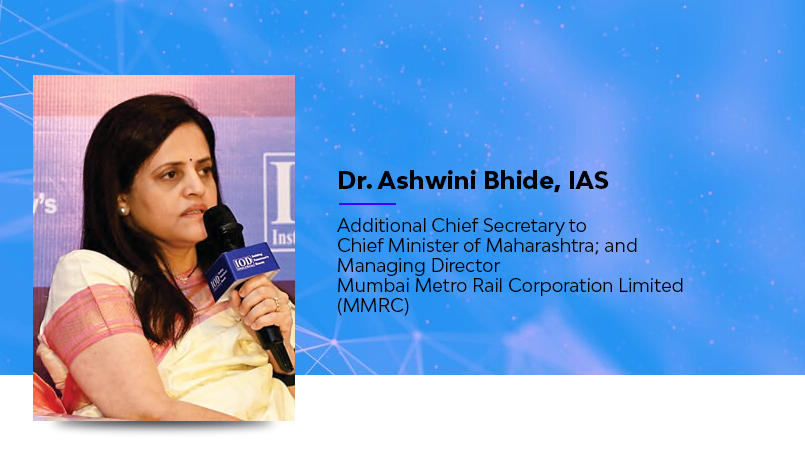
Dr. Ashwini Bhide, IAS
Additional Chief Secretary to Chief Minister of Maharashtra; and Managing Director Mumbai Metro Rail Corporation Limited (MMRC)
Owned by: Institute of Directors, India
Disclaimer: The opinions expressed in the articles/ stories are the personal opinions of the author. IOD/ Editor is not responsible for the accuracy, completeness, suitability, or validity of any information in those articles. The information, facts or opinions expressed in the articles/ speeches do not reflect the views of IOD/ Editor and IOD/ Editor does not assume any responsibility or liability for the same.