 Quick Links
 Connect us

 Directors Databank (Empannel Yourself)
 Become a
  Become a
  Blog
Blog
 Become an Awards Assessor
 Publications
 Contact Us







IOD Special Talk - Can We Continue Business as Usual?

A reflection on the urgent need to reimagine corporate responsibility
In gatherings such as these, one often senses the quiet fatigue that follows a series of intense deliberations. Yet, I have always believed that moments of fatigue are also moments of honesty. They compel us to ask whether what we are saying is truly engaging, or merely familiar.
I must begin with a candid admission. I do not come from the corporate world. My professional journey, spanning over three decades in the civil services, has been rooted largely in rural India, in questions of development, livelihoods, and equity. Naturally, my perspective is shaped by these experiences, and what I offer is less of a corporate lens and more of a ground level view of how systems actually function, and often, how they fail.
A recent, seemingly mundane experience stayed with me. We were in the process of utilising budget allocations before the close of the financial year, and a significant portion was being spent on procuring computers. The discussion revolved around configurations, whether to choose i5, i7, or even newer models. When I suggested a lower configuration, I was told it would not support the latest software. It struck me as deeply paradoxical. Hardware that remains perfectly functional is rendered obsolete not by its own limitations, but by the design of software ecosystems that compel continuous upgrades.
This is not an isolated phenomenon. It is reflective of a larger pattern of consumption driven not by necessity, but by design. Devices are replaced within years, sometimes even sooner, not because they cease to function, but because systems are built to outpace them. And one must ask, with some seriousness, whether such models of growth can genuinely coexist with our stated commitments to sustainability.
My reflections, however, are not limited to critique. They are also informed by examples of remarkable innovation and resilience, often emerging from spaces that remain underacknowledged. My engagement with institutions such as the Institute of Rural Management at Anand, Gujarat exposed me to a new generation of social enterprises working directly with farmers. These models are not merely about profitability; they are about partnership. Farmers are not treated as the weakest link in the value chain, but as stakeholders with a rightful share in the value they help create.
This is particularly significant because, in traditional market structures, those who bear the greatest risks often receive the least returns. Farmers operate under conditions of deep uncertainty, weather, credit, labour, and market fluctuations, yet their incomes rarely reflect this risk. The imbalance is structural, and it calls for a rethinking of how value is distributed.
Equally transformative has been the evolution of self-help groups across India. Today, millions of women, organised into such collectives, are not only improving their own economic conditions but are reshaping local governance and service delivery. Their contribution goes far beyond micro-finance. They have created systems of trust, accountability, and responsiveness that often surpass formal institutions.
Devices are replaced within years, sometimes even sooner, not because they cease to function, but because systems are built to outpace them. And one must ask, with some seriousness, whether such models of growth can genuinely coexist with our stated commitments to sustainability.
In states such as Maharashtra, initiatives like the Mann Deshi Mahila Bank demonstrate how community led financial institutions can function with remarkable efficiency and empathy. Similarly, models such as Stree Nidhi Credit Cooperative Federation have redefined access to credit, offering timely support while maintaining high levels of repayment discipline.
What stands out in these examples is not just innovation, but intent. These systems are designed around people, not processes. They recognise that financial inclusion is not merely about access, but about dignity and trust.
At the grassroots, one also encounters a quiet but powerful ecosystem of community knowledge workers. The Krishi Sakhi, the Pashu Sakhi, the Poshan Sakhi, each represents a decentralised, community driven approach to knowledge dissemination. These women, often with limited formal education, provide highly contextual, practical guidance that directly improves livelihoods. In many cases, they succeed where formal systems struggle.
This brings me to a deeper concern around how we define knowledge itself. I recall a striking example from the United States, where the proliferation of Burmese pythons in the Florida Everglades posed a serious ecological challenge. Despite the involvement of leading experts, it was members of the Irula tribe from Tamil Nadu, individuals with generations of lived expertise in handling snakes, who were able to offer effective solutions. Their knowledge, refined over centuries, proved invaluable.
Yet, such knowledge systems remain marginal in our formal frameworks. We celebrate them episodically, often through awards, but rarely integrate them into mainstream education or policy. There is an urgent need to bridge this divide, to recognise that expertise does not reside only within formal institutions.
My own journey has been one of continuous unlearning. Entering the field with the confidence of formal education, I gradually came to recognise the depth of knowledge that exists beyond it. The more I engaged with communities, the more I realised how much there was to learn, and how limited our conventional frameworks often are.
Encouragingly, there are individuals and enterprises seeking to challenge these norms. Initiatives such as MasterG and Daughters are not only creating livelihoods but also redefining gender roles within traditional industries. Similarly, the emergence of women masons under programmes like Pradhan Mantri Awas Yojana signals a gradual but important shift in how opportunities are distributed.
These are not isolated success stories. They are indicators of what becomes possible when systems are designed with inclusion and intent.
The broader message, however, remains clear. We cannot continue to operate within existing paradigms and expect fundamentally different outcomes. Whether it is in business, governance, or development, incremental adjustments will not suffice. What is required is a willingness to question, to rethink, and, where necessary, to redesign.
We cannot continue to operate within existing paradigms and expect fundamentally different outcomes. Whether it is in business, governance, or development, incremental adjustments will not suffice. What is required is a willingness to question, to rethink, and, where necessary, to redesign.
CSR, ESG, and governance frameworks must evolve beyond compliance. They must engage with the realities on the ground, with questions of equity, sustainability, and long-term impact. This is not merely a moral imperative; it is a strategic one.
If there is one reflection, I would leave you with, it is this. The future will not be shaped by those who perfect existing systems, but by those who have the courage to reimagine them.
 Back to Home
Author

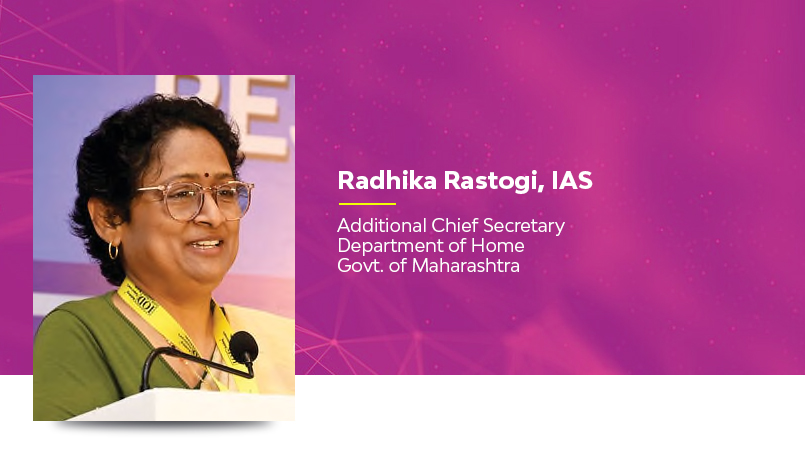
Radhika Rastogi, IAS
Additional Chief SecretaryDepartment of HomeGovt. of Maharashtra
Owned by: Institute of Directors, India
Disclaimer: The opinions expressed in the articles/ stories are the personal opinions of the author. IOD/ Editor is not responsible for the accuracy, completeness, suitability, or validity of any information in those articles. The information, facts or opinions expressed in the articles/ speeches do not reflect the views of IOD/ Editor and IOD/ Editor does not assume any responsibility or liability for the same.