 Quick Links
 Connect us

 Directors Databank (Empannel Yourself)
 Become a
  Become a
  Blog
Blog
 Become an Awards Assessor
 Publications
 Contact Us







IOD Special Talk - When Governance Holds the World Together

Boards, Alliances and the Quiet Systems that make Global Collaborations Work
It is a privilege to address such a distinguished gathering of leaders from across the country and the wider region. I am deeply honoured to contribute to a conversation shaped by experience, insight and thoughtful leadership. To be hosted by an institution of such considerable standing, and to convene in India's international gateway city, lends this occasion particular significance. Here, the aspirations of global connectivity have transcended the conceptual realm-they are tangible, operational and firmly embedded in everyday institutional practice.
The theme of this dialogue could not be more timely. The question of how international engagement can help scale governance excellence stands at the very centre of the challenges organisations face today.
Access to global markets, capital, talent and technology can undoubtedly accelerate growth. Yet it also demands governance systems capable of matching that operational ambition. Opportunity without institutional readiness invariably carries risk. What truly enables sustained success is not access alone, but rather the strength and resilience of the governance infrastructure that underpins it.
Access to global markets, capital, talent and technology can accelerate growth, but it also demands governance systems capable of matching that operational ambition.
I am reminded of an enduring observation: alone, we can accomplish very little; together, we can achieve far more. This principle holds true across authorities, regulators and institutions alike. Scale today does not derive merely from organisational size or staffing levels, but from strategic alliances. The real challenge, however, lies not in forming partnerships, but in ensuring they function effectively over time. Governance becomes the invisible architecture that holds these alliances together-providing clarity of rules, soundness of decision-making, accountability and, ultimately, trust.
We are no longer operating within a stable or familiar global environment. What we are witnessing is a world that is increasingly uncertain, non-linear and fragmented-a condition that has been building for more than two decades.
No organisation operates in isolation. Whilst partnerships open doors to opportunity, they also bring exposure to new and evolving forms of risk: cyber threats, data vulnerabilities, reputational hazards and regulatory complexity. The response cannot simply be caution. It must be confidence-grounded in robust governance and an acceptance that this volatility is now intrinsic to the global operating environment.
Scale today does not come merely from size or staffing, but from alliances. The real challenge, however, is not forming partnerships, but ensuring they function well.
In this context, sovereignty has assumed renewed importance. Yet sovereignty should not be conflated with isolation. Capital, data, information and risk now move across borders far more rapidly than education systems and institutions have been able to adapt. Legal and regulatory frameworks are working diligently to keep pace, but it is evident that leadership must extend beyond what is formally prescribed. Boards and regulators have a critical role to play in minimising friction, managing exposure and avoiding unintended consequences.
This reality places renewed emphasis on the quality of governance systems at the highest level. At the heart of this lies the board, supported by strong technical capability and independent judgement. One principle that has guided much of our thinking is the conception of the rule of law as economic infrastructure. Predictable and enforceable legal systems underpin growth, investment and trust. In a rapidly changing environment, the rule of law must offer both certainty and adaptability-enabling innovation whilst maintaining confidence.
Sovereignty has taken on renewed importance. Yet sovereignty should not be confused with isolation.
Governance itself has become a competitive capability. Capital and talent gravitate towards markets that are transparent, efficient and forward-looking. Strong governance reduces long-term costs, builds institutional resilience and differentiates robust systems from fragile ones. Leadership today must therefore evolve beyond retrospective oversight to active system design. This includes shaping decision pathways, clarifying accountability, structuring meaningful board dialogue and guiding the responsible deployment of technology within institutions and markets.
At the board level, this requires a deep understanding of regulatory intent, ethical responsibility and the intelligent exercise of discretion. Boards must be nationally grounded yet globally informed, particularly when engaging in international alliances. Regulations, too, must evolve in tandem. Many risks arise not from innovation itself, but from misalignment between regulatory frameworks and operational reality. Better regulation does not mean less regulation-it means smarter, clearer and more adaptive frameworks that anticipate complexity.
We have already witnessed the value of innovative regulatory approaches: sandboxes, pilot regimes, phased implementation and outcome-based supervision. These tools preserve regulatory integrity whilst enabling learning and reducing systemic blind spots. They allow systems to evolve without sacrificing control or accountability.
Ultimately, boards and regulators must collaborate closely in building credibility and trust within our ecosystems. When governance is strong, leaders can confidently engage with the world-and the world can engage with India with equal confidence. That is the shared responsibility before us, and the opportunity we must collectively seize.
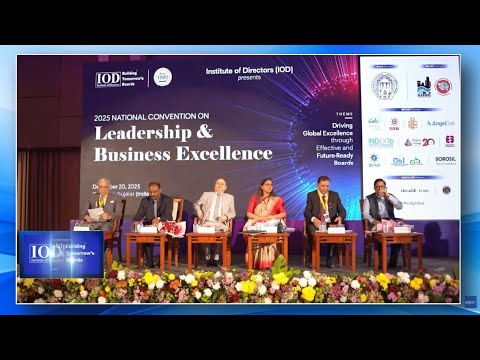
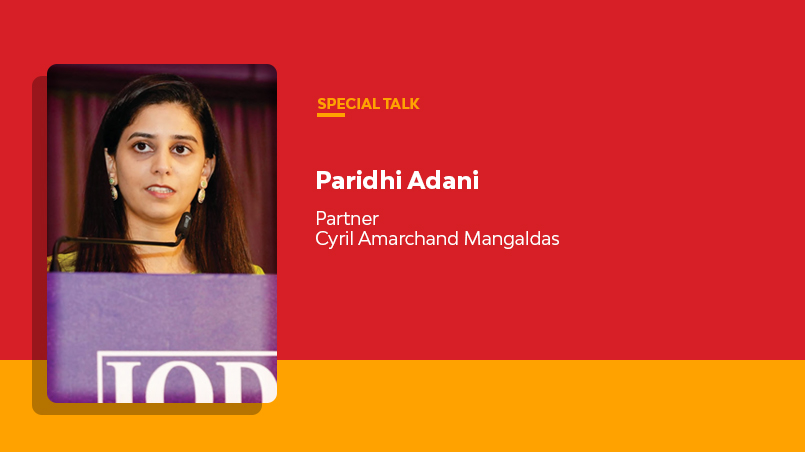
Excerpts from the 'Keynote Address' delivered by Ms. Paridhi Adani, Partner, Cyril Amarchand Mangaldas on 20th December, 2025 at the National Convention on Leadership and Business Excellence, held at Radisson GIFT City Club, Gandhinagar, Gujarat (India).
 Back to Home
Author
Ms. Paridhi Adani
Partner, Cyril Amarchand Mangaldas
Owned by: Institute of Directors, India
Disclaimer: The opinions expressed in the articles/ stories are the personal opinions of the author. IOD/ Editor is not responsible for the accuracy, completeness, suitability, or validity of any information in those articles. The information, facts or opinions expressed in the articles/ speeches do not reflect the views of IOD/ Editor and IOD/ Editor does not assume any responsibility or liability for the same.