 Quick Links
 Connect us

 Directors Databank (Empannel Yourself)
 Become a
  Become a
  Blog
Blog
 Become an Awards Assessor
 Publications
 Contact Us







The Europe-India Trade Corridor

Reshaping Global Supply Chains, Investment Flows,
and the Future of Bilateral Commerce
The last two years have seen a remarkable rise in the warmth of Europe's economic relations with India. There is now a potentially, extraordinarily, enhanced business opportunity for firms in the two powers after a hat trick of recent, important trade deals.
For India, these agreements represent more than just market access, they signal the country's growing emergence as a central pillar of the global economic order.
The EU is the second largest trading partner for India - right after China and ahead of the US - accounting for 11.5% of India's trade in goods. As India accelerates its economic transformation through initiatives such as Make in India, Digital India, and its push toward resilient global supply chains, deeper engagement with Europe could significantly enhance trade, technology transfer, and investment flows.
India's vast English-speaking population positions the country as a natural hub for European businesses seeking to expand operations. This linguistic advantage significantly reduces barriers to communication, legal frameworks, and professional services, making India an accessible gateway to the broader Asian market for European enterprises.
For corporate boards and global investors, these agreements are not merely technical trade arrangements. They represent a strategic realignment of supply chains, investment flows, and technological cooperation at a time when the global economic order is undergoing rapid change.
Over the next five years, the global economy is forecast to increase by around $40 trillion in size - a huge chunk of which will come from Asia, with India now the world's fastest growing economy with a GDP surpassing $4 trillion.
A Strategic Moment for Europe and India
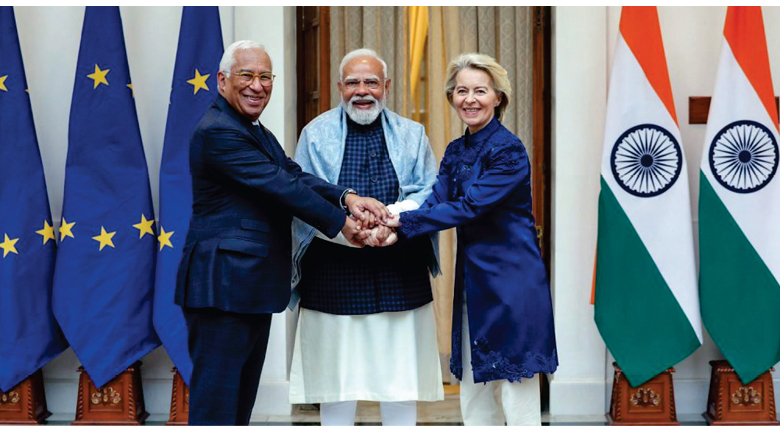
The process began in March 2024 when an agreement was signed by India with the European Free Trade Area (EFTA) which comprises Norway, Switzerland, Iceland and Liechtenstein. This was followed in July 2025 and January 2026 respectively when the UK and EU agreed trade deals with India, all after much more than a decade of negotiations.
These three deals have different areas of focus, for instance, the UK-India agreement centres around services, with both nations granting each other Most Favoured Nation (MFN) status. This is a significant declaration that ensures the most advantageous trade terms extended to any third country will automatically apply to bilateral trade between both the nations.
The even bigger opportunity could come from the EUIndia deal, which covers around 2 billion people and about a quarter of global GDP, and is more focused on goods.
For Indian manufacturers, exporters and start-ups, these agreements will open unprecedented access to advanced European markets. Sectors such as pharmaceuticals, textiles, auto components, engineering goods, and emerging technology industries are particularly well placed to benefit. Similarly, the services sector is already a cornerstone of India's export economy and will see expanded opportunities for IT professionals, business process outsourcing, and professional services across European markets.
Within this landscape, the textile and apparel sector stands to gain significantly. Currently, Indian textile exports to the EU are subject to duties ranging from 8-12%, while competitors such as Bangladesh and Vietnam enjoy preferential or zero-duty access under existing trade arrangements. The new agreements are expected to help level this playing field, enabling Indian exporters to compete more effectively in high-value segments such as fashion apparel, technical textiles, and home furnishings.
A similar dynamic is visible in the UK market, where Indian garments face import duties of approximately 10-12%. With these tariffs expected to be phased out under the UK-India agreement, industry estimates suggest that exports could rise by 20-30% over the next three to five years, strengthening India's position in premium global apparel value chains.
UK-India Partnership beyond Trade
The UK-India relationship has evolved into a multidimensional partnership that extends well beyond traditional commerce. Both governments have committed to strengthening intellectual property right frameworks, with joint calls to promote creativity, innovation, and sustainable development across industries. These provisions aim to create a more predictable environment for technology licensing, pharmaceutical patents, plus creative industries and sectors where both nations possess significant competitive strengths.
Education and research collaboration has emerged as a particular priority. British and Indian universities have expanded joint degree programmes, research partnerships, and academic exchanges. New initiatives focus on AI research, clean technology development, and advanced manufacturing areas where combined expertise could yield globally competitive innovations.
The UK has also launched targeted EU youth engagement initiatives in India, designed to cultivate the next generation of business leaders, entrepreneurs, and policy professionals. These programmes foster people-to-people connections that will underpin commercial relationships for decades to come, building networks of trust and mutual understanding that transcend any single trade agreement.
Geopolitical Context and Strategic Alignment
Of course, Europe has long had some of the largest economic networks in the world. For instance, even before recent deals with India and other powers including the Mercosur bloc in South America, the EU benefited from around 75 partners and more than $2 trillion in trade ties. This reflects not only Europe's longstanding outward orientation. In addition, the region has sought to double down on its economic links with the rest of the world, including after Russia's invasion of Ukraine. Wider new uncertainties include the policies of US President Donald Trump, especially his tariffs.
For Europe, there is growing recognition too that many large new business opportunities lie in Asia. Over the next five years, the global economy is forecast to increase by around $40 trillion in size - a huge chunk of which will come from Asia, with India now the world's fastest growing economy with a GDP surpassing $4 trillion.
India is forecast to become the world's third largest economy by the end of this decade, behind China and the US. The Indian middle-class consumer market, alone, will reach some 95 million by 2035, larger than the population of Europe's biggest economy, Germany.
For India, the European deals signal a wider shift toward deeper trade partnerships with high-income economies. This approach aims to integrate Indian industries more firmly into global supply chains, attract high-quality investment, and accelerate the modernisation of key sectors such as advanced manufacturing, clean energy, digital services, and logistics.
The agreements also align with India's ambition to become a global manufacturing hub and a trusted partner in the diversification of global supply chains. This is also a priority for some Western economies seeking alternatives to overly concentrated production networks.
While India has historically been perceived as a high-tariff, highly regulated market, the three trade deals allow for greater reciprocal market access. That said, businesses will still have to navigate sometimes complex rules of origin, customs compliance, and regulatory requirements to fully leverage them in the coming years.
Underpinning the trade deals between Europe and India is growing political warmth with New Delhi widely perceived in the West as an increasingly friendly, longterm geopolitical ally. There is increasingly seen to be a shared commitment to a rules-based global order, effective multilateralism and sustainable development. This includes converging interests around shared defence mechanisms, including for maritime security in the Indian Ocean where around 40% of bilateral Europe-India trade passes.
These points were highlighted by Finland President Alex Stubb in January at the World Economic Forum in Davos when he called the EU-India deal a “strategic geopolitical move” between two powers who are also the world's largest democracies, in terms of overall population. What President Stubb emphasises here is a growing view that trade is becoming increasingly intertwined with wider foreign policy issues at a time of international political flux.
Scale and Strategic Depth
Full ratification of the EU-India deal will probably take till at least 2027. The EU is already India's largest trade partner with bilateral trade in goods standing at around $135 billion in the financial year 2023-24, an increase of almost 90% in the last decade.
There is much upside potential given that EU tariffs on Indian goods average 3.8%, while India's on EU goods are 9.3%. Forecasts for future bilateral trade indicate this could exceed $200-250 billion in goods and services within a decade.
The January 2026 agreement represents the most farreaching market opening that India has ever offered to a trading partner. India has pledged to eliminate tariffs on almost all EU exports of goods.
The deal also contains significant wins for New Delhi. This includes preferential access for Indian goods to EU markets across almost all tariff lines.
For corporate boards, the most significant implication is the potential acceleration of cross-border manufacturing partnerships and technology transfer.
AI, Technology, and Research Collaboration
Building on the EU-India Trade and Technology Council established in 2023, both powers have committed to joint research initiatives spanning AI governance, semiconductor development, quantum computing, and cybersecurity. European and Indian technology firms are increasingly forming joint ventures to develop AI-driven solutions for healthcare, agriculture, financial services, and smart manufacturing. For IT professionals on both sides, the agreements promise expanded mobility, mutual recognition of qualifications, and collaborative research opportunities that could position the Europe-India corridor as a global innovation hub.
The UK has similarly prioritised technology and research partnerships with India, with dedicated funding streams for joint AI research, biotechnology development, and space cooperation. These initiatives recognise that future economic competitiveness will depend increasingly on mastery of emerging technologies.
Clean Energy and Sustainable Development
The EU also hopes to expand cooperation with India in clean energy. According to the Climate Trends organisation, the trade deal builds on bilateral frameworks including the Clean Energy and Climate Partnership, first signed in 2016, which coordinates joint efforts on renewable energy, energy efficiency and clean hydrogen.
For India, such collaboration could support its ambitious energy transition goals, including achieving 500 GW of renewable energy capacity by 2030. Green hydrogen, in particular, has become a growing pillar of cooperation, with both powers identifying it as central to their longterm decarbonisation pathways.
For corporate leaders in energy, infrastructure, and industrial sectors, these partnerships could unlock major investment opportunities across renewable generation, grid modernisation, storage technologies, and sustainable fuels.
Strategic Implications for Corporate Boards
For corporate leaders and directors, the emerging Europe-India trade architecture presents several strategic considerations:
1. Supply Chain Diversification
Companies should evaluate India's growing role as a global manufacturing and supply chain hub, particularly in sectors such as electronics, pharmaceuticals, automotive components, and renewable energy technologies.
2. Investment and Partnership Opportunities
The scale of anticipated investment flows-particularly under the EFTA framework-suggests significant opportunities for joint ventures, technology partnerships, and cross-border innovation ecosystems.
3. Services and Digital Economy Expansion
India's rapidly expanding digital economy and services sector create substantial potential for collaboration in fintech, telecommunications, AIdriven services, and digital infrastructure.
4. Green Transition Collaboration
Europe-India cooperation in renewable energy and green technologies could become one of the most significant industrial transformations of the coming decades.
Conclusion
The convergence of economic interests, strategic priorities, and political alignment between Europe and India suggests that the coming decade could represent a defining period in the evolution of bilateral relations.
For corporate boards, the message is clear: the emerging Europe-India trade corridor is not simply a policy development, but a structural shift in the global economic landscape.
Businesses that proactively position themselves within this expanding partnership will likely find themselves at the forefront of one of the most dynamic growth stories of the 21st century.
 Back to Home
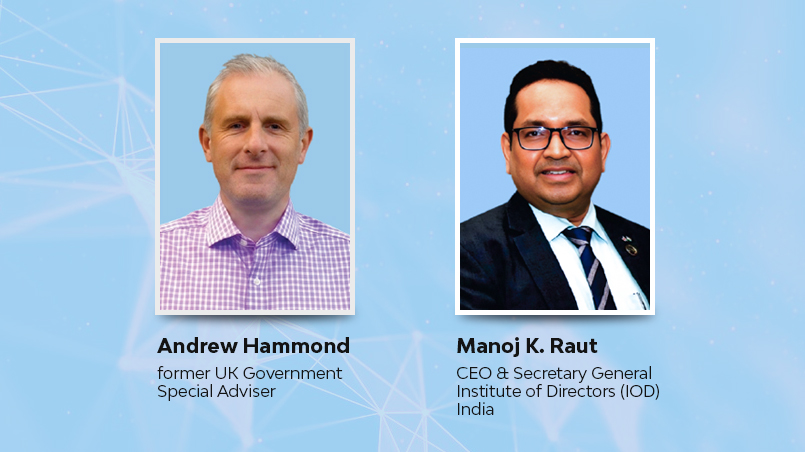
Authors

Andrew Hammond
He was formerly employed as a Government Special Adviser at a time when the UK last held the Presidency of the EU. He has since worked as a Board Member, C-Suite Adviser and Consultant to leading organisations in the public, private, and third sectors on strategy and performance, including navigating complex political and economic landscapes that impact operations, reputation, policy and investments. His work has been published in leading media outlets, including the Wall Street Journal, Financial Times, and the Times of India. He has travelled to India for over three decades, and previously lived in South Asia. He studied at Stanford Graduate School of Business plus the London School of Economics.

Manoj K. Raut
He is the CEO & Secretary-General of the Institute of Directors, India, where he has played a transformative role in evaluating IOD into one of the world’s most respected networks of directors, policymakers, and business leaders. A seasoned CEO, distinguished board leader, and passionate crusader for corporate governance, with over 25 years of exceptional experience in institution building, boardroom leadership, and global governance advocacy. A key architect in the internationalisation of Indian boardrooms, he has significantly expanded IOD’s global presence across London, the United Arab Emirates, Europe, Africa, and Asia. He serves on multiple boards, contributes to global governance forums, and is the Editor of Director Today. Mr. Raut holds a Post Graduate Diploma in Business Management and a Law Degree (LLB) from Govt. Lingaraj Law College, Berhampur University, along with a First-Class Honours degree in Botany (B.Sc. Hons.) from Khallikote Autonomous College. He began his professional journey in law before joining IOD as a Management Trainee in 2000, steadily rising through the ranks to his current leadership position as CEO.
Owned by: Institute of Directors, India
Disclaimer: The opinions expressed in the articles/ stories are the personal opinions of the author. IOD/ Editor is not responsible for the accuracy, completeness, suitability, or validity of any information in those articles. The information, facts or opinions expressed in the articles/ speeches do not reflect the views of IOD/ Editor and IOD/ Editor does not assume any responsibility or liability for the same.