 Quick Links
 Connect us

 Directors Databank (Empannel Yourself)
 Become a
  Become a
  Blog
Blog
 Become an Awards Assessor
 Publications
 Contact Us







Risk Oversight in a Fragmented World

How Boards are Re-engineering Resilience
For decades, corporate strategy was built on a simple premise: the world, while imperfect, was broadly stable. Risks were episodic, disruptions to be managed when they arose, not conditions to be continuously governed.
That premise no longer holds. Today, volatility is structural. Geopolitics shapes trade, technology access, capital flows, and regulation in real time. Conflicts endure, policies shift abruptly, and national priorities increasingly override global integration. As a result, risk has moved from the margins of governance to its core.
The World Economic Forum's Global Risks Report 2026 describes this as an “age of competition,” marked by fragmentation and confrontation. But for boards, the more consequential shift is not just the presence of risk-it is the convergence of risks. Trade policy, supply chains, capital allocation, and market access are no longer separable variables; they interact, compound, and often cascade. In this environment, the question is no longer how quickly organisations respond to shocks. It is how deliberately they prepare for them.
What is required is an inherent capability to adapt, improvise, and operate across multiple systems. The opportunity now is to institutionalise adaptability, combining it with scale, technology, and governance to build structurally resilient organisations.
Where traditional risk frameworks fall short
Most enterprise risk frameworks were designed for a world where disruptions were localised, temporary, and largely independent.
None of those assumptions apply today. Risks are now systemic. A regulatory decision in one market can reconfigure global supply chains. A geopolitical conflict can alter cost structures overnight. Technology restrictions can disrupt innovation pipelines across geographies. These effects do not remain contained, they propagate across interconnected systems.
Yet, governance models have not kept pace. Boards often receive risk updates as discrete categories geopolitical, operational, financial when in reality these risks are deeply interdependent. The result is a fragmented view of exposure, where second and third-order effects are not fully understood.
As companies rethink dependencies and diversify risk, India is emerging as a pivotal node in strategies such as China+1, supply chain de-risking, and regional manufacturing hubs.
The critical governance question is no longer whether risks are being identified. It is whether they are being understood systemically and governed proactively.
The shift that matters: Resilience as strategy
The most effective boards are not attempting to predict the next disruption. They are building organisations that can operate through multiple disruptions.
This marks a fundamental shift from risk avoidance to resilience-led strategy.
Three changes define this transition.
• From a single future to multiple plausible scenarios:
Annual plans anchored to one macro view are giving way to scenario-based decision-making. The question has evolved from “What do we think will happen?” to “If we are wrong, where are we exposed, and what would we wish we had done earlier?”
This is not theoretical planning. It is a discipline for capital allocation and strategic choice.
• Rebalancing efficiency with resilience:
For decades, efficiency dominated-lean supply chains, just-in-time inventory, lowest-cost sourcing. That model has limits. The pandemic exposed its fragility. Current geopolitics has made that fragility structural.
Organisations are now redesigning supply networks not to abandon efficiency, but to embed resilience alongside it. According to the United Nations Conference on Trade and Development (UNCTAD), global companies are actively reconfiguring supply chains to diversify risk while sustaining global integration. Progressive boards are going further by measuring time-to-recover; tracking supplier concentration; and stress-testing logistics flexibility.
• From linear supply chains to strategic ecosystems: Supply chains are no longer linear flows of goods and services. They are complex ecosystems shaped by policy, partnerships, and geopolitical alignment.
Visibility must extend beyond Tier-1 suppliers to deeper dependencies, trade routes, and potential chokepoints.
As Nassim Nicholas Taleb argues in ‘Antifragile’, systems that endure are those that adapt-and often strengthen-under stress. Increasingly, boards are designing for that outcome.
An Indian boardroom perspective in a multipolar world
For Indian companies, the current environment presents a distinct strategic moment-one where geopolitical shifts are not just risks to be managed, but opportunities to be shaped.
India's rising economic and geopolitical relevance has posiitioned its corporations at the intersection of global realignments in trade, technology, and supply chains. As companies rethink dependencies and diversify risk, India is emerging as a pivotal node in strategies such as China+1, supply chain de-risking, and regional manufacturing hubs.
For boards, three implications stand out.
• First, global integration must be balanced with strategic positioning. Indian companies are no longer peripheral participants in global value chains; they are becoming critical nodes. Sectors such as pharmaceuticals, electronics, and specialty chemicals are seeing accelerated interest as global firms diversify away from concentrated geographies.
Government-led initiatives like the Production Linked Incentive (PLI) scheme are reinforcing this shift by incentivising scale, localisation, and global competitiveness. For boards, the question is not just how to participate in these opportunities, but how to build capabilities that remain competitive beyond policy support-on quality, reliability, and innovation.
• Second, supply chain strategy must move from cost arbitrage to capability leadership. The China+1 strategy is often interpreted narrowly as geographic diversification. In practice, it is a more complex redesign of supply networks.
Leading Indian companies are responding by building multi-location manufacturing capabilities; strengthening domestic supplier ecosystems; and investing in backward integration in critical inputs.
In pharmaceuticals, for instance, the push toward reducing dependence on imported APIs has led to renewed focus on domestic manufacturing resilience. In electronics and auto components, supplier diversification and localisation are becoming strategic priorities.
Boards must therefore evaluate supply chains not just on efficiency, but on continuity, control, and adaptability.
• Third, governance must evolve from oversight to strategic foresght. In a multipolar world, regulatory regimes, trade relationships, and capital flows are increasingly fluid. This requires boards to engage more deeply in forward-looking questions:

- Where are we structurally exposed?
- Which markets or supply nodes are critical to continuity?
- What capabilities must we build today to remain relevant across multiple geopolitical scenarios?
This is a shift from monitoring performance to stresstesting strategy.
The boards that will lead
The current environment is not a phase to be managed. It is a structural shift to be internalised.
The implications for boards are clear:
• Risk must be governed systemically, not in silos
• Strategy must be built across multiple plausible futures, not a single base case
• Resilience must be embedded into operating models, not treated as a contingency
• Capital allocation must balance efficiency with strategic choice, not optimise for short-term returns alone
• Governance must shift from oversight to foresight, with deeper engagement in strategic assumptions
Boards that lead will not be defined by how they respond to disruption. They will be defined by how deliberately they prepare for it, design for it, and operate through it. Because in a fragmented world, resilience is no longer defensive. It is a source of sustained competitive advantage.
 Back to Home
Author

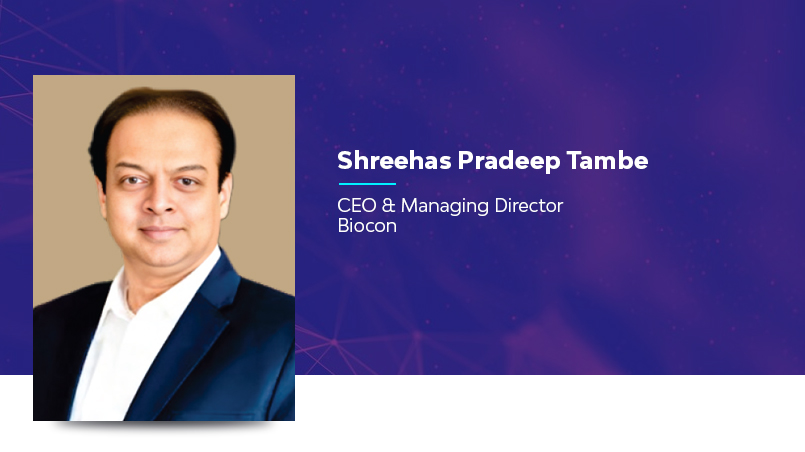
Shreehas Pradeep Tambe
He is the CEO and Managing Director of the combined generics and biosimilars business at Biocon Limited. Prior to leading Biocon Biologics, he served as Chief Operating Officer and later Deputy CEO, overseeing enterprise-wide operations and driving the global growth agenda. Under his leadership, Biocon has emerged among the world’s top five biosimilar companies by revenue, with a valuation of USD 5.5 billion in 2025. He started his career in Research & Development and is an inventor on 60+ patents. He is a recipient of ET Edge India’s Impactful CEO Award (2025) and the BW Pharma World Pharma Leadership Award (2026). He has represented India’s biopharmaceutical sector at key global forums, including the Global Generics CEO Summit, the Festival of Biologics, and the U.S.- India Bioeconomy Workshop, and has worked closely with policymakers on initiatives such as the PLI and PRIP schemes to strengthen India’s life sciences ecosystem.
Owned by: Institute of Directors, India
Disclaimer: The opinions expressed in the articles/ stories are the personal opinions of the author. IOD/ Editor is not responsible for the accuracy, completeness, suitability, or validity of any information in those articles. The information, facts or opinions expressed in the articles/ speeches do not reflect the views of IOD/ Editor and IOD/ Editor does not assume any responsibility or liability for the same.