 Quick Links
 Connect us

 Directors Databank (Empannel Yourself)
 Become a
  Become a
  Blog
Blog
 Become an Awards Assessor
 Publications
 Contact Us







IOD Special Talk - CSR in Transition: From Obligation to Impact

The subject before us, Corporate Social Responsibility (CSR), is by no means unfamiliar. Yet, over time, the very meaning of CSR has undergone a profound transformation. What was once understood as a largely philanthropic or compliance driven function has now become an integral component of the broader ESG framework. Today, it is not merely about intent, but about accountability, measurement, and demonstrable impact, increasingly monitored through structured disclosures such as the Business Responsibility and Sustainability Reporting framework.
Drawing from my own experience of over three decades in public service, including leadership roles across sectors such as steel and telecommunications, I have witnessed this evolution first-hand. There was a time when CSR was peripheral to core business strategy. That is no longer the case. The legislative shift in 2013, which formally embedded CSR into company law, marked a turning point. By mandating a defined allocation of profits towards social responsibility, it institutionalised the idea that businesses are not isolated economic entities, but integral participants in the social contract.
At its conceptual core, CSR emerges from this very idea of a social contract. Organisations draw upon societal resources, human capital, natural assets, and infrastructure. In doing so, they assume an implicit obligation to contribute meaningfully to the very ecosystem that sustains them. This principle finds resonance in the idea of trusteeship, articulated with clarity and conviction by Mahatma Gandhi, who envisioned enterprise not as ownership, but as stewardship.
It is no longer adequate to assess CSR through inputs alone. The emphasis must be on outcomes and impact, on understanding where interventions are taking place, whom they are reaching, and what tangible difference they are making. This requires a more nuanced approach, one that combines quantitative metrics with qualitative insight.
However, the journey from obligation to impact remains incomplete. For a considerable period, CSR implementation was largely measured through financial outlays, the extent to which organisations fulfilled the mandated expenditure. The emphasis, more often than not, was on compliance rather than outcomes. This approach, while necessary in its time, is no longer sufficient.
What we are now witnessing is a gradual but important shift towards impact driven evaluation. Frameworks governing ESG and sustainability reporting are placing increasing emphasis on the quality, credibility, and verifiability of data. The focus is expanding beyond standalone CSR initiatives to include the sustainability performance of entire value chains. Concepts such as assurance, data integrity, and outcome measurement are gaining prominence, reflecting a more mature and accountable approach.
At the same time, this transition is not without its challenges. Concerns around superficial reporting, inconsistencies in data, and what is often described as greenwashing continue to persist. Yet, there is also a clear movement towards strengthening systems, enhancing transparency, and embedding credibility into disclosures.
From the vantage point of sectors that are inherently resource intensive, the urgency of this shift becomes even more pronounced. Industries such as steel, for instance, contribute significantly to carbon emissions and environmental impact. In such contexts, CSR cannot be viewed in isolation. It must align closely with environmental responsibility, operational practices, and long-term sustainability goals.
Equally important is the question of measurement. It is no longer adequate to assess CSR through inputs alone. The emphasis must be on outcomes and impact, on understanding where interventions are taking place, whom they are reaching, and what tangible difference they are making. This requires a more nuanced approach, one that combines quantitative metrics with qualitative insights.
As I set the stage for the discussion, I was conscious that the richness of this conversation would lie in the diversity of perspectives brought in by the panel. Rather than prescribing narrowly defined themes, I encouraged each panellist to draw upon their own experience and reflect on the challenges and opportunities that define CSR today.
It is through such collective reflection that we can begin to move beyond established frameworks and engage with the deeper questions that confront us. CSR, in its evolving form, is not merely a regulatory requirement. It is a lens through which we must rethink the relationship between business, society, and the environment.
The task before us is not simply to comply, but to contribute meaningfully, to ensure that responsibility is not an afterthought, but a defining principle of how institutions operate and create value.
 Back to Home
Author

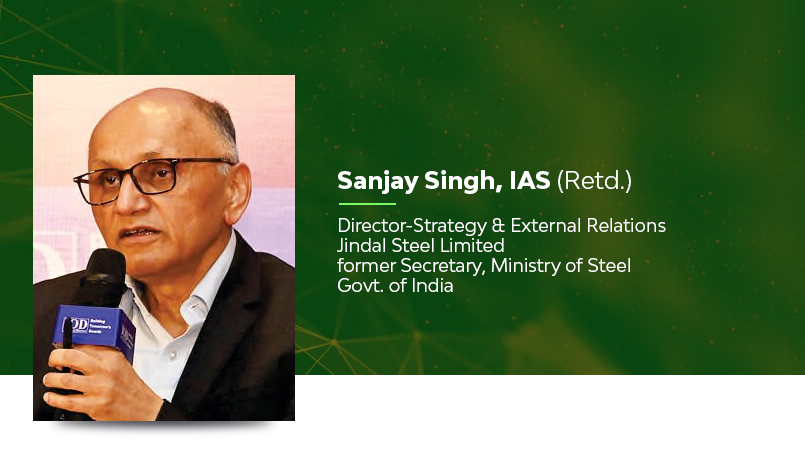
Sanjay Singh, IAS (Retd.)
Director-Strategy & External Relations Jindal Steel Limitedformer Secretary, Ministry of Steel, Govt. of India
Owned by: Institute of Directors, India
Disclaimer: The opinions expressed in the articles/ stories are the personal opinions of the author. IOD/ Editor is not responsible for the accuracy, completeness, suitability, or validity of any information in those articles. The information, facts or opinions expressed in the articles/ speeches do not reflect the views of IOD/ Editor and IOD/ Editor does not assume any responsibility or liability for the same.