 Quick Links
 Connect us

 Directors Databank (Empannel Yourself)
 Become a
  Become a
  Blog
Blog
 Become an Awards Assessor
 Publications
 Contact Us







IOD Special Talk - The Quiet Architecture of Trust
By- Institute of Directors | Authored by- Hon'ble Justice Mrs. Sunita Agarwal
Feb 05, 2026


A Constitutional perspective on trust, restraint, and responsibilities of Future-Ready Corporate Boards
It is my absolute privilege to address this first-ever National Convention on Leadership and Business Excellence, in this vibrant commercial hub - GIFT City, in Gujarat, marking thirty-five years of sustained contribution of the Institute of Directors (IOD) to Corporate Governance in India. Institutions, like individuals, are ultimately judged by how consistently they serve; and not by how loudly they speak. The longevity of IOD is a testimony to its quiet but significant role in shaping Boardroom thinking in our country.
The theme, “Driving Global Excellence through Effective and Future-Ready Boards” could not be more timely than today. We live in an age where Excellence is no longer local, Risk is no longer linear, and Failure is no longer forgiving. In such a competitive environment, the boardroom becomes one of the most significant spaces of leadership in the modern society.
Let me confess, at the outset, that I am a novice in the field of commerce and industry. I am thankful to the organizers for giving me this opportunity to see a world which is outside my comfort zone, I was wondering what would I speak about. I come from a different institutional universe of the judiciary, whereas you daily live with markets, capital, competition, and innovation. Yet, precisely because our domains are distinct, this dialogue becomes more valuable. 'Judiciary' and 'Corporates' may operate in different fields, but both are Institutions of Trust. Both exercise power and affect lives far beyond their immediate stakeholders. Ultimately, both derive legitimacy not only from authority but from good governance. Therefore, I made a small effort to make some comparisons between the two institutions from the perspective of constitutional governance, institutional leadership, and long-term trust.
In constitutional courts, justice is not an event, it's a process. Similarly, Corporate integrity is not an incident, it is a product of sustained governance choices.
One of the enduring lessons of constitutional governance is that while power is inevitable, wisdom is a choice. Therefore, what matters is not the possession of power but the decision to use it wisely. True excellence lies in the quality of decisions taken when no one is watching, when incentives seem misaligned and shortcuts appear tempting. In business, leadership is no longer about command and control, but it is about making judgment under uncertainty, when data is incomplete, consequences are long-term, and public scrutiny is relentless. It is here that boards assume a role far deeper than compliance or oversight.
Boards are the architects that shape leadership, accountability and trust. Through appointments, evaluations, succession planning, and culture-setting, boards determine not only who leads, but shape how leadership is exercised.
In Constitutional Courts, justice is not an event, it is a process. Similarly, corporate integrity is not an incident; it is a product of sustained governance choices.
An effective board understands that the most important function is not approving strategy slides, but asking the difficult questions, which the management may be reluctant to ask itself.
Judiciary and Corporations may operate in different fields, but both are institutions of trust. Both exercise power and affect lives far beyond their immediate stakeholders. Ultimately, both derive legitimacy not only from authority but from good governance.
One of the gravest governance failures, in any public or private institution, is the absence of constructive dissent. When unanimity becomes routine, it is often a sign of disengagement rather than alignment. As Peter Drucker once observed, “The most important thing in communication is to hear what isn't being said.” Boards must be able to hear that silence.
Independence of mind is the soul of the Boardroom. From a constitutional standpoint, independence is not merely a structural safeguard; it is a state of mind. A judge who fears consequences is not independent, even after being constitutionally protected. Similarly, a director who hesitates to speak the truth against power is not independent, despite the formal status.
Effective boards are marked by independence of thought, courage of conviction, and clarity of purpose. This does not mean confrontation. It means engagement. It means understanding that loyalty to an institution sometimes require disagreement among individuals.
Much is said today about “future-ready” boards. Often, this discussion focuses on technology, digital disruption, artificial intelligence, or sustainability metrics. These are undoubtedly important. But future-readiness begins elsewhere. A Future-Ready Board understands that continuity without relevance leads to institutional decline.
Every institution, be it a court, a company, or a regulator, must periodically ask itself uncomfortable questions:
• Are our assumptions still valid?
• Are our incentives still aligned with our purpose?
• Are we preparing leaders for the world that is coming, or the world that has already passed?
In the judicial institutions, we have learnt a lesson that delay, once tolerated, becomes systemic. In business, irrelevance follows the same path. It arrives gradually, and then suddenly envelops the whole. Future-ready boards are, therefore, characterised not by certainty, but by intellectual humility. They recognise that expertise must be refreshed, that learning must be continuous, and that governance structures must evolve. In this sense, futurereadiness is not a checklist but a mindset.
Governance is ultimately about trust. Courts do not command obedience; they command trust. Likewise, and in the practical world, businesses do not operate solely on contracts, they operate on credibility. Trust is the most fragile yet the most valuable asset that any institution possesses. It takes decades to build and moments to lose. Boards sit at the intersection of trust by multiple stakeholders including shareholders, employees, creditors, consumers, regulators, and society. Balancing their trust and interest is not an accounting exercise but a moral exercise.
In recent years, we have seen that markets may forgive losses, but society rarely forgives ethical failure, signaling that reputational damage is often irreversible. As Warren Buffett famously remarked, “It takes twenty years to build a reputation and five minutes to ruin it.” Boards exist precisely to ensure that those five minutes never arrive.
In judiciary, we have learnt that rules matter, but culture determines the outcomes. The same rule, applied in different cultures, produces vastly different results. Institutional culture, therefore, is not a mere symbolic idea. It shapes everyday behaviour of the members and provides guidance beyond written rules.
Boards must, therefore, endeavour to cultivate a healthy and principled culture in their institutions. How are decisions rewarded? How are failures addressed? How is dissent treated? How is power exercised? These questions rarely appear in annual reports, yet they determine whether organisations remain ethical under pressure. A future-ready board understands that culture is what remains when policies fail.
One of the most delicate aspects of Corporate Governance is the relationship between boards and management. Too much distance leads to abdication whereas too much interference leads to paralysis. The relationship between board and management is neither adversarial nor ceremonial. The ideal relationship is of principled partnership. Management brings executional and operational expertise. Boards bring perspective, continuity, and restraint. When each respects the other's role, institutions flourish. In courts, we often say that independence does not mean isolation. The same holds true here. Boards must be engaged, informed, and accessible without becoming intrusive.
As Indian enterprises increasingly operate on global platforms, governance standards are rightly benchmarked internationally. But global excellence cannot be achieved by imitation alone. Global excellence demands local integrity. Institutions succeed globally when they are anchored locally in values, accountability, and social responsibility.
India's corporate journey is unique. It operates in a democracy marked by diversity, aspiration, and inequality. Boards must, therefore, understand that long-term legitimacy arises not merely from profit, but from contribution.
Environmental responsibility, fair employment practices, and ethical supply chains are no longer optional reputational tools, they are governance imperatives.
Leadership is ultimately about institutional legacy. Positions pass. Titles change. Markets fluctuate. What endures are institutions. And institutions endure only when leaders think beyond their tenure. The true test of leadership, whether in a judicial or corporate institution, is whether the institution is stronger after you leave than when you arrived. Boards, more than any other body, are custodians of this legacy. Their decisions today shape not just next year's performance, but the organisation's place in history.
As the philosopher Edmund Burke observed, I quote: “Society is a partnership of the dead, the living and the unborn”. So is governance.
In conclusion, as we reflect on driving global excellence through effective and future-ready boards, let us remember that excellence is not an end, but a discipline. Governance is not a burden, but a privilege. Leadership is not about visibility, but responsibility. Strong boards do not seek attention; they earn trust. Future-ready boards do not predict the future; they prepare for it. And truly effective boards remember that power, when guided by values, becomes stewardship.
The Institute of Directors, over the past thirty-five years, has played a vital role in nurturing this understanding and values. As it builds tomorrow's boards, I hope this convention becomes not merely a celebration of the institution's success, but a renewed commitment to its deeper purpose.
I leave you with one final thought, drawn from Constitutional wisdom but equally applicable to commerce.
Institutions do not fail because they lack intelligence; they fail because they abandon restraint. May our boards, our businesses, and our institutions continue to lead with wisdom, courage, and conscience.
I wish the convention all the success.
Thank you. Jai Hind!
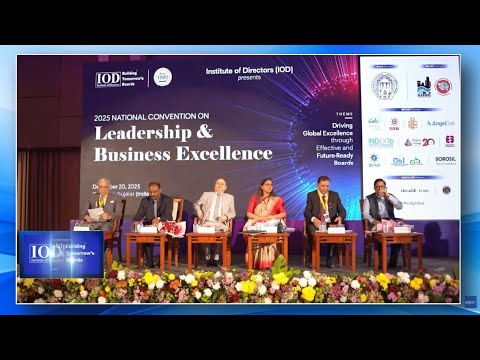
Excerpts from the 'Chief Guest Address' delivered by Hon'ble Justice Mrs. Sunita Agarwal, Chief Justice of Gujarat High Court, on 20th December, 2025 at the National Convention on Leadership and Business Excellence, held at Radisson GIFT City Club, Gandhinagar, Gujarat (India).
 Back to Home
Author

Hon'ble Justice Mrs. Sunita Agarwal
Chief Justice of Gujarat High Court
Owned by: Institute of Directors, India
Disclaimer: The opinions expressed in the articles/ stories are the personal opinions of the author. IOD/ Editor is not responsible for the accuracy, completeness, suitability, or validity of any information in those articles. The information, facts or opinions expressed in the articles/ speeches do not reflect the views of IOD/ Editor and IOD/ Editor does not assume any responsibility or liability for the same.