 Quick Links
 Connect us

 Directors Databank (Empannel Yourself)
 Become a
 Become a
 Blog
 Become an Awards Assessor
 Publications
 Contact Us







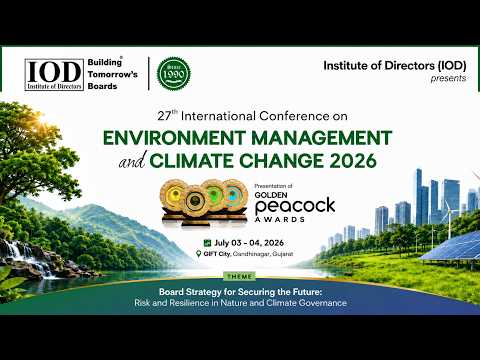
Board Strategy for Securing the Future: Risk and Resilience in Nature and Climate Governance
By- Institute of Directors | Authored by- Lt. Gen. Surinder Nath, PVSM AVSM (Retd.)
Nov 04, 2026


Over the last twenty-seven years, this Conference has evolved into one of the most respected international platforms for dialogue on sustainability, environmental stewardship, governance and responsible leadership. It has consistently brought together policymakers, regulators, corporate leaders, academics, experts and practitioners from around the world to deliberate on issues that are shaping the future of economies, societies and institutions.
The theme of the Conference - “Board Strategy for Securing the Future: Risk and Resilience in Nature and Climate Governance” - is both timely and profoundly relevant.
We are living through an era of unprecedented environmental transformation. Climate change, biodiversity loss, ecosystem degradation, water stress, resource scarcity and extreme weather events are no longer isolated environmental concerns. They have emerged as interconnected risks affecting economic growth, financial stability, public health, food security and social well-being across the world.
US-Iran-Israel war has destroyed benefits of climate friendly development over the years. Military operations generate substantial greenhouse gas emissions through aircraft, missiles, naval deployments and damaged infrastructure. According to recent assessments, the first weeks of the conflict produced millions of tonnes of CO₂-equivalent emissions. Attacks on oil and energy facilities increase the risk of air, soil and marine pollution, while disruptions in the Strait of Hormuz a route carrying roughly 20% of global oil trade can trigger energy insecurity and encourage short-term reliance on coal and other high-emission fuels. The conflict also diverts political attention and financial resources away from climate action, adaptation and sustainability investments.
Decision of US government to oppose Paris Climate Convention and denying WHO to initiate humanity-oriented actions have added huge loss to quality of life. Whereas collective actions since Paris meet in 2025 had gradually improved systems, regulations and technologies but actions of last one year has reversed positive actions. India has played an important role, but one India cannot find all the solutions.
Today, environmental risks have become governance risks.
They influence investment decisions, supply chains, infrastructure planning, resource management and long-term business sustainability. Increasingly, governments, businesses and institutions are recognising that resilience and sustainability are no longer optional aspirations; they are strategic imperatives.
India's challenge is particularly significant.
While our nation is home to nearly 18 per cent of the world's population, we possess only about 4 per cent of global freshwater resources. This reality makes water security, ecosystem conservation and climate resilience not merely environmental priorities but fundamental requirements for sustainable development.
Climate change is no longer a future possibility; it is a present reality.
The frequency and intensity of heatwaves, floods, droughts, cyclones and wildfires have increased across many parts of the world. Scientific evidence continues to reinforce those environmental disruptions are becoming more frequent, more severe and more costly.
For India, these challenges carry special significance.
According to a district-level heat risk assessment undertaken by the Council on Energy, Environment and Water (CEEW), nearly 57 per cent of India's districts, home to approximately 76 per cent of our population, face high to very high heat-risk conditions. Rising temperatures are placing increasing pressure on public health systems, agriculture, energy demand, water availability and urban infrastructure.
Recent evidence presented in the State of India's Environment 2026 report indicates that India experienced extreme weather events on 331 out of 334 days in 2025, resulting in 4,419 reported deaths and widespread impacts on lives, livelihoods and infrastructure. Such findings remind us that climate risks are no longer occasional disruptions; they are increasingly becoming a persistent feature of our development landscape.
Ladies and Gentlemen, Climate change, however, represents only one dimension of the challenge before us.
An equally important concern is the growing degradation of natural ecosystems.
For many years, environmental discussions focused primarily on carbon emissions and climate mitigation. Today, there is increasing recognition that climate stability and ecological stability are inseparable. Healthy ecosystems are essential for sustaining economic activity, supporting livelihoods and enhancing resilience.
Forests, wetlands, rivers, grasslands, mangroves and oceans provide invaluable ecosystem services. They regulate water cycles, support agriculture, absorb carbon, protect coastlines, preserve biodiversity and strengthen resilience against natural disasters.
When these ecosystems deteriorate, the consequences extend far beyond environmental damage. They affect food security, water security, economic productivity, public health and social stability.
Nature loss is therefore emerging as one of the defining governance challenges of our time.
India occupies only 2.4 per cent of the world's geographical area, yet it is home to nearly 8 per cent of the world's recorded biodiversity, making it one of the world's seventeen mega-diverse countries.
The State of India's Environment 2026 report highlights a sobering reality: seven of the nine planetary boundaries that support life on Earth have already been breached. This serves as a warning that environmental degradation is no longer a future threat but a present challenge affecting the stability of natural systems upon which economies and societies depend.
India's commitment to ecosystem conservation is reflected in the fact that the country now hosts 89 Ramsar Sites, the highest number in Asia, covering more than 1.35 million hectares of wetlands. These wetlands serve as vital natural buffers against floods, droughts and climate-related disasters while supporting biodiversity and local livelihoods.
Climate governance without nature governance is incomplete.
Corporate boards play a pivotal role in strengthening climate governance by integrating climate-related risks and opportunities into long-term business strategy.
The concept of resilience has consequently acquired unprecedented importance.
The challenge before us today is not only to reduce risks but also to strengthen resilience.
With a coastline extending over 7,500 kilometres, India faces increasing exposure to cyclones, coastal erosion, sea-level rise and extreme weather events. Strengthening resilience across coastal ecosystems, urban centres, infrastructure networks and communities will therefore be essential for safeguarding future growth and prosperity.
We need resilient infrastructure, resilient cities, resilient agricultural systems, resilient supply chains and resilient communities.
Resilience is no longer an option; it is a strategic imperative.
Fortunately, there are reasons for optimism.
India’s Leadership for Climate Action.
India has demonstrated remarkable leadership in advancing sustainable development and climate action.
The Annual Report for 2025-26 of the Ministry of Environment, Forest and Climate Change provided a comprehensive overview of the ministry’s initiatives and policies. Major key highlights can be presented as follows;
1. Climate Change & Sustainability;
• Climate resilience and adaptation are increasingly becoming central pillars of India's environmental governance framework.
2. Afforestation;
• The campaign reflects a transition from plantation-focused programmes to long-term tree survival and maintenance strategies.
3. Air Quality Management;
• 22 cities have already met National Ambient Air Quality Standards (NAAQS) for PM10.
• Over 1,125 lakh metric tonnes of legacy waste have been remediated, reducing pollution and methane emissions.
4. Regulatory Reforms & Ease of Doing Business;
• Consent-to-Operate processes are moving toward perpetual validity in several categories, significantly reducing compliance complexity.
5. Plastic Pollution & Circular Economy;
• India intensified its national campaign against plastic pollution through the ‘One Nation, One Mission – End Plastic Pollution’ initiative.
• Circular economy principles are becoming more deeply embedded in India's environmental policies and international engagements.
At COP26 in Glasgow, India announced its commitment to achieve Net Zero emissions by 2070, a landmark pledge that has become a guiding framework for the country's long-term development strategy.
India's climate strategy is founded on the principle that climate responsibility and economic development must advance together.
Under its updated Nationally Determined Contributions (NDCs) under the Paris Agreement, India has committed to:
• Reducing the emissions intensity of GDP by 45 per cent by 2030 from 2005 levels;
• Achieving about 50 per cent cumulative installed electric power capacity from non-fossil fuel sources by 2030; and
• Creating an additional carbon sink of 2.5–3 billion tonnes of CO₂ equivalent through additional forest and tree cover by 2030.
The encouraging reality is that India is already making substantial progress.
• India has reduced the emissions intensity of its GDP by approximately 36 per cent between 2005 and 2020.
• India has already created an estimated 2.29 billion tonnes of additional carbon sink through forests and tree cover, bringing the country significantly closer to its 2030 target.
• India achieved the milestone of deriving more than 50 per cent of its installed electricity capacity from non-fossil fuel sources ahead of schedule, fulfilling one of the most important pillars of its Paris Agreement commitments.
• Indian Installed solar capacity has grown to more than 135 GW, making India one of the fastest-growing solar energy markets in the world. (During 2025 alone, India added a record 44.5 GW of renewable energy capacity, the highest annual renewable energy addition in the country's history)
• Under the National Green Hydrogen Mission, India has set an ambitious target of producing 5 million metric tonnes of green hydrogen annually by 2030.
• India has also committed to restoring 26 million hectares of degraded land by 2030 one of the largest land-restoration commitments in the world.
These achievements demonstrate that India's climate strategy is development-driven rather than development-constrained. They show that environmental sustainability, economic growth and social inclusion can advance together through innovation, investment and effective governance.
The future will not be secured solely through technological breakthroughs or policy interventions.
It will be secured through effective governance.
Good governance today must encompass environmental stewardship, climate accountability, biodiversity protection and long-term resilience planning.
The institutions that succeed in the future will be those that recognise environmental sustainability not as a constraint on growth, but as a foundation for enduring prosperity.
Over the next two days, we shall deliberate upon critical issues relating to climate governance, nature-related risks, biodiversity conservation, sustainability reporting, energy transition, green finance, technological innovation and resilience-building strategies.
I am confident that the discussions and deliberations at this Conference will generate valuable insights and actionable recommendations for strengthening nature and climate governance.
This evening, we shall also have the privilege of recognising excellence through the presentation of the Golden Peacock Awards for Occupational Health & Safety, Environment Management, Energy Efficiency and Eco-Innovation – 2026.
These prestigious awards honour organisations that have demonstrated outstanding commitment to sustainability, innovation, responsible governance and operational excellence. The award winners represent the highest standards of corporate responsibility and serve as inspiring examples of how economic success can be aligned with environmental stewardship and social value creation.
• The defining challenge of our era is no longer simply managing climate risks. It is building resilience in our ecosystems, our infrastructure, our institutions and our communities.
• History will not judge us by the challenges we inherited. It will judge us by the resilience we built, the ecosystems we protected and the future we secured for generations to come.
Let us therefore work together to create a future that is environmentally sustainable, economically prosperous and socially inclusive.
 Back to Home
Author

Lt. Gen. Surinder Nath, PVSM AVSM (Retd.)
President, Institute of Directors
former Chairman, UPSC
former Vice Chief of Army Staff and
former Independent Director, L&T Ltd.
He took over as the President of Institute of Directors with effect from 02 December, 2022
Owned by: Institute of Directors, India
Disclaimer: The opinions expressed in the articles/ stories are the personal opinions of the author. IOD/ Editor is not responsible for the accuracy, completeness, suitability, or validity of any information in those articles. The information, facts or opinions expressed in the articles/ speeches do not reflect the views of IOD/ Editor and IOD/ Editor does not assume any responsibility or liability for the same.