 Quick Links
 Connect us

 Directors Databank (Empannel Yourself)
 Become a
  Become a
  Blog
Blog
 Become an Awards Assessor
 Publications
 Contact Us







From Solving Business Problems to Strategic Integration: The Independent Director's Role in Tax, M&A and Policy

Boards rarely destroy value because a director did not know a section of tax law. They destroy value when obvious questions are not asked early enough, or answers are accepted because the organisation has fallen in love with a transaction. This is not confined to weak boards; it is the natural risk of enthusiastic ones.
Byju's is a striking example. At its peak, it was valued at US$22 billion. In quick succession, it acquired Aakash, WhiteHat Jr, Great Learning, Epic, Osmo and other businesses. Epic alone had an announced price of US$500 million. By 2023, representatives of three major investors had left its board, its statutory auditor had resigned citing delayed financial statements, and its valuation had collapsed.
It would be simplistic to attribute that collapse to acquisitions alone, or judge directors without knowing what was placed before them. But it is legitimate to ask if the board asked the following questions and tested while the acquisition machine was running:
• How many businesses could management integrate at once?
• Were the acquisitions producing cash, or merely adding revenue and narrative?
• How much depended on pandemic-era behaviour continuing?
• Was debt being raised against a durable business, or an inflated valuation?
• When did growth become momentum?
Good governance does not require avoiding every uncertain tax position. It requires the board to understand the exposure, allocate it and decide with its eyes open.
Kingfisher Airlines offered an earlier warning. Its acquisition of, and merger with, Air Deccan combined a premium airline with a low-cost carrier. The attractions were evident: market share, routes, aircraft and reach. But the group had to reconcile different operating models amid high fuel costs and intense price competition. It accumulated heavy losses and debt, underwent restructuring and eventually stopped flying.
That failure had several causes. Yet a board considering the transaction should have demanded answers to elementary questions like:
• Was Kingfisher acquiring scale, or importing losses?
• Could a luxury brand and low-cost discipline live under one roof?
• What would happen if fuel prices rose, fares stayed constrained and fresh capital dried up together?
• If the answer to every difficulty was that the promoter would continue funding the business, was that a strategy, or merely an assumption?
This is where an independent director earns the seat.
Independence is neither habitual opposition nor ceremonial affirmation. It is the discipline of asking the unwelcome question while changing course is still affordable.
Tax demands the same discipline, and rarely gets it. Tax is often invited into a transaction after the commercial structure is settled, when advisers must validate, optimise or repair what has been agreed. That is too late. Tax can determine an acquisition's price, cash flows and viability. In my experience, tax seldom kills a deal at the outset; it more often kills value quietly afterwards.
Consider a company proposing to acquire a profitable manufacturing business. The headline numbers are attractive and current tax payments appear regular. A hurried diligence stops there. A serious one asks what sits behind them. Has the target wrongly claimed GST credits? Has it treated employees as consultants, failed to withhold tax, taken aggressive transfer-pricing positions, or enjoyed incentives that may not survive a change in ownership? Are customs classifications disputed? Are accumulated credits genuinely usable? A demand raised three years after completion may relate to the seller's period, but the cash leaves the business the buyer now owns.
The legal form of the acquisition matters just as much. In a share purchase, the company retains its history and liabilities; only its shareholders change. Buying the business rather than the shares is not an automatic answer either. Indian GST law can make the transferor and transferee jointly and severally liable for tax, interest and penalty relating to the period before a business transfer, including amounts determined later.
An indemnity from the seller looks reassuring on paper. The board should ask whether it will still be valuable on the day it is invoked. Is the seller financially capable of honouring it? Does it survive long enough for assessments to conclude? Are disputed positions specifically covered? Should part of the price sit in escrow, or should tax insurance be considered? Above all, has the exposure been reflected in the price?
Tax diligence, in other words, is not a compliance annexure. It is part of valuation. An acquisition priced at Rs. 1,000 crore but carrying an unprovided exposure of Rs. 150 crore did not become a bad transaction when the tax notice arrived; it was mispriced on the day it was approved. Good governance does not require avoiding every uncertain tax position. It requires the board to understand the exposure, allocate it and decide with its eyes open.
Public policy completes the picture. Regulation can alter a business model faster than a competitor, and geopolitics does so with unsettling regularity. Policy cannot remain a periodic update from the government-relations team. For a regulated activity, the direction of policy is part of the business model itself.
India's online money-gaming industry illustrates the point. Business models rested on the distinction between games of skill and gambling, and on treating the platform fee rather than the amount staked as taxable value. From October 2023, the amended GST regime-imposed tax at 28 per cent on specified deposits with online gaming suppliers. Separately, authorities pursued large demands for earlier periods under the pre-amendment law, a position contested by the industry. Parliament then enacted the Promotion and Regulation of Online Gaming Act, 2025, prohibiting online money games. It would be unfair to suggest that a board should have predicted this precise sequence. That is not the test. The sector had long faced state-level restrictions, litigation and uncertainty over its legal classification. A vigilant board need not predict the next notification. It must recognise when the economics of the enterprise rest upon a contested legal or policy position. It should then ask what the business looks like under an adverse interpretation, how much capital remains at risk, whether diversification is real, and what management will do if the core assumption fails.
The board must also examine the company's own policy advocacy. Is its position evidence-based? Does it serve only the company, or can it be defended as sound policy? Would the board be comfortable if its representations became public tomorrow?
In an age of instant disclosure, private advocacy and public reputation cannot be separated. Three practical habits follow:
1. Major proposals must reach the board while alternatives are still real, not after management has negotiated a near-final deal and the only remaining question is ratification.
2. Board papers should set out dissenting assumptions and downside cases rather than presenting consensus as certainty.
3. Boards must review major decisions after the event: what was promised, what occurred, which assumptions failed, and who remained accountable for integration.
The independent director of the future need not be the cleverest specialist in the room. Specialists answer the questions they are given. The director's larger responsibility is to recognise when the wrong question is being asked, when inconvenient facts have been fragmented across functions, and when corporate momentum is being mistaken for judgment. That, and not distance from the business, is what truly gets you the board seat: the ability to see the enterprise whole, and the courage to say so in time.
 Back to Home
Author

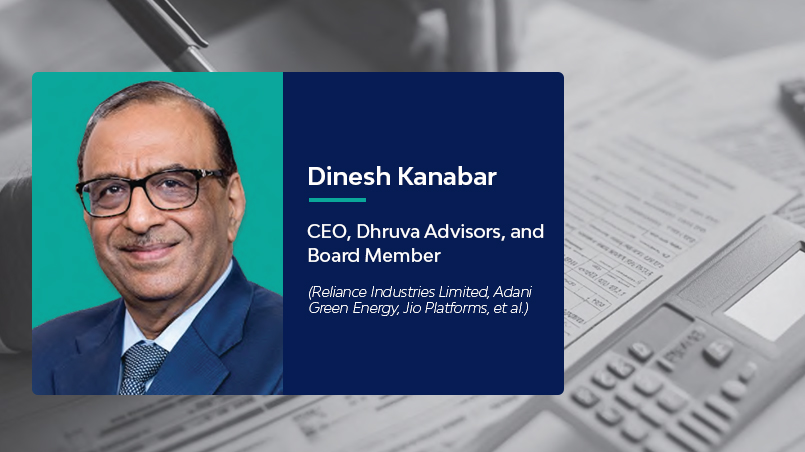
Dinesh Kanabar
Mr. Dinesh Kanabar is widely recognised among India's leading Chartered Accountants, with a distinguished career spanning decades at the forefront of the country's tax, regulatory and policy landscape. He currently serves on the boards of several prominent companies, including Adani Green Energy Ltd., and Jio Platforms Ltd. He is the Founder of Dhruva Advisors India Pvt. Ltd. and Vice Chairman of Ryan Tax Holdings, USA. Earlier, Mr. Kanabar worked closely with the Government of India on several significant policy initiatives and served as a member of the Rangachary Committee. He has also held senior leadership positions, including Deputy CEO of KPMG India, bringing extensive expertise in taxation, policy, governance and corporate strategy.
Owned by: Institute of Directors, India
Disclaimer: The opinions expressed in the articles/ stories are the personal opinions of the author. IOD/ Editor is not responsible for the accuracy, completeness, suitability, or validity of any information in those articles. The information, facts or opinions expressed in the articles/ speeches do not reflect the views of IOD/ Editor and IOD/ Editor does not assume any responsibility or liability for the same.