 Quick Links
 Connect us

 Directors Databank (Empannel Yourself)
 Become a
 Become a
 Blog
 Become an Awards Assessor
 Publications
 Contact Us







SEBI Chairman on Equipping Independent Directors for the Boardroom India Needs

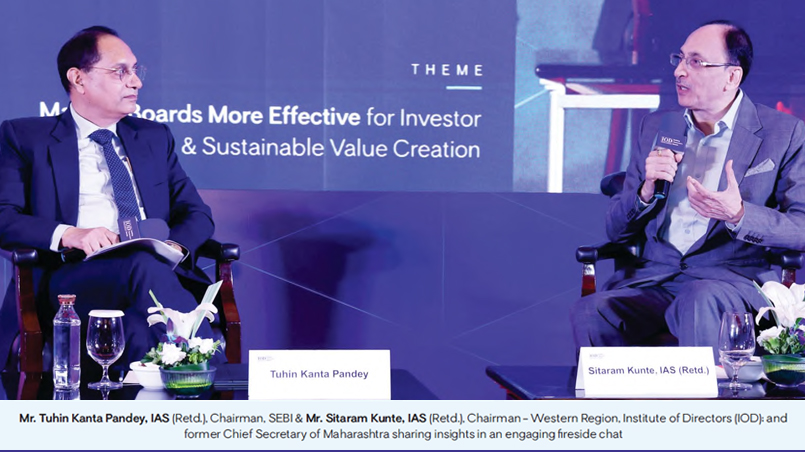
Mr. Kunte: As you look at the next decade of India's capital markets, what should an effective Board look like? What qualities will be critical for Boards to build lasting investor confidence and create sustainable long-term value?
Mr. Pandey: I believe effective Corporate Governance rests fundamentally on the quality of the institutional framework within which a business operates. Investors studies not only at performance, but also whether the board is capable, informed and equipped to exercise forward-looking vision. An effective board must first be compliant with regulatory requirements, including the appropriate balance of executive, non-executive, independent and women directors. Beyond compliance, however, it requires the right mix of competence and diversity of thought, extending beyond financial and industry expertise. Independence is equally critical. Directors must exercise objective judgement, independent of Management, promoters and even prevailing consensus within the boardroom. This requires viewing their role through the lens of stewardship rather than mere decision-making. The board must also insist on the quality and integrity of information available to it.
Effectiveness depends on moving beyond asking questions to achieving outcomes by identifying issues, challenging assumptions, evaluating alternatives, assigning responsibility, monitoring implementation and verifying results. Ultimately, board effectiveness is a continuum, shaped by the quality of information, the capability to integrate it, the courage to ask the right questions and the capability to translate deliberation into outcomes.
Mr. Kunte: Independent Directors are expected to ask difficult questions and challenge management when necessary. What changes in Boardroom culture would help such Directors exercise greater independence, courage and judgement?
Mr. Pandey: A strong board culture begins by creating space for constructive deliberations. A healthy boardroom should make challenge normal rather than exceptional, while recognising that independence does not mean just opposition. Directors must bring an independent perspective, but ultimately their responsibility is to improve the quality of decisions and protect the interests of all stakeholders, particularly minority shareholders. Questions are therefore essential, but they are means, not an end. This requires high-quality information, well-reasoned board papers and direct access to functional leaders such as the CFO, CRO, Compliance Officer, CTO and Internal Auditor, rather than information flowing exclusively through a single management channel. Board committees should similarly function as centres of substantive scrutiny, not procedural staging points. Their deeper examination of audit, risk, remuneration and other critical matters can materially strengthen board deliberations. For instance, in evaluating an acquisition, the board should test projected outcomes against downside scenarios, concentration and geopolitical risks, and their implications for valuation. The strongest boardroom, therefore, is not one without disagreement, but one where informed disagreement promotes better decisions.
Mr. Kunte: SEBI has progressively strengthened the governance framework covering areas such as ESG, cyber governance and Independent Directors. Looking ahead, what further governance & regulatory measures can Indian Boards expect, particularly around AI governance & responsible adoption, climate risk and emerging technologies?
Mr. Pandey: I do not believe boards can evade the challenges posed by an increasingly interconnected risk environment. If we speak of future-proofing Indian boards, the imperative is to move from reactive governance towards anticipatory governance. AI, cyber, climate, geopolitical and third-party risks can simultaneously affect operations, financial performance, resilience, reputation, regulatory compliance and investor confidence. By the time a board reacts, the damage may have already be been done. AI governance therefore requires responsible adoption. Boards must learn where AI is deployed, which decisions it influences, the data on which it depends, the risks it creates, who remains accountable and what happens when systems fail. Data poisoning, historical bias, privacy, cybersecurity and data quality must form part of this oversight, alongside appropriate risk classification for material AI use cases. 'Future-proofing' is therefore not an optional choice. It is an ongoing governance responsibility, and there is no escape from it.
Mr. Kunte: Women currently represent around 19% of Board positions in India. While representation has improved, concerns about tokenism remain. What more can be done to achieve meaningful diversity and strengthen women's participation in Board leadership? How is SEBI aligning with the government's vision for a 33% representation, as proposed in the Parliament and expected to take effect from 2029?
Mr. Pandey: I believe the regulatory trajectory on gender diversity has rightly evolved from establishing minimum representation to encouraging more substantive participation. Regulation 17 of LODR has opened the boardroom door, while subsequent measures have encouraged companies to move beyond mandatory requirements. Yet, if we aspire to meaningfully increase women's representation, the challenge is no longer simply access; it is capacity, participation and progression. Boards and Nomination and Remuneration Committees must therefore examine succession planning through a diversity lens. Where are women falling out of the leadership pipeline? Are workplace structures creating barriers between middle and senior management? Board diversity cannot be treated as an appointment exercise triggered by a vacancy. It is fundamentally a long-term talent development and succession planning responsibility. We must also guard against the unintended consequences of tick-box compliance, where appointments become concentrated among a limited pool of women directors. The objective should be to nurture a wider and deeper leadership pipeline. The next stage of gender diversity must be a progression from presence to participation, participation to influence, and influence to leadership. Regulation can open the boardroom door, but boards and NRCs must ensure that access translates into substantive governance.
Mr. Kunte: Directors can sometimes face legal and regulatory proceedings even after leaving the Board. What measures could help provide greater clarity and reasonable protection to Directors, while maintaining accountability and investor protection? Is SEBI considering some reforms to mandate extended coverage or safeguards for directors provided under the D&O Insurance, so they can take up roles without the fear of unwarranted legal actions.
Mr. Pandey: Effective corporate governance requires independent directors to participate with confidence and without allowing the fear of potential litigation to compromise their judgement or enquiring minds. This is where Directors and Officers (D&O) insurance assumes importance. The SEBI LODR framework recognises this concern by requiring the top 1,000 listed entities, based on market capitalisation, to provide D&O insurance for their independent directors, with the quantum and scope of cover determined by the board. However, D&O insurance should not be viewed as a shield against accountability. Its purpose is to provide appropriate protection to directors who have acted in good faith, exercised due diligence and relied on sound board processes. The objective, therefore, is not to dilute responsibility, but to make protection operational through adequate and continuing insurance coverage. Independent directors must remain accountable for their decisions, while having the confidence to exercise robust, objective and courageous oversight without undue apprehension of personal liability.
Mr. Kunte: Building on the MII mandate, is SEBI considering extending similar, more rigorous external evaluation requirements to listed and public companies to further strengthen boardroom governance?
Mr. Pandey: I would distinguish market infrastructure institutions from other listed entities because their public utility function places an exceptionally high premium on governance. Exchanges and depositories underpin the functioning of financial markets, operating continuously and at extraordinary speed. Consequently, governance failures are simply not an option. Their framework therefore incorporates safeguards such as limits on shareholding and the requirement for a substantial representation of Public Interest Directors, reflecting their wider accountability to the market and public interest. For other listed entities, our guidance on board evaluation provides flexibility through internal assessment, external evaluation or a combination of both, allowing companies to adopt an approach suited to their size, complexity, business model and board composition. External evaluation can strengthen independence, provided the assessor is free from related-party relationships or conflicts of interest. However, I believe there is an important distinction between regulatory compliance and governance maturity. Evaluation can assess board processes, agendas and participation, but the deeper question is whether directors exercise genuine independent judgement and stewardship.
Mr. Kunte: Finally, if you could leave every Director in India with one principle, habit or mindset to strengthen investor confidence and create long-term value, what would it be?
Mr. Pandey: I do not believe the director of the future will be some superhuman figure capable of mastering every emerging complexity. The real challenge is to build the necessary capabilities at scale and with quality.
- First, as always integrity remains non-negotiable.
- Second, competence and specialised skills are essential; sound judgement cannot rest on common sense alone when enterprises and risks have become increasingly complex.
- Third, experience must be complemented by continued learning.
However, accomplished a director may be, established expertise can quickly become outdated. Directors must therefore engage with new issues at sufficient depth to understand their implications across the enterprise. This makes capacity development indispensable, particularly for independent directors. I believe India has the institutional capacity to build such a system through collaboration. We need a different pedagogy, combining case studies, experience sharing and tabletop exercises, and a culture of continuous learning. The objective should be capacity development at both scale and quality. This is the rationale behind developing a collaborative capacity development network that brings institutions together to strengthen the capabilities of independent and other board directors for the challenges ahead.
Mr. Kunte: What gives you the greatest confidence about the future of India's capital markets and what is the one area where Boards must improve most urgently?
Mr. Pandey: I believe India's capital markets are expanding at a remarkable pace, with public markets, private markets, alternative investments, REITs and corporate bonds all witnessing sustained growth. More significantly, India is undergoing a structural shift from a nation of savers to a nation of investors. The rapid expansion of demat accounts and the growing participation of investors beyond the top cities demonstrate how technology, market infrastructure and a robust regulatory framework are broadening access and strengthening investor confidence. The mutual fund industry, too, has witnessed extraordinary acceleration in assets under management, illustrating how rapidly financial participation is deepening. What makes this transformation particularly significant is the convergence of three forces: a growing investor base, a dynamic issuer ecosystem and world-class market infrastructure and intermediaries. Together, they are creating a deeper, broader and more resilient capital market. I therefore believe India has an exceptionally compelling long-term opportunity to emerge as one of the world's most attractive capital-market ecosystems.
Excerpts from the “Fireside Chat” between
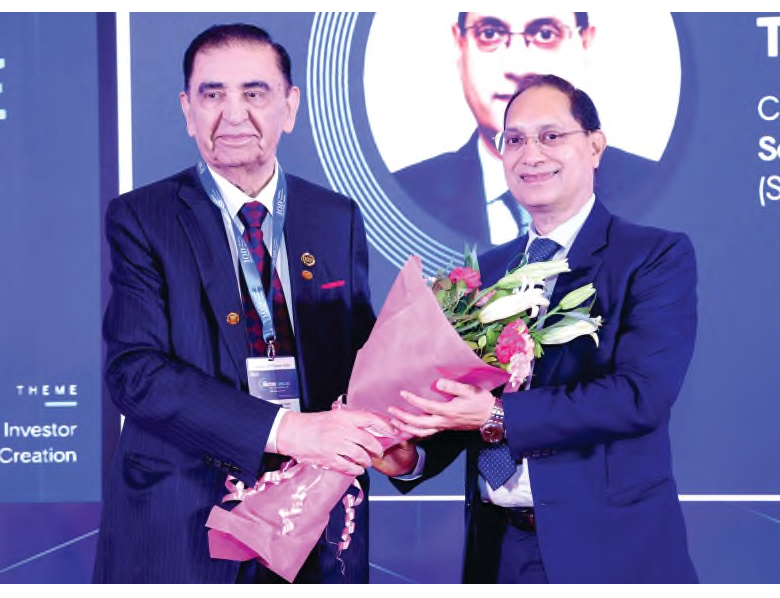
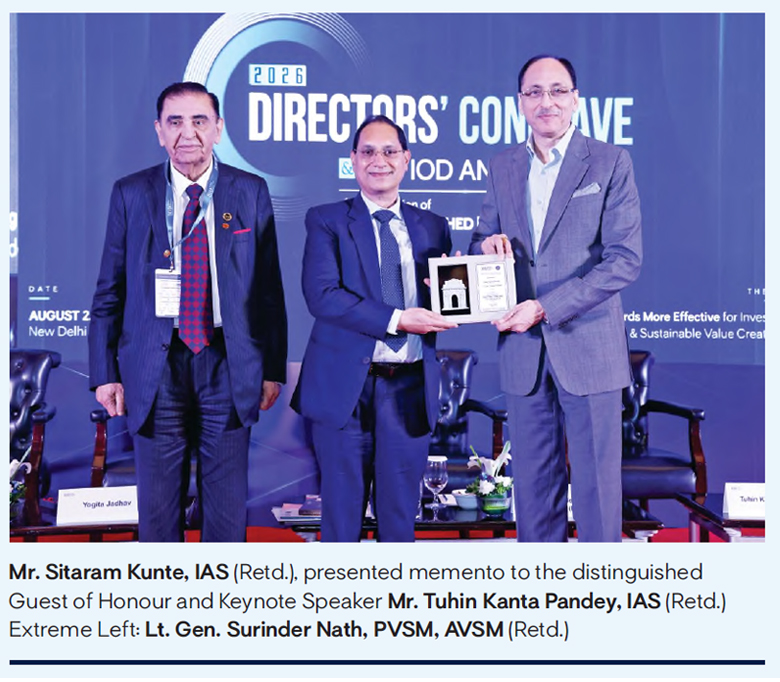
Mr. Tuhin Kants Pandey, IAS (Retd.), Chairman, SEBI and Mr. Sitaram Kunte, IAS (Retd.), Chairman-Western Region, IOD; and former Chief Secretary of Maharashtrafrom the Keynote Session at the Annual Directors' Conclave & 36 IOD Annual Day held on August 22, 2026 at the Hotel Le-Meridien, New Delhi.
 Back to Home
Author
Institute of Directors India
Bringing a Silent Revolution through the Boardroom
Institute of Directors (IOD) is an apex national association of Corporate Directors under the India's 'Societies Registration Act XXI of 1860'. Currently it is associated with over 31,000 senior executives from Govt, PSU and Private organizations of India and abroad.
Owned by: Institute of Directors, India
Disclaimer: The opinions expressed in the articles/ stories are the personal opinions of the author. IOD/ Editor is not responsible for the accuracy, completeness, suitability, or validity of any information in those articles. The information, facts or opinions expressed in the articles/ speeches do not reflect the views of IOD/ Editor and IOD/ Editor does not assume any responsibility or liability for the same.