 Quick Links
 Connect us

 Directors Databank (Empannel Yourself)
 Become a
  Become a
  Blog
Blog
 Become an Awards Assessor
 Publications
 Contact Us







From Four Decades in Public Service to Boardroom: Lessons for Independent Directors on Accountability & Strategy

Public service brings in a lot of experience across different sectors, and in some sectors one does develop deeper insights. Thus, when one joins the boardroom, one can bring in that experience, but it is equally important to keep oneself updated in the sector in which one has accepted the board position.
Boardroom is a sounding box for new ideas, drawing inputs from the Independent Directors, who act as watchdogs on decisions and steps taken, on compliance, and understanding the direction in which the sector is moving and the efforts made for the same; and last but not the least is the vigilant eye maintained on the same.
Public service at higher positions means the buck stops with you in drafting policies, getting inputs from all stakeholders, presenting them to lawmakers, and getting them through. The execution is constantly monitored. The role of an Independent Director is not hands-on. It is to be aware of what is happening in the sector, thoroughly read what is presented to the board, ask for details if gaps are noticed, and ensure the decision-making is as informed as possible.
We are all aware of the cases of Satyam and IL&FS, or for that matter Yes Bank, where the information submitted to the board was based on leapfrogs without working out the details, the diversification, the flow of funds, the transfer of funds to other activities, and, most importantly, the questioning of chartered accountants during the pre-meet of the audit committee has been the gap; the evident red flags were not noticed or marked. The result has been collapse and a bad name for the company, requiring strong regulatory measures.
Strategising the future of the company is the responsibility of Promoters, Management, and Shareholders; whereas Independent Directors can have open discussions on the same through in-depth discussions on short and long-term strategies, any diversification in the business line, the scope of getting new business, the expertise available, and, most importantly, the IRR. These hard questions are a must for the Independent Directors to fathom and understand in the board meeting. The Independent Directors are insulated as they do not monitor day-to-day operations.

The role of an Independent Director is not hands-on. It is to be aware of what is happening in the sector, thoroughly read what is presented to the board, ask for details if gaps are noticed, and ensure the decision-making is as informed as possible.
In one of the companies, it was decided to acquire another company. Besides management, the Independent Directors had a series of frequent online meetings to ensure debt status, bank clearances, land issues, and employee issues were all clear. That experience ensured the deal went smoothly. The company later changed from financier-based corporate governance to a promoter-investor model, bringing good value to the company.
Another example I will give is of hiving off non-productive, loss-making assets whose liabilities had been coming to the holding company for years. That required diligent planning and deep diving by the audit committee to get all the facts on the table.
Another interesting case is of a group that was at the helm of affairs in a company and then created a new company and acquired products at a low value; when scrutinized, there were litigations, but then that group started buying shares from the market to become the major stakeholder. Here, Independent Directors need to be neutral and strictly act by law, per the legal provisions of SEBI, company law, and other relevant laws. In such cases, timely advice from regulators is often not available, and thus the Board needs to pursue matters so that what is legally correct and good for the company is done.
Under Section 149(12) of the Companies Act, 2013, Independent Directors are protected from blanket liability and are only held accountable for acts of omission or commission that occurred with their knowledge, through board processes, with their consent/connivance, or where they failed to act diligently. Thus, diligent discussions based on what management presents, asking for information, taking advice from experts if needed, and then proceeding accordingly with no prejudice, are essential.
The independent director has an opportunity to guide the board with their experience, but it is also a challenge to participate in decision-making based on what is provided by management to the board. This can be a limiting factor, as Independent Directors do not have access to direct information or, for that matter, access to day-to-day working. If the promoter or management intentionally tries to hide information or mislead the board, discussions, pointed meetings, and observations in the board meetings become an instrument to get the knowledge. The audit committee and closed-door discussions with the internal audit team or statutory auditors, and now there is a committee under the direction of the NFRA (National Financial Reporting Authority), in the name of TCWG (Those Charged with Governance), that is meant to strengthen the audit ecosystem to ensure statutory auditors flag any areas of concern to the audit committees and board of directors, in the form of a pre-audit committee, and to provide a platform to understand if management has failed to put up critical information. Here, the responsibility lies with statutory auditors to ensure they flag all concerns and discuss them. These discussions are documented, and that also becomes evidence of due diligence in strategic direction and ensures accurate financial reporting for informed decision-making.
It is important to understand that the independent director attends board meetings and sub-committee meetings and does not participate in day-to-day management issues, but guides the company to bring in efficiency, transparency, and well-understood decision-making processes. Section 149(12), therefore, shields Independent Directors from the misdeeds of corporates unless negligence or connivance is proven, as they are legally permitted to rely on what is presented to sub-committees and the board by management. Hence, the key element is ensuring due diligence and documentation of the same, as while in service one is hands-on with access to information, but as an independent director it is important to equip oneself to keep abreast of developments in the sector and the market for the company, and to deep-dive into management's claims to be able to arrive at informed decisions.
Most companies believe in growth and fair play; hence, it is not something to fear or an impediment, but what is important is that the board must take advice from experts if needed, use their knowledge, and have open discussions in the board. The review of board members, especially the promoters or management personnel, should not be treated as routine, but as an opportunity and a platform to indicate if Independent Directors have reservations about the board not having free and frank discussions.
Having Independent Directors is an asset to the company, bringing in expertise from different related fields to add strength to the board, and, based on free and frank discussions, strategising the growth of the company. It enables the board to bring in experience and contribute to long and short-term steps to be taken, or add value to decision-making processes in the company. Similarly, for Independent Directors, it is an opportunity to bring their experience and expertise to the table.
Some key takeaways for IDs:
• Limited Liability: Section 149(12) shields independent and non-executive directors (who are not promoters or key managerial personnel) from corporate misdeeds unless direct connivance or negligence is proven.
• Immunity from Certain Acts: Independent Directors are generally not liable under peripheral laws (such as the Negotiable Instruments Act) simply by virtue of holding the title of director, without specific involvement.
• Reliance on Management: IDs are legally permitted to rely on financial statements, audit reports, and professional presentations provided by management, provided they maintain supervisory oversight.
• What Diligence is Expected for Protection? To maintain this legal protection, Independent Directors must demonstrate active engagement rather than passive approval.
• Record Dissent: If disagreeing with a board decision, directors must ensure their dissent is explicitly documented in the board minutes.
• Ask Critical Questions: Regulatory bodies scrutinise whether directors actively questioned related-party transactions, financial statements, and internal control weaknesses.
• Utilise Professional Advice: The role permits accessing independent professional advice when evaluating complex company matters
• Looking for protection for a specific jurisdiction: Check on Directors and Officers (D&O) insurance coverage for Independent Directors.
 Back to Home
Author

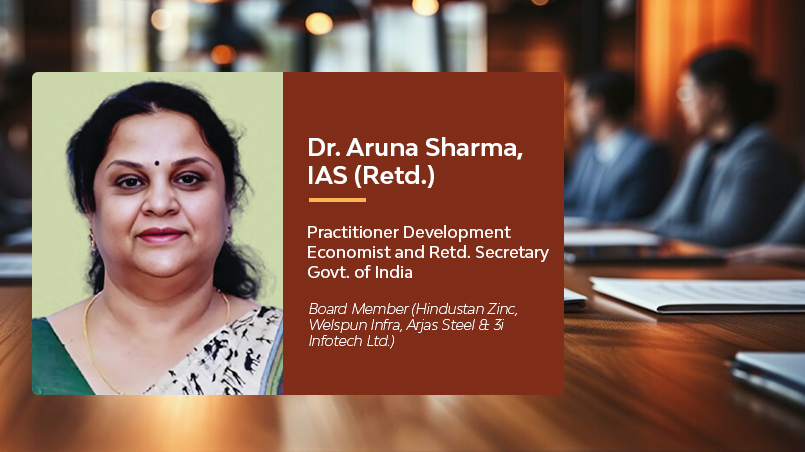
Dr. Aruna Sharma, IAS (Retd.)
Dr. Aruna Sharma, IAS (Retd.) is a practitioner of development economics with an illustrious career in public administration, having served as former Secretary, Ministry of Steel and Ministry of IT, Government of India. She currently serves on the boards of Hindustan Zinc, Welspun Infra, Arjas Steel (a subsidiary of Sandur Manganese and Iron Ores), and 3i Infotech Ltd.
Owned by: Institute of Directors, India
Disclaimer: The opinions expressed in the articles/ stories are the personal opinions of the author. IOD/ Editor is not responsible for the accuracy, completeness, suitability, or validity of any information in those articles. The information, facts or opinions expressed in the articles/ speeches do not reflect the views of IOD/ Editor and IOD/ Editor does not assume any responsibility or liability for the same.