 Quick Links
 Connect us

 Directors Databank (Empannel Yourself)
 Become a
 Become a
 Blog
 Become an Awards Assessor
 Publications
 Contact Us







Boards in a Rapidly Changing World: Innovative Strategies for Resilience and Sustainability
By- Institute of Directors | Authored by- Lt. Gen. Surinder Nath, PVSM AVSM (Retd.)
Nov 04, 2026


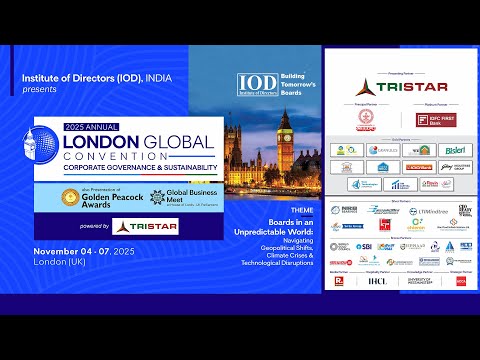
The Institute of Directors along with Tristar is organising 32nd Annual World Congress on “Leadership for Business Excellence and Innovation” with the theme “Boards in a Rapidly Changing World: Innovative Strategies for Resilience and Sustainability”. IOD has been focusing on strategies for sustainability to ensure that the world is a better place to live in through sustainable and efficient practices dominated by corporate world. During recent past, most of the leading global companies have pledged with UN to attain net zero by 2050 or much earlier. A proper understanding of sustainable practices calls for every one of the players to be on the same platform. Let me deal with sustainability and its elements.
Sustainability is a holistic approach that focuses on meeting present needs without compromising the ability of future generations to meet their own. It encompasses environmental, social, and economic dimensions, commonly referred to as the triple bottom line people, planet, and profit. The concept has gained global prominence due to pressing challenges such as climate change, resource depletion, social inequalities, and economic instability. Achieving sustainability requires businesses, governments, and individuals to adopt responsible practices that balance growth with environmental stewardship and social well-being.
Environmental sustainability is a critical component that addresses issues like carbon emissions, deforestation, biodiversity loss, and pollution. The transition to renewable energy sources, such as solar and wind power, is essential in reducing dependence on fossil fuels, which contribute significantly to global warming. Sustainable waste management, including recycling, composting, and circular economy initiatives, plays a key role in minimizing environmental impact. Water conservation, afforestation, and sustainable agriculture also contribute to preserving ecosystems and ensuring the long-term availability of essential resources.
Social sustainability focuses on human well-being, equity, and community development. It includes fair labour practices, access to quality education and healthcare, and the protection of human rights. Organizations are increasingly integrating Corporate Social Responsibility (CSR) initiatives into their strategies to support local communities and improve social conditions. Inclusivity and diversity in workplaces, along with ethical sourcing of materials, further strengthen the social sustainability agenda. Empowering communities through education and skill development fosters long-term resilience and social cohesion.
Economic sustainability ensures that economic activities generate long-term value without causing environmental degradation or social harm. Sustainable business models prioritize efficiency, innovation, and ethical practices to create financial stability while addressing global challenges. The adoption of green technologies, responsible investments, and transparent governance mechanisms can drive sustainable economic growth. Governments play a crucial role by implementing policies that incentivize sustainable practices, such as carbon pricing, subsidies for clean energy, and regulations promoting sustainable supply chains.
It is relevant to also briefly mention of the impact of circular economy. The circular economy is a transformative economic model designed to minimise waste, maximise resource efficiency, and create sustainable business practices. Unlike the traditional linear economy, which follows a "take, make, dispose" approach, the circular economy emphasises reusing, recycling, and regenerating materials, thereby reducing environmental impact, and fostering long-term economic growth. This approach ensures that resources are continuously cycled back into the economy, reducing the need for raw materials, and lowering ecological footprints. At the core of the circular economy lies the principle of designing products for longevity and reusability.
I wish that the participants consider all important and relevant issues relating to sustainability and evolve innovative strategies to attain overall prosperity for the world. I am sure this convention will lead to new pathways for Sustainable Global Economic Growth where IOD and the global corporate world will play an important role.
 Back to Home
Author

Lt. Gen. Surinder Nath, PVSM AVSM (Retd.)
President, Institute of Directors
former Chairman, UPSC
former Vice Chief of Army Staff and
former Independent Director, L&T Ltd.
He took over as the President of Institute of Directors with effect from 02 December, 2022
Owned by: Institute of Directors, India
Disclaimer: The opinions expressed in the articles/ stories are the personal opinions of the author. IOD/ Editor is not responsible for the accuracy, completeness, suitability, or validity of any information in those articles. The information, facts or opinions expressed in the articles/ speeches do not reflect the views of IOD/ Editor and IOD/ Editor does not assume any responsibility or liability for the same.