 Quick Links
 Connect us

 Directors Databank (Empannel Yourself)
 Become a
  Become a
  Blog
Blog
 Become an Awards Assessor
 Publications
 Contact Us






What Truly Gets You the Board Seat: Equipping IDs for the Future Boardrooms

One question I am often asked by professionals considering a board career is “What does it really take to get a board seat?”
My answer has changed over the years. Earlier, I would have said that deep functional expertise especially in functions like Finance, HR and Business Operations, leadership experience and a good reputation were the foundation. I still believe they are essential. But today, they are no longer sufficient. The boardroom is changing faster than many aspiring Independent Directors realise. Companies are dealing with AI, cyber risk, geopolitical uncertainty, changing consumer behaviour, new business models, regulatory scrutiny and increasing stakeholder expectations. In such an environment, boards need people who bring more than a distinguished career. They need directors who can bring relevance, judgement and the ability to ask the right questions.
A board seat is not a reward for a successful career. It is a responsibility for what a company needs next.
Expertise and experience gets you noticed; Relevance gets you appointed. In today's context, a board does not necessarily need another successful CEO, CFO or technology leader. It needs a particular capability at a particular point in its journey. This is an important distinction. What matters in a boardroom is the ability to connect that expertise to a larger business question(s) at hand.
I have seen organisations look for technology expertise when what they really needed was someone who understood how technology could change the business. Similarly, a company may look for an experienced finance professional, but what it actually needs is someone who can challenge capital allocation decisions and understand the strategic consequences.
Expertise and experience gets you noticed. Relevance gets you appointed.
The question for an aspiring ID should therefore not simply be, “What have I achieved?”
It should be, “What problem can my experience help this board solve?”
That is a much more powerful proposition. The future ID, therefore, cannot remain a specialist.
Indeed, my own career across telecom, IT services, FMCG and digital transformation has taught me that technology rarely remains a technology issue for long. AI is a good example. The board's role is not to understand every algorithm. It is to ask whether the organisation is solving the right business problem, whether the data is reliable, who owns the outcome, what the risks are and whether the investment will create sustainable value. The same applies to cyber security, digital transformation and emerging technologies. These same principles apply just as much to Finance, HR, Operations, Sustainability and other functional areas of expertise.
The future Independent Director therefore needs T-shaped expertise - deep knowledge in one or two areas, combined with enough understanding of strategy, finance, risk, regulation, people and technology to participate meaningfully in the larger conversation.
Governance knowledge is only the starting point. Courses, certifications and the Independent Directors' databank are important. They provide a foundation and help aspiring directors understand their statutory responsibilities. But completing a course does not make someone board-ready.
Board effectiveness comes from judgement. It comes from knowing when to challenge management, when to listen, when to ask a difficult question and, equally importantly, when not to. An effective Independent Director should be able to disagree without becoming adversarial. Constructive dissent is one of the most valuable contributions an ID can make to a board.
Alongside judgement, continuous learning is no longer optional. The pace of change means that what made someone relevant five years ago may not be enough today. I believe every Independent Director needs a personal learning agenda. It should include emerging technology, cyber and data risks, regulatory developments, changing business models and geopolitical trends - but also the fundamentals of the industries in which they serve.
The best directors I have interacted with are curious. They continue to ask questions. They read beyond the board papers. They understand the business, its customers and its competitive environment.
So, what truly gets you the board seat especially the first time?
In my experience, it is not simply the number of years you have worked, the seniority of your last designation or the number of certificates on your profile. The seats, especially the first one usually comes from the 4Rs:
Reputation + Relevance + Relationships + Readiness
It does not happen simply by registering as an ID. And once you get the seat, the real test begins.
The future boardroom will have little patience for passengers. It will need directors who are prepared, relevant and willing to contribute. For aspiring Independent Directors, therefore, the objective should not be to “get a board seat.” It should be to become the kind of director that a board would actively want in the room.
You have to be able to answer an important question, “What capability can I bring to a board that it will genuinely need over the next five years?”
That question forces us to look beyond our past achievements and think about the future. And perhaps that is the real transition we need in developing Independent Directors - from being experienced professionals to becoming future-ready board leaders.
The best Independent Director is not the person who has all the answers. It is the person who knows which questions the board must ask before making the decision.
 Back to Home
Author

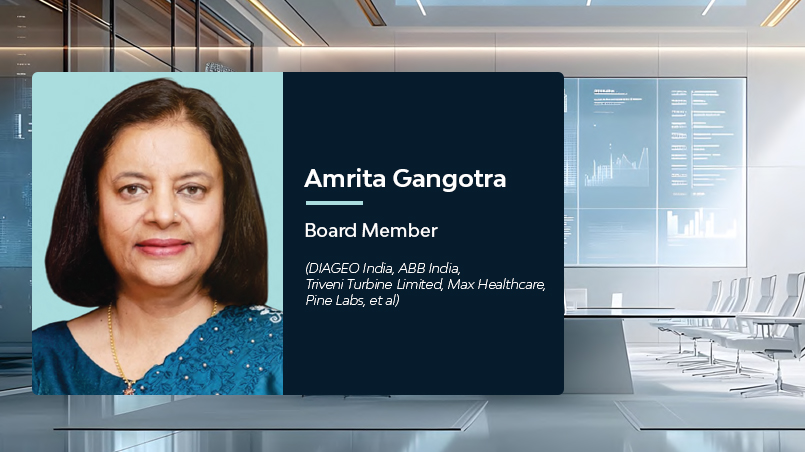
Amrita Gangotra
Ms. Amrita Gangotra is the Founder and Managing Partner of Ityukt Digital and an award-winning technology and business leader with over 35 years of experience. She currently serves as an Independent Board Director on the boards of several prominent Indian and global companies, including ABB, Diageo India, Vistaar Financial Services, Pine Labs, Sterlite Technologies, Triveni Turbine, Max Healthcare and India1 Payments. As a former CIO and CTIO at leading global telecom companies Vodafone and Airtel, Ms. Gangotra brings extensive expertise at the intersection of technology, business transformation and strategic leadership.
Owned by: Institute of Directors, India
Disclaimer: The opinions expressed in the articles/ stories are the personal opinions of the author. IOD/ Editor is not responsible for the accuracy, completeness, suitability, or validity of any information in those articles. The information, facts or opinions expressed in the articles/ speeches do not reflect the views of IOD/ Editor and IOD/ Editor does not assume any responsibility or liability for the same.