 Quick Links
 Connect us

 Directors Databank (Empannel Yourself)
 Become a
  Become a
  Blog
Blog
 Become an Awards Assessor
 Publications
 Contact Us







Beyond the Score: Understanding ESG Ratings as a Strategic Governance Tool

For decades, corporate governance has been aimed towards maximizing shareholder value, assessed almost exclusively through financial metrics. However, with the times changing, we see the business landscape evolving into one that operates under a social conscience. We are seeing the topic of sustainability go from a handful of slides relegated to the end of the board agenda. to now being front and centre. To consider Environmental, Social and Governance (ESG) as merely a checkbox activity could be strategically risky in a market where regulators, lenders, asset managers and customers are becoming far more sophisticated in how they distinguish disclosure from discipline. What once passed as narrative is now being tested against evidence, comparability and the credibility of the systems underneath it.
An ESG rating isn't a grade on a report card, nor is it a marketing tool to place on a corporate website. A rating compresses a vast amount of information about control quality, operating discipline, disclosure credibility and controversy exposure into a signal the market can act on. That is precisely why it matters. It tells your whether companies remain investable when conditions turn hostile.
Some companies still view ESG compliance as a sunk cost, something that they must pay to tick the compliance. The difference between a company playing offenses or defence is entirely tied to capital allocation. What is needed is investor stewardship as a formal discipline of long-term value protection. Principles for Responsible Investment (PRI) defines stewardship as the use of investor rights and influence to protect and enhance overall long-term value and explicitly links it to engagement, voting and fiduciary duty. So, a favourable rating reduces the probability of engagement escalation, lowers the risk of negative voting outcomes and improves a company's standing with investors whose mandates are now tied to resilient governance and credible sustainability execution.
Investors aren't demanding ESG data out of a sense of altruism. They are integrating this data into their core risk-return models because they know that climate risk is investment risk. A favourable rating signals to the broader market that a company has built structural safeguards against external shocks. That directly translates into better access to capital through sustainability-related financing.
But the advantage of ESG scores goes deeper still. If you treat the rating as a diagnostic tool, it points directly to operational inefficiencies. A poor score in energy utilisation or waste management isn't just an environmental issue; it is an efficiency issue and an unnecessary drain on operating expenses. Here the data reveals a telling gap. While almost all applicable companies disclose energy intensity and renewable energy use, only about one-third (36%) disclose ISO 50001 energy management certification, and although disclosure on waste is strong (95% report waste intensity and 92%report waste recycled or recovered), the ratings question goes beyond mere availability of data. By systematically fixing the root causes that drag down an ESG score, companies invariably streamline their operations. This is where ESG stops being a reporting exercise and becomes an operational transformation agenda. The score forces multiple teams into the same room around the same set of facts. It reveals where resources are being wasted, where oversight is too thin, where supplier controls are too weak, and where management is tolerating frictions that quietly erode margins and resilience.
While almost all applicable companies disclose energy intensity and renewable energy use, only about one-third (36%) disclose ISO 50001 energy management certification.
The Social pillar often gets misunderstood for corporate philanthropy. It isn't. It is a measure of survival whether your workforce, customers and local communities will support business, or will they actively impede. In many sectors, that survival question now extends well beyond employee welfare. It reaches into customer protection, product integrity, and digital trust. The data illustrates this distinction: while 98% of applicable companies report mechanisms to receive and respond to consumer complaints, only 78% disclose ISO 9001 certification, meaning complaint mechanisms show companies can respond when issues arise, but quality systems show whether product responsibility is built into everyday process discipline. A company with weak labour practices, poor customer outcomes, or fragile stakeholder relationships may still look profitable in the short term, but it is often operating with hidden instability. Social weakness rarely stays social for long it eventually becomes operational, legal, reputational or financial.
Similarly, the Governance pillar scrutinizes the architecture of accountability. It asks the hard questions about incentive alignment. Does the board have the right mix of expertise to foresee emerging non-financial threats? If the governance of a company is unprepared, every environmental and social commitment it makes is nothing more than a marketing exercise. The data suggests the foundational structures are well established, with Independent Directors constituting an average of 51%of the board and 91% of applicable companies disclosing a board diversity policy; the next level of leadership lies in using these structures to drive decisions and measurable outcomes. This is where corporate stewardship belongs. At board level, stewardship should be treated as a discipline of long-term value protection and not a side committee exercise, but a direct test of whether directors are safeguarding the enterprise against foreseeable non-financial risks. Strong corporate governance supports financial stability and long-term value creation. So, the real governance question is not whether the board has approved an ESG policy, but whether it has established the decision rights, escalation routes, incentive structures and assurance mechanisms required to make that policy real.
So, how do boards embed ESG into their corporate strategy? It requires prioritization.
First, boards need to get serious about materiality. A tech firm doesn't need to obsess over direct emissions that a cement company does, but it better have a strategy for data privacy and algorithmic bias. Boards need to use rating diagnostics to isolate the three or four highly material factors that threaten their specific business model and focus their energy there.
This highlights the importance of materiality assessment. NSE Sustainability's data indicates that most companies disclose that they undertake materiality assessments. While policies and committees demonstrate an important level of preparedness, materiality assessment adds deeper value by helping companies identify and prioritize the most relevant risks and opportunities that truly matter to their business and stakeholders. This is also where stewardship becomes more intelligent, focused, and outcome oriented. Investors should look beyond the existence of policies and assess whether the right material risks are being governed with the appropriate level of urgency and accountability. In stronger governance and stewardship frameworks, engagement priorities are linked to sector-specific drivers such as cyber oversight, water stress, customer protection, supply-chain controls, or climate-risk integration, rather than broad ESG messaging. This enables investors and companies to focus their efforts on issues that have the greatest potential to influence long-term resilience, performance, and stakeholder trust.
Second, a sustainability target is just empty words until it shows up in the capex budget. Capital must be deployed to future proof physical assets, not just buy carbon offsets. If the market believes that transition spending is credible, disciplined, and tied to material risk reduction, capital becomes easier to attract. Capital follows credibility. ESG simply makes this fact more emphasised .
Compliance-only thinking is therefore inadequate. Regulation can raise the floor, but it cannot deliver strategy. The advantage emerges only when boards use the same ESG information architecture for enterprise risk management and internal audits. That is the point at which ESG stops being seasonal reporting and becomes part of how the business is run.
None of this matter however, if the culture doesn't support it. You can write the best sustainability strategy in the world, but if the middle management views it as a distraction from their 'real' jobs, it will fail. It is here where it is determined whether a risk is escalated early, whether data is reported honestly, and whether operational teams understand that ESG performance is inseparable from execution quality. In companies that get this right, ESG is not treated as an overlay. It is embedded into how plant heads, procurement leads, product teams, risk officers and finance managers are expected to think and act.
The quickest way to change corporate culture is through compensation. If executive leadership is paid entirely based on short term financial metrics, they will manage the company for the short term. Boards need to tie a meaningful percentage of executive variable pay, both short and long term, to specific measurable outcomes. Yet this is where the sharpest gap appears, only 12% of companies linked executive variable pay to sustainability or ESG parameters, indicating that incentive alignment with sustainability outcomes remains at an early stage. And in a more stewardship-oriented market, remuneration design no longer stays inside the boardroom. Investors increasingly use stewardship to examine whether pay structures reinforce long-term resilience or quietly reward short-term extraction. If the annual report celebrates sustainability while the incentive architecture rewards the opposite, the contradiction will be noticed. Dialogue will harden.
Boards must treat ESG data with the same exact rigor as financial data. That means stronger internal controls, clear definitions, auditable evidence trails, better assurance and a willingness to incorporate controversy monitoring when reality diverges from self-disclosure. A company becomes more resilient when the underlying control environment is good enough that the numbers can survive scrutiny.
This accountability must cascade down. Procurement teams should be evaluated not just on how cheaply they source materials, but on the verified ESG performance of those suppliers. When these systemic feedback loops are in place, the entire internal conversation shifts. Treasury feels the market's confidence or doubt through financing terms. Investor relations absorb the questions that serious shareholders are now asking. Risk functions see the early warning signs. ESG only becomes strategic when these functions stop operating as parallel silos and start working from a shared view of material exposure, transition readiness and governance quality. That is how ratings move from external observation to internal co-ordination.
Boards can no longer afford to review their ESG ratings once a year right before the annual report goes out. These ratings are dynamic, multidimensional mirrors reflecting the true resilience of the enterprise. That is the real shift now underway; from disclosure to discipline and from annual narrative to continuous governance. Once a rating is understood in that way, it stops being a score to defend and becomes a governance tool to deploy.
Views expressed in the Article are my own and not of the organisation.
The statistics are based on the NIFTY 500 companies.
 Back to Home
Author

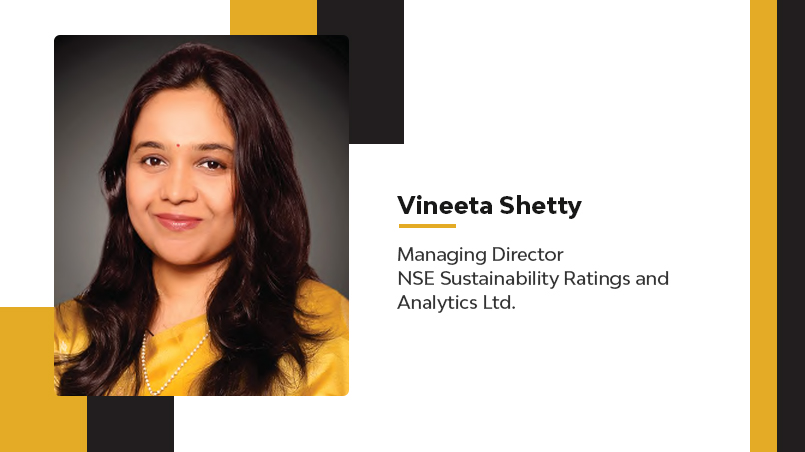
Ms. Vineeta Shetty
She has two decades of experience in financial services with experience spanning across diverse Exchange functions including new products, risk management, regulatory compliance, and the establishment of new business initiatives. She has played a pivotal role in the launch of NSE's mutual fund platform and was instrumental in setting up and managing the Central KYC Registry - an essential piece of national digital public infrastructure. Currently, she heads the ESG Ratings business under NSE Sustainability Ratings and Analytics Ltd. Prior to her tenure at NSE she worked with J P Morgan Chase. Ms. Shetty is a Chartered Accountant, Financial Risk Manager (GARP) and holds a Certificate in ESG Investing (CFA Institute).
Owned by: Institute of Directors, India
Disclaimer: The opinions expressed in the articles/ stories are the personal opinions of the author. IOD/ Editor is not responsible for the accuracy, completeness, suitability, or validity of any information in those articles. The information, facts or opinions expressed in the articles/ speeches do not reflect the views of IOD/ Editor and IOD/ Editor does not assume any responsibility or liability for the same.