 Quick Links
 Connect us

 Directors Databank (Empannel Yourself)
 Become a
  Become a
  Blog
Blog
 Become an Awards Assessor
 Publications
 Contact Us







Enhancing effectiveness of Boardroom functions

Generative Artificial Intelligence tool is the precious key
Boardroom functions of the corporate companies play a significant role in the arena of critical governance of late, as the operations of the companies have become highly complex owing to extremely demanding regulatory stipulations, often leading to the need for a systemic evaluation of the processes, emerging technological disruptions and vigilance with a defined strategy.
Digital transformation faces challenges related to talent, culture and operating models. Technology leaders must ensure that they have the digital foundation needed to leverage Generative Artificial Intelligence (Gen AI) in a safe and scalable way.
Only a few technologies have adopted Gen AI. The enormous productivity gains, its potential to transform stakeholders' experience and the nature of work itself into delight are the key. While the excitement (and worry) remains, the roadmap for turning Gen AI potential into strategy and then execution is imperative. The technology is still new. Risks and regulatory issues persist. Talent is scarce or unavailable. The costs of innovating with Gen AI are vague.
Whether businesses are ready for Gen AI, and AI more broadly, in terms of their digital foundation and infrastructure, remains the pertinent question.
The Industry-Transcending Power of Generative AI
All domains, from astronomy to anthropology, salt to software, music to metallurgy or medicine, physiology to psychology, farmers to pharmacology, are impacted by AI and derive benefits in terms of multiple options, cost saving and decision making.
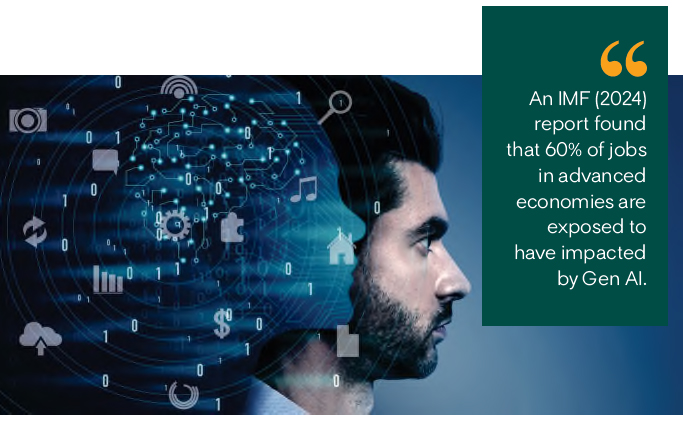
An IMF (2024) report found that 60% of jobs in advanced economies are exposed to have impacted by Gen AI. Even “early adopters” of new technology are actively exploring and experimenting with Gen AI.
Marc Kermisch, a Global Chief Digital Officer, in London, believes it is “an imperative and an obligation” to actively explore its potential in his business. “We are very anchored into determining how we can leverage this technology to continue to push the boundary of how we serve our farmers and construction operators,” says Kermisch. Need to categorising Gen AI, use-cases into three core areas:
1. Customer impact: how can we use gen AI to provide access to knowledge or tools that make it easier for customers to use our products and interact with us?
2. Employee productivity: How can we leverage our partners' tools or a Gen AI directly to drive productivity in our employee base? And lastly,
3. How can Gen AI help us design and develop our products, both in terms of software and vehicle architecture.
Telecommunication is also moving surprisingly quickly on generative AI. Nik Willetts, the CEO of TM Forum, admits he is surprised by just how fast many of the very large companies in his network have been able to move with this technology. “We have studied how telecoms around the world are using gen AI and 94% of executives in this space believe Gen AI is going to have a meaningful effect on their business in five years. And there are some good reasons for that. Some of the early adopters are generating meaningful savings and productivity improvements on the back of AI,” explains Willetts.
Other sectors, like banking, hospitality industry, entertainment, education, research and development (R&D), use Gen AI while the regulatory landscape catches up. Still a few financial institutions are actively exploring the potential of Gen AI in less-sensitive areas of their business, where there is more freedom to innovate. “The first wave of opportunities will focus on areas that are low risk to data privacy, bias, legal, and regulatory concerns,” says John Wei, EVP & CTO of Integreon. Firms within the Banking sector are looking at a number of low-risk use cases that can drive productivity, including contract risk scoring, legal review of documents, fraud detection, ideation in the marketing department, and conversational IT service management tools, among others.
On Solid Ground for AI-Everywhere
Our research has found that there are two capabilities that companies we call 'digital masters' do better than other companies they compete with. One is they are better at using technologies in their customer experience, employee experience, business models, and operations. That's their digital capability. The other side is their leadership capability. They are better at developing the capability to innovate and change over time,” says George Westerman, a senior lecturer at MIT Sloan School of Management.
Technology and Culture as the Digital Foundation
Technology leaders must ensure that their organiations have the digital foundation needed to leverage Gen AI in a safe and scalable way across the business. George Westerman from MIT Sloan School of Management says companies that are more successful at building this foundation share a focus on technology and leadership. A customised Gen AI could help immensely in exploiting fully the digital capability, as well as their leadership competence. They are better at developing the capability to innovate and change over time.” The digital foundation is akin to the brakes on a sports car.
Data Analytics is the key
Access to organisational authentic data, is important and that data is what feeds the Gen AI machine. Dion Hinchcliffe from Constellation Research believes that how organisations think about and organise their data is the key to success. A study reveals that a lot of organisations that have successfully transformed their businesses, tended to have a clear vision of their AI processes and the results. They fixed both the cultural and technical obstacles in getting data to where it needs to be,” he explains. Mr. Hinchcliffe affirms that digital leaders such as Nordstrom, Disney, and Nike have all managed to dismantle the traditional data “fiefdoms” that exist within organisations, where the marketing department feels ownership over their data and systems. “These organisations are clear that data belongs to the whole organisation and must be used to serve the customer, wherever they may be interfacing with the business. That's a hard cultural change and a hard technical change to make, but without it you're going to go nowhere fast with AI”
Transformative role of AI
The role of CIOs has to be redefined in this evolving scenario. Willetts cautions against looking at gen AI as just a technology problem: “I think where we will see a big gap emerge between those who genuinely get value out of gen AI and those who don't, will be between those who see it as a holistic transformation challenge and those who see it as a digital transformation challenge. We live in a world of continuous technological and economic evolution, and AI is going to power the next wave of this. The challenge is who can bring the whole company on that journey and get past the classical trap of this being a technology problem?” Such is the potential power of generative AI.
Conclusion
Leveraging Gen AI for unstructured data to enhance business planning and budgeting by prudent pruning and customising it is needed. Data integration is crucial in decision-making. Integrating Gen-AI capabilities with digital twin technology in an enterprise planning software platform provides end-to-end visibility of operations and helps in decision-making across supply chain, procurement, finance, marketing, steps and external partnerships. Gen AI empowers employees to gain deeper insights into unstructured data and tribal knowledge, thus accelerating knowledge transfer and enhancing overall competence of the organisation.
 Back to Home
Author

Prof. Venkateswaran Bala
He is a Professor of Management at Ramakrishna Mission Vivekananda College (Autonomous), Chennai. Earlier, he served as Professor of Management (Banking & Finance) for the MBA programme under the Pondicherry Central University Twinning Programme at Loyola College, Chennai. A distinguished banking and finance professional, he brings nearly three decades of experience in the sector, having served as Assistant General Manager with Bank of Baroda and Lakshmi Vilas Bank (now DBS Bank). A prolific writer and soughtafter speaker, Prof. Venkateswaran regularly contributes to leading publications such as Business Standard, BusinessLine, The Economic Times, and Financial Express. He has authored numerous articles on corporate governance, ESG, banking, and finance, and has delivered lectures and training programmes for banks, professional institutions, and industry forums. In recognition of his contributions to education and professional development, he has been honoured with the Lifetime Achievement Award and Best Mentor Award. He also serves as an Advisor to Goodwill Wealth Management Pvt. Ltd., Chennai.
Owned by: Institute of Directors, India
Disclaimer: The opinions expressed in the articles/ stories are the personal opinions of the author. IOD/ Editor is not responsible for the accuracy, completeness, suitability, or validity of any information in those articles. The information, facts or opinions expressed in the articles/ speeches do not reflect the views of IOD/ Editor and IOD/ Editor does not assume any responsibility or liability for the same.