 Quick Links
 Connect us

 Directors Databank (Empannel Yourself)
 Become a
  Become a
  Blog
Blog
 Become an Awards Assessor
 Publications
 Contact Us







The Three Governance Choices: How Boards Can Govern for Long-Term Climate Resilience
By- Institute of Directors | Authored by- Hon'ble Justice Mrs. Sunita Agarwal
Aug 12, 2026


A very good evening to all,
Esteemed members of the Institute of Directors, senior leaders of the industry, distinguished business professionals, dear friends, ladies and gentlemen.
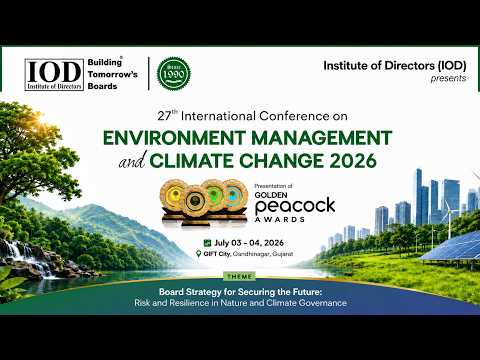
It is my proud privilege to be a part of this 27th International Conference on 'Environment Management and Climate Change' at GIFT City, which itself stands as a symbol of India's aspiration to build institutions that are prepared for the future. I congratulate the Institute of Directors for bringing together this distinguished gathering of policy makers, industry leaders, regulators and professionals to deliberate upon an issue that has steadily moved from the margins of public discourse to the centre of institutional decision making.
The transition from disclosure to accountability is where climate governance acquires real substance. Reporting informs stakeholders. Accountability drives action.
The theme of this year's Conference, "Board Strategy for Securing the Future: Risk and Resilience in Nature and Climate Governance," reflects that transformation. It recognises that environment management is no longer confined to pollution control, regulatory compliance or corporate social responsibility. It has become a question of governance, strategy and long-term institutional resilience.
Climate change has undoubtedly accelerated this transformation. It is perhaps the most visible manifestation of environmental degradation and has compelled institutions to think not only about growth, but about the conditions that make growth possible. Year after year, the World Economic Forum's Global Risks Report has ranked environmental threats such as extreme weather, biodiversity loss and the degradation of natural systems as the gravest that the world faces over the coming decade - and above every economic, geopolitical or technological risk. Consequently, environment management is no more simply about protecting nature. It is about preserving the foundations upon which economic prosperity, social well-being, and ultimately the quality of life depend. And I am confident that our deliberations today will inspire us to move beyond preserving the environment towards making it flourish for generations to come.
Our constitutional jurisprudence has also begun to reflect this changing perception. Recently, the Supreme Court of India recognised the fundamental right to be free from the adverse effects of climate change. This was a significant constitutional development. Yet it also invites a larger and deeper institutional question.
A fundamental right ordinarily comes into play after a violation has occurred. That is the nature of adjudication. Courts intervene when injury has already been suffered.
Environmental degradation and climate change, however, rarely unfold through a single defining event. Their consequences accumulate gradually, often unnoticed, until they begin to affect economies, communities and institutions in ways that are difficult to reverse. By the time the law is called upon to respond, the opportunity for prevention may already have passed.
That is not a limitation of the law. Rather, it is a reminder that the first responsibility for preventing environmental harm and building institutional resilience rests elsewhere. It rests with those institutions that make decisions before crises emerge, allocate capital before risks materialise, and govern with foresight rather than hindsight.
In the corporate sphere, no institution bears that responsibility more directly than the Board of Directors. But what is it about the changing relationship between nature, climate and governance that has placed Boards at the centre of this conversation?
The answer lies in the profound transformation that environmental responsibility itself has undergone.
One of the defining features of environmental degradation and climate volatility is that they dissolve boundaries. They do not distinguish between public and private action, between one industry and another, or between one generation and the next.
This is what makes nature and climate governance fundamentally different from the traditional challenges that Boards have managed. Conventional business risks could often be identified, measured and managed within organisational boundaries. Environmental risks, however, have defied those practices. Consequently, resilience in nature and climate governance has become as important as business efficiency and profitability.
That changing landscape prompts us to reconsider a long-held convention of corporate governance. Directors have always occupied a fiduciary position and have been entrusted with safeguarding the interests of the company while creating sustainable value for its shareholders. That principle remains unchanged.
What has changed is the reach of corporate decision-making. Decisions relating to energy use, emissions or even infrastructure, technology, and investment no longer conclude with the balance sheet. They affect the quality of our air and water, the resilience of communities and the availability of resources upon which future prosperity depends. Governance, therefore, cannot remain indifferent to consequences that extend well beyond the enterprise.
There is a further dimension to this responsibility. For much of the past decade, environmental governance was understood mainly through the language of climate - emissions, carbon and rising temperatures. Nature in its wider sense, which includes our living systems, fresh water, soil and the diversity of species, was often treated as a distant backdrop rather than a present concern of the boardroom. That assumption can no longer hold.
An enterprise does not merely act upon nature - it depends upon it. Pollination, clean water, fertile land and a stable coastline are not amenities. They are inputs, as real to the durability of a business as capital or labour. The World Economic Forum has estimated that more than half of the world's economic output is moderately or highly dependent on nature and the services it provides. For the Indian economy being built upon agriculture and the monsoon, that dependence is not an abstraction. It is felt in our fields, our reservoirs and the livelihoods of millions. A Board that governs for the long term must therefore strategize not only what its enterprise releases into nature, but what it draws from it.
The law is steadily recognising this changing reality through evolving standards of environmental governance and sustainability. Yet good governance has never been measured by compliance alone. Leadership demands something more. It begins where compliance ends.
Our constitutional culture offers an important perspective. It recognises that those who exercise power over resources affecting the community do so not merely as owners, but as trustees. This principle has long formed part of our constitutional understanding of public responsibility. It reminds us that authority is accompanied by duty, and that stewardship is an indispensable attribute of legitimate governance.
Viewed through that constitutional lens, Boards governing in an era of environmental uncertainty perform a role that extends beyond conventional corporate oversight. Their responsibility, therefore, does not end with the register of shareholders. It also extends to the register of environmental consequences. As Benjamin Franklin wisely observed, "An ounce of prevention is worth a pound of cure." In the context of environmental governance, those words have never carried greater significance.
However, the rise of nature and climate governance has not rewritten the fundamentals of good governance. It has changed the questions that now come before boards, and for which the Boards must strategize with resilience. There are three governance choices that I believe will increasingly shape our future.
1) Governance choice is to balance between competing legitimate interests.
Nature and climate governance is rarely about choosing between what is right and what is wrong. More often, it requires reconciliation among competing goods. Economic growth, environmental responsibility, energy security, innovation, affordability and employment - each serves an important public purpose. They must be balanced with fairness, foresight and institutional responsibility.
Good governance is reflected in making principled decisions that remain sustainable over time and inspire confidence among all stakeholders.
In many ways, this is no different from the task entrusted to constitutional institutions. Courts are often called upon to balance competing constitutional values. For instance, between individual fundamental rights and directive principles of the State. The convergence of nature and climate risk has made that exercise of judgment more important than ever.
2) Governance choice lies between disclosure and accountability.
n recent years, climate disclosures have become an integral part of corporate governance. They have improved transparency, encouraged better assessment of climate risks and strengthened stakeholder confidence. These developments are undoubtedly welcome.
Yet disclosure is only the beginning of governance. There is a distinction between describing a risk and owning it. A board that approves a detailed climate risk disclosure has fulfilled a reporting requirement. But a board that then asks - What have we committed to do about it? By when? And who is answerable if we do not? - has performed governance.
The transition from disclosure to accountability is where climate governance acquires real substance. Reporting informs stakeholders. Accountability drives action.
3) Governance choice lies between chasing global standards and acknowledging local realities.
India's position in the global climate conversation is unique. We are among the countries most vulnerable to climate change. For instance, India is home to nearly a fifth of the world's people but holds only about four per cent of its fresh water, and close to six hundred million of our citizens already live with high water stress. At the same time, we continue to pursue the equally important goals of economic growth, energy access and social development. We cannot simply adopt governance frameworks designed in economies that completed their industrialisation decades ago.
Global standards provide valuable benchmarks. Their real strength, however, lies in thoughtful adaptation. Governance frameworks are most effective when they reflect the economic, social and developmental realities in which institutions actually function.
Local integrity within global standards is what makes climate governance both credible and sustainable in the Indian context.
These three choices are not separate exercises but expressions of a single quality of judgment - the readiness to strategize and govern for the long term, even when the pressures of the moment pull in another direction. As Justice Benjamin Cardozo reminded us that enduring ideals must not yield to the expediency of the passing hour. Nature and climate governance calls for that same institutional discipline.
Across industries, many organisations are proving that sound environmental governance is not a constraint on success, but a foundation for it. This evening, the Golden Peacock Awards will be presented to such organisations whose outstanding achievements in environment management, energy efficiency, occupational health and eco-innovation have set exemplary standards. I extend my heartfelt congratulations to each of the award recipients. These awards represent something more than recognition of individual excellence.
Every institution is shaped not only by the rules it follows but also by the values it chooses to celebrate. What we honour publicly sends a powerful message about what we consider worthy of aspiration. That is why recognition is itself an instrument of good governance. It encourages others to learn, improve and raise their own standards. It demonstrates that environmental responsibility and sustainable business practices are not distant ideals but proven and achievable realities.
For over three decades, the Golden Peacock Awards have played this role with distinction. Instituted in 1991, they have become a recognised benchmark of corporate excellence and are conferred only after a rigorous and independent multi-tier assessment. What makes this year's recognition special is its breadth.
The honoured organisations represent a range of industries - from steel, cement and chemicals to renewable power, aviation and data centres – which is a clear sign that environmental leadership is no longer confined to a few sectors, but is taking root across our economy.
Ultimately, every generation is confronted with a defining challenge that tests the strength of its institutions. For our generation, that challenge is the changing climate and the mounting strain on the natural world. History will not judge us by the scale of our economic growth or the pace of our technological progress alone. It will ask whether, at a moment of unprecedented scientific knowledge and institutional capacity, we had the wisdom to act with responsibility and restraint.
In that sense, action on nature and climate is not only an environmental imperative. It is an institutional opportunity to create rather than await the future. It invites governments, businesses, regulators, courts and citizens alike to reaffirm a timeless principle that progress is meaningful only when it can be sustained, and that development endures only when it leaves the next generation richer than the one before. That, too, is the enduring promise of our Constitution.
I am confident that the experience and leadership gathered in this room will continue to shape that future with vision, integrity and purpose.
Thank you.
Jai Hind.
 Back to Home
Author

Hon'ble Justice Mrs. Sunita Agarwal
Chief Justice, Gujarat High Court during 27th International Conference on Environment Management & Climate Change & Presentation of the Golden Peacock Awards, held on July 03, 2026 at the Radisson GIFT City Club, Gandhinagar, Gujarat.
Owned by: Institute of Directors, India
Disclaimer: The opinions expressed in the articles/ stories are the personal opinions of the author. IOD/ Editor is not responsible for the accuracy, completeness, suitability, or validity of any information in those articles. The information, facts or opinions expressed in the articles/ speeches do not reflect the views of IOD/ Editor and IOD/ Editor does not assume any responsibility or liability for the same.