 Quick Links
 Connect us

 Directors Databank (Empannel Yourself)
 Become a
  Become a
  Blog
Blog
 Become an Awards Assessor
 Publications
 Contact Us







Measuring What Matters: Understanding Nature as the Foundation of Resilient Business and Sustainable Finance

Resilience for business and finance in today's changing world means accounting for many aspects – technology, geopolitics, sustainability - and among them, nature has emerged as a clear issue for senior decision-makers, regardless of sector. With nature degradation and nature loss accelerating, leading to consequences across the economy, finance, society and planet, it has become increasingly difficult to ignore nature-related issues within risk management and strategy.
Over recent years, the World Economic Forum's annual Global Risks Report has identified sustainability-related risks, including 'Biodiversity loss and ecosystem collapse', 'Extreme weather events' and 'Critical change to Earth systems' as within the top ten most severe long-term risks (WEF 2026). Although these perceptions of nature and climate risks class them as critical long-term global risks, they are immediate: research from the Stockholm Resilience Centre shows that the world has surpassed seven out of nine boundaries for a safe and stable planet (Stockholm Resilience Centre 2025).
Over 700 organisations have committed to publishing TNFDaligned disclosures, representing over USD $22 trillion in AUM and over USD $9 trillion in market cap from across 52 countries, and over 800 organisations have published TNFDaligned reports, growing at nearly 50% per year.
Why does this matter for business and for board directors?
These negative changes to nature and global ecosystems are not separate from the economy, from business and finance. As ecosystem services come under pressure, investments, credit ratings, share price and market capitalisation are affected as well – but many businesses are not adequately accounting for how those risks show up in their investments, business models and operations. Evidence from a range of academic papers, policy and research shows that nature-related risks can lead to significant financial effects, identified through a review of over 600 pieces of evidence across 360 sources focused on physical, transition and systemic risks resulting in both economic and non-economic effects (TNFD 2025). Companies that fail to assess nature as material expose themselves to significant risks. Nature has never been a niche issue, despite previously being considered only within ESG conversations – nature is fundamental and changes to ecosystem services, such as the provision of clean water or fertile soil, can affect financing, operations, capital allocation, investment and other short- and long-term financial outcomes for a company or financial institution.
Many organisations, including the Taskforce on Naturerelated Financial Disclosures (TNFD), have done the work to create frameworks and guidance that support corporates and financial institutions to understand, assess and disclose their nature-related dependencies, impacts, risks and opportunities (known collectively as naturerelated issues). The TNFD has worked with scientific bodies and consulted heavily with the market, including over 1800 Forum Members, to design the framework and guidance, released in final form in September 2023.
The TNFD's LEAP approach provides a methodology for the assessment of nature-related issues, moving through four phases: Locate, Evaluate, Assess and Prepare. Additional guidance and capacity-building materials from the TNFD provide support on moving from the understanding and assessment cultivated through the LEAP approach to embedding these into governance, risk management, organisational strategy and beyond. As of November 2025, over 700 organisations have committed to publishing TNFD-aligned disclosures, representing over USD $22 trillion in AUM and over USD $9 trillion in market cap from across 52 countries, and over 800 organisations have published TNFD-aligned reports, growing at nearly 50% per year.
For board directors moving towards a stronger understanding of how nature and their business interface, and what this means for organisational governance, strategy, investment and risk management, the TNFD has created a practical resource titled “Asking Better Questions on Nature: For board directors”, which sets out twelve key questions board directors can ask of company executives to surface critical information about their organisation's nature-related issues.
This deeper understanding, through conversations within the company and among executives and directors, creates the base for decisions that go beyond surfacelevel commitments or general CSR initiatives without organisational impact. Once all levels of a company or financial institution are cognisant of how nature plays into their role and into the wider functioning of the organisation, it becomes more difficult to make decisions without a consideration of the nature-related risks and opportunities present.
The questions in TNFD's “Asking Better Questions on Nature” guide for board directors encompass gaining a high-level overview of nature's relevance to a business through to integrating nature across decision making alongside external factors such as regulations and investor expectations. Although nature can be complex, breaking down the topic through these questions can help guide executives through a conversation that leads to a holistic understanding of how nature should be considered across organisational decision making.
Aspects such as metrics and data may seem more difficult than, for example, climate and GHG emissions, due to how nature is location specific. The TNFD's LEAP approach includes location in the L phase and provides guidance on scoping and prioritisation for nature-related assessment. Nature also cannot be summarised in a single metric like CO2-equivalents for greenhouse emissions for climate, but the TNFD has defined a set of core naturerelated metrics that together paint a complete picture of a company's dependencies and impacts on nature, and ensuing risks and opportunities.
TNFD's guidance provides a recommended set of indicators and metrics for both assessment and disclosure of nature-related issues, including sector-specific assessment and disclosure metrics for some sectors. Some indicators and metrics may be easy to find the data for and quantify, due to other requirements such as environmental impact assessments, supply chain surveys, climate-related data or asset location data. Others may be more difficult, but the TNFD encourages organisations to start where they can and build capacity over time.
With a complete and credible set of metrics and scienceinformed decisions, corporates and financial institutions should begin to see not only the nature-related risks that might affect the business, but also opportunities for investment, operational efficiency, new products and growth. Management of nature-related risks but also pursuit of opportunities can create long-term positive impact for a business and across investments – as well as for the planet. The resilience of business depends on the resilience of nature, and both can be nurtured in tandem.
In India as well as globally, nature is being considered at regulatory and policy levels, as well as by business and finance directly. Nature and nature-related issues are becoming central to risk and strategy throughout the Indian economy due to increasing levels of water stress, dependence on land and agricultural commodities, natural-resource-intensive sectors, infrastructure growth and supply-chain exposure. Of over 700 TNFD Adopters globally – organisations that have publicly committed to publishing TNFD-aligned nature disclosures – more than 25 are headquartered in India, and over 20 have already published TNFD-aligned disclosures.
India Business & Biodiversity Initiative (IBBI), the Confederation of Indian Industry (CII) and the TNFD published guidance regarding the alignment of the Business Responsibility & Sustainability Reporting (BRSR) and TNFD frameworks. The guidance outlines a high level of consistency between the two, including significant overlap between TNFD's core disclosure metrics and the BRSR core indicators. This means that many Indian companies may inadvertently be meeting the TNFD's recommendations already, integrating nature into existing sustainability disclosures and reporting.
 Back to Home
Author

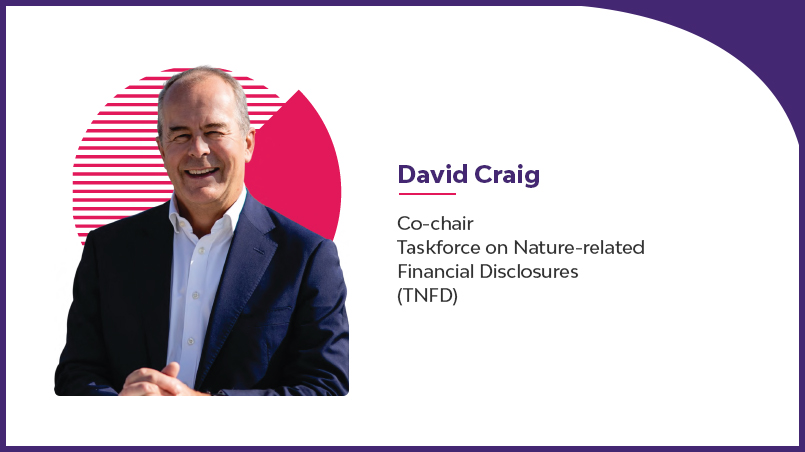
Mr. David Craig
Co-Chair of the Taskforce on Nature-related Financial Disclosures (TNFD), leading global efforts to mobilise capital towards nature-positive outcomes. With over 30 years of experience in financial markets, technology and market infrastructure, he founded Refinitiv, which was acquired by the London Stock Exchange Group in 2021 in the UK's largest technology acquisition. He currently chairs the Investment Committee of Triple Private Equity Partners and serves on the boards of several nature-technology businesses. Mr. Craig has advised leading public institutions, including the Monetary Authority of Singapore, the Bank of England and the Bank of Spain, on data, technology and AI. He is also a Trustee of the Natural History Museum, a member of the Sustainable Markets Initiative, and co-authored Bluebook (2025), reflecting on leadership, business transformation and technology-enabled growth.
Owned by: Institute of Directors, India
Disclaimer: The opinions expressed in the articles/ stories are the personal opinions of the author. IOD/ Editor is not responsible for the accuracy, completeness, suitability, or validity of any information in those articles. The information, facts or opinions expressed in the articles/ speeches do not reflect the views of IOD/ Editor and IOD/ Editor does not assume any responsibility or liability for the same.