 Quick Links
 Connect us

 Directors Databank (Empannel Yourself)
 Become a
  Become a
  Blog
Blog
 Become an Awards Assessor
 Publications
 Contact Us







Challenges of AI Technology in Corporate Governance


Ensuring Accountability in the Age of Innovation
The Institute Of Directors (IOD) organised a Conference on Business Excellence and Leadership on the theme, 'Board Leadership for Competitive Advantage' on 14th May, 2026 in New Delhi. The conference served as a national platform for advancing organisational excellence, leadership effectiveness; and the presentation of the famed Golden Peacock Awards. It also specifically highlighted the role of AI in shaping future operations.
Artificial Intelligence (AI) is transforming the way businesses operate, compete, and make decisions. From predictive analytics and automated reporting to customer profiling, fraud detection, recruitment, and risk management, AI is increasingly becoming a part of the corporate strategy. However, while AI offers speed, efficiency, and deeper insights, it also creates significant challenges for corporate governance. Boards and senior leadership must now ensure that AI is used responsibly, ethically, and transparently.
One of the biggest challenges is accountability. In traditional governance, responsibility for decisions can usually be traced to individuals or committees. With AI however, decisions may be influenced by complex algorithms that even managers may not fully understand. If an AI system makes a wrong recommendation, rejects a loan application unfairly, produces a biased hiring shortlist, or causes financial loss, the question arises: who is accountable-the developer, management, vendor, or the board? This lack of clarity can weaken governance structures.
Another major concern is transparency and explainability. Many AI models function as “black boxes,” where the outcome is visible but the reasoning behind it is difficult to explain. For boards, this creates a serious oversight problem. Directors are expected to question management decisions and understand key risks, but if AIdriven decisions cannot be clearly explained, board supervision becomes limited. This is especially concerning in areas such as finance, healthcare, employment, insurance, and compliance.
Data governance is also a critical challenge. AI depends on large volumes of data, including customer data, employee information, financial records, and market intelligence. Poor data quality can lead to inaccurate outputs, while weak data protection can expose companies to privacy breaches, cyberattacks, and regulatory penalties. Boards must therefore ensure that organisations have strong policies for data collection, consent, storage, security, and usage.
AI also increases the risk of bias and discrimination. If AI systems are trained on biased or incomplete data, they may produce unfair results. For example, recruitment algorithms may unintentionally discriminate against certain groups, or credit assessment tools may disadvantage specific communities. Such outcomes can damage a company's reputation, invite legal scrutiny, and undermine stakeholder trust.
Another governance challenge is over-reliance on technology. AI can support decision-making, but it should not replace human judgment. Boards must guard against the tendency to accept AI-generated outputs without adequate questioning. Strategic decisions involving people, ethics, reputation, and long-term value require human wisdom, not just machine-based prediction.
There are also concerns around cybersecurity and operational risk. AI systems can be manipulated, hacked, or fed misleading data. A compromised AI tool may produce harmful recommendations or expose sensitive corporate information. As AI becomes embedded in business processes, boards must treat AI risk as part of enterprise risk management.
Finally, many boards face a knowledge gap. Directors may not fully understand AI technology, its risks, or its governance implications. Without sufficient AI literacy, boards may either ignore important risks or depend excessively on management and external vendors.
AI presents both an opportunity and a governance challenge. For corporate boards, the issue is not merely technological but fiduciary. Directors must ensure that AI adoption aligns with ethics, law, transparency, accountability, and stakeholder interests. Strong AI governance will require clear policies, regular audits, board-level oversight, data protection, human accountability, and continuous learning. Only then can AI become a tool for responsible innovation rather than a source of unmanaged risks.
The IOD is organising its annual International Conference on Environment Management and Climate Change on the theme, "Board Strategy for Securing the Future: Risk and Resilience in Climate Governance" at GIFT City (Gandhinagar), Gujarat on June 03 - 04, 2026. The conference will provide an opportunity to hear leading international and national experts on strategies to preserve the environment in the present scenario. On behalf of the IOD, I have the pleasure to invite you to take advantage of this important opportunity and participate in the conference.
 Back to Home
Author

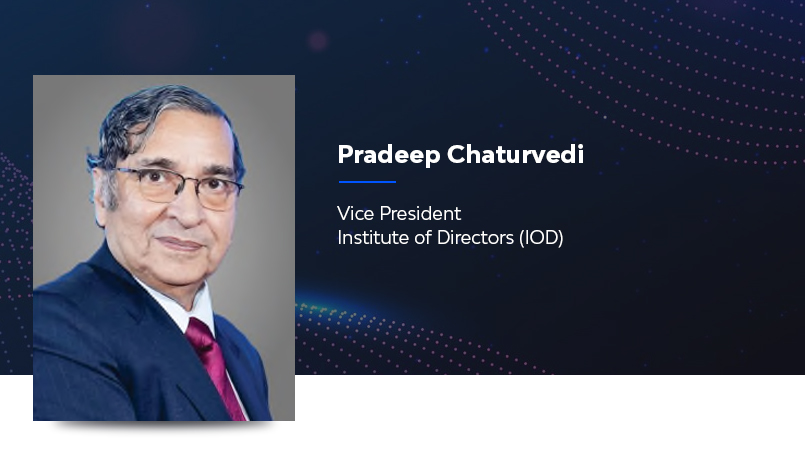
Pradeep Chaturvedi
Vice President - Institute of Directors
He is former Advisor FAO & former Chairman, Institution of Engineers, Delhi. He is a Mechanical Engineer & has been involved with Environment & Energy Policy (planning & implementation) of energy projects under the UN Agencies for over three decades in India & other Asian and Pacific countries. He is Vice-President, World Environment Foundation & Institute of Directors, India.
Owned by: Institute of Directors, India
Disclaimer: The opinions expressed in the articles/ stories are the personal opinions of the author. IOD/ Editor is not responsible for the accuracy, completeness, suitability, or validity of any information in those articles. The information, facts or opinions expressed in the articles/ speeches do not reflect the views of IOD/ Editor and IOD/ Editor does not assume any responsibility or liability for the same.