 Quick Links
 Connect us

 Directors Databank (Empannel Yourself)
 Become a
  Become a
  Blog
Blog
 Become an Awards Assessor
 Publications
 Contact Us







Health Insurance Literacy: How Boards Can Advance Women's Financial Inclusion Journey in India

India has built impressive insurance infrastructure. Yet infrastructure without literacy is merely architecture without a door.
Let me ask a simple question: Do you know what your health insurance actually covers?
Not the premium amount. Not the insurer's name.
I mean the waiting periods, sub-limits, exclusions, preventive benefits, and conditions that determine whether your policy will support you when you need it most.
If you paused before answering, you are not alone.
Health insurance literacy in India is facing a significant challenge. It is not merely a rural issue. It is an urban issue, a professional issue, and perhaps most importantly, a women's issue. Until we recognise the problem clearly, we risk designing solutions for the wrong diagnosis.
The Numbers Tell a Compelling Story
India's Health Insurance reflects a paradox. Coverage has expanded significantly, yet comprehension remains limited across demographic groups.
Consider the following numbers:
• Only 30% of women aged 15-49 have health insurance coverage, compared with 33% of men.
• Approximately 34% of rural households remain without any form of health insurance.
• Nearly 47.1% of India's total health expenditure continues to come directly from household out-ofpocket spending.
• India's life expectancy stands at 70.2 years, but healthy life expectancy is only 62.6 years, meaning the average Indian spends more than eight years living with illness or disability.
• Across Southeast Asia, Indonesia reports health insurance coverage among women of approximately 58.2%, while India remains at 30%. Within India itself, coverage varies dramatically-from nearly 88% in Rajasthan to less than 2% in certain Union Territories.
Distributing an insurance card is not the same as delivering financial protection. When an employee discovers a policy limitation only during a medical emergency, the benefit has effectively failed at the moment it was needed most.
The insurance map increasingly mirrors the literacy map. That is not coincidence; it is a policy signal.
There are, however, encouraging signs. Women opting for preventive-care benefits have doubled in recent years, and Tier-2 city enrolment continues to accelerate. Awareness is rising. Product innovation must now catch up. The figures mentioned above reveal an uncomfortable reality. While women are increasingly included in India's financial system, they often remain excluded from financial decisionmaking. True inclusion is not merely about access to products; it is about agency, understanding, and confidence in using them. Health insurance literacy sits at the intersection of all three.
The Three Indias of Health Insurance Literacy
India's health insurance landscape challenge manifests across social and economic segments, but the underlying issue remains the same, it reveals three distinct realities, each requiring a different approach.
• India One: The Rural Woman
She may not be formally educated and is often not the primary financial decision-maker within her household. Healthcare engagement frequently begins only when illness has become unavoidable-a persistent cough ignored for months or a symptom recognised too late.
Only 1.9% of Indian women aged 30-49 have undergone cervical cancer screening, despite cervical cancer claiming more than 75,000 lives annually. The gap between these two facts is not primarily medical; it is cultural.
• India Two: The Semi-Urban Woman
She carries an insurance card but has little understanding of the protection it offers. She occupies a neglected middle ground—too urban for grassroots interventions and insufficiently targeted by sophisticated awareness campaigns. She is perhaps the most reachable woman in India today yet remains one of the least engaged.
• India Three: The Metro Professional Woman
She is educated, financially independent, and digitally connected. She may even hold multiple health insurance policies.
Yet ask her about her room-rent limits, waiting periods, or preventive care benefits, and the response is often uncertainty.
India has built impressive insurance infrastructure. Yet infrastructure without literacy is merely architecture without a door.
I have had this conversation with women leading large organisations and managing significant responsibilities. The knowledge gap remains surprisingly widespread.
Today, women account for only 22% of policy proposers in India. Fewer than one in four health insurance policies are purchased by women in their own names.
We Were Never Taught to Put Our Health First
Oscar Wilde famously wrote: “To love oneself is the beginning of a lifelong romance.”
For many women in India, self-care has never been culturally encouraged.
How many women postpone a medical appointment because school fees are due?
How many prioritise a child's minor illness while delaying their own screening tests for years?
The issue is rarely affordability alone. It is often a deeply embedded belief that spending on oneself is somehow less important than spending on others.
This is not an individual's failure. It is inherited social conditioning, and the consequences extend beyond personal health. An uninsured illness can erase years of household savings, disrupt education, and push families into financial distress. Women's health is not merely a social issue; it is a critical economic issue.
Why This Is a Governance Issue
For many organisations, women's financial inclusion is discussed through the lenses of diversity, equity, and workforce participation. Yet financial resilience rarely receives the same level of board attention.
Health insurance literacy offers boards a practical opportunity to advance women's financial inclusion while simultaneously strengthening workforce wellbeing and organisational resilience.
Boards routinely discuss employee wellbeing, talent retention, diversity, ESG commitments, and long-term value creation. Yet a critical question rarely appears on board agendas:
Do employees understand and utilise the health protection benefits being provided to them?
An employee who does not understand preventive health benefits will not use them. A manager who misunderstands policy limitations may face financial hardship despite being insured. A workforce that remains underinformed creates hidden organisational costs through absenteeism, disengagement, productivity loss, delayed treatment, and avoidable health expenditures.
These are not merely social concerns; they are business risks.
Distributing an insurance card is not the same as delivering financial protection. When an employee discovers a policy limitation only during a medical emergency, the benefit has effectively failed at the moment it was needed most. Such failures may remain invisible to boards, but their consequences are borne entirely by employees.
Boards that overlook this gap are not merely missing a wellbeing opportunity—they are accepting a governance blind spot.
A Framework for Action
Closing the health insurance literacy gap requires boards to move from passive provision to active stewardship and coordinated actions across multiple stakeholders.
• Leadership
Women who have navigated the healthcare system must share their experiences. Personal stories often achieve what advertising campaigns cannot.
Boards should regularly review data on benefit utilisation, preventive care participation, and employee awareness alongside other workforce indicators. Low utilisation of health benefits should be treated as a governance signal rather than an administrative statistic.
• Institutions and Education
Employers must move beyond distributing insurance cards. Health literacy should become an essential workplace capability and a life skill taught in schools.
A girl who understands insurance at fifteen is more likely to demand financial protection at twenty-five.
• Community
Health literacy spreads most effectively through trusted communities. Women learn best from trusted networks. Whether through self-help groups, anganwadis, workplaces, or digital communities, peerto- peer education remains one of the most effective drivers of behavioural change.
• Demand Better Product Design from Insurer Partners
Boards possess significant procurement influence. Insurer partnerships should be evaluated not only on premiums and network size but also on product simplicity, claims experience, preventive care offerings, and member education support.
Insurers that make policies easier to understand contribute directly to workforce resilience and organisational wellbeing.
Policy documents should be understandable to the people who purchase them. Simplicity and transparency must become competitive advantages.
The Moment We Are In
India already possesses all the foundational elements required for transformative progress: a young population, large-scale public health initiatives, expanding insurance penetration, and digital infrastructure capable of reaching the last mile.

The missing ingredient is not technology. It is not a policy. It is not the capital.
It is understanding.
True financial inclusion will not be measured solely by the number of policies issued. It will be measured by the number of people who understand, trust, and effectively use the protection available to them.
For boards, this represents both a responsibility and an opportunity. Organisations that champion health insurance literacy are not simply supporting employee wellbeing; they are strengthening workforce resilience, advancing gender equity, improving productivity, and creating long-term value.
The next phase of India's financial inclusion journey will be defined not by coverage alone, but by comprehension. Boards that recognise this-and act on it-will not merely govern effectively. They will lead the way toward a healthier, more financially secure India.
 Back to Home
Author
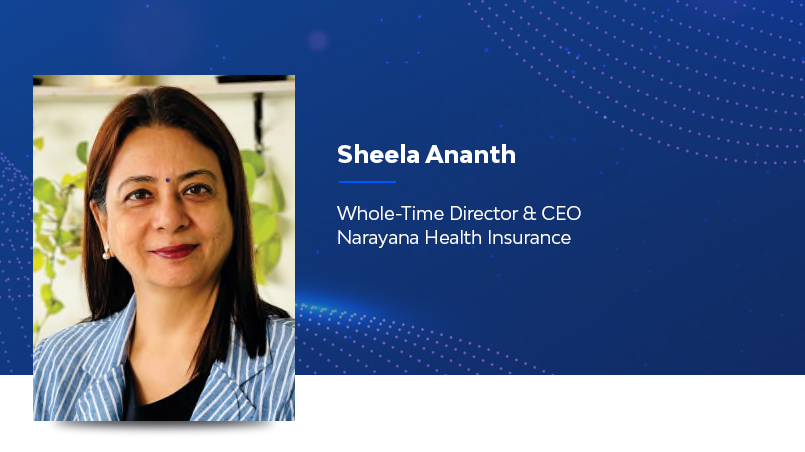
Sheela Ananth
She is a distinguished healthcare and health insurance leader with over two decades of experience driving business growth, innovation, and operational excellence across the healthcare ecosystem. As Whole-Time Director and CEO of Narayana Health Insurance, she is spearheading India's first provider-led health insurance company, focused on making quality healthcare more affordable, accessible, and patient-centric. She is also a founding member of Vidal Health TPA. Ms. Sheela has played a pivotal role in shaping the health insurance and healthcare services landscape in India. A strategic advisor to healthcare startups, she is passionate about advancing healthcare accessibility, financial protection, preventive health, and technology-driven innovation.
Owned by: Institute of Directors, India
Disclaimer: The opinions expressed in the articles/ stories are the personal opinions of the author. IOD/ Editor is not responsible for the accuracy, completeness, suitability, or validity of any information in those articles. The information, facts or opinions expressed in the articles/ speeches do not reflect the views of IOD/ Editor and IOD/ Editor does not assume any responsibility or liability for the same.