 Quick Links
 Connect us

 Directors Databank (Empannel Yourself)
 Become a
 Become a
 Blog
 Become an Awards Assessor
 Publications
 Contact Us







CSR and Exploring Evolution of ESG in the New World Economy
By- Institute of Directors | Authored by- Lt. Gen. Surinder Nath, PVSM AVSM (Retd.)
Nov 04, 2026


A focus on CSR and ESG at the same time makes this event unique and significant for future socio-economic development of the country. This conference follows the COP-28 in Dubai, with the focus on climate change and environment, that clearly bought out the issues of sustainability, decarbonisation, environment protection and governance practices. Corporate Social Responsibility is not a new concept, even when Mahatma Gandhi mentioned Trusteeship the whole idea was woven around the present-day CSR concept. Experts have believed businessmen have a social responsibility to peruse policies, make decisions and act in ways consistent with the values and objectives of the society.
CSR considered in the present context is an important medium to overcome the difficulties of the deprived and the needy persons. Through CSR, various companies discharge their responsibility towards the society that exists in their eco-system. The corporate citizenship has evolved encompassing the provisions of Companies Act 2013 and the actions that helped serve the society in an inclusive and responsible manner. Provisions of Schedule VII of the Companies Act 2013 have facilitated larger contribution of the corporate sector into the government programmes. Boards have been involved in areas of greater social significance and their role has been prominent in making CSR inclusive in their strategic planning to include, Rural Development, Education, Health, Safe Drinking Water and Sanitation and Women Empowerment by Enhancing Vocational Skills. This integrated approach of corporate world with Government Programmes and Schemes have created an ecosystem where larger number of persons are able to get out of hunger, malnutrition and poverty trap and live a more decent life.
Boards have evolved strategy for economic growth which focuses on diversity, equality and inclusiveness. There has been appreciable impact of CSR activities on uplifting the poor out of poverty and malnutrition trap. Good corporate governance ensures effective and inclusive CSR programme.
Initially the Companies Act 2013 had directed companies to focus on areas around their operation for CSR activities. However, in August 2021, government decided to allow companies to spend in other areas. Companies were expected to balance local area preference with national priorities. IOD had in recommendations of its earlier CSR events pointed out the need for such an approach and had represented to Ministry of Corporate Affairs as well as leading corporate houses.
CSR emphasises and advocates the role of business in society, beyond the traditional role of maximizing profits. Corporates are presently considered also the engines of social transformation. In other words, CSR has moved from fringes to the mainstream of corporate consciousness, turning business into a cause. The biggest challenge today, lies in managing diversity and bridging disparities, investing in local communities, seeking their trust and making a difference in their lives.
India’s companies have spent major share of CSR funds on education, health and rural development during the 7 years of FY 2014-15 to FY 2020-21. Around 33% of the total CSR funds spent by the companies was in the states of Maharashtra, Karnataka, Gujarat, Andhra Pradesh and Tamil Nadu. CSR fund spending on pan-India projects was Rs 41,398 Crore. This amounts to 32% of the total CSR spending. Around 60% of the total CSR funds spent by the companies is in the areas of education, healthcare and rural development related activities. Maharashtra, India’s, biggest contributor to GDP, spent the highest amount (Rs. 18472 Crore) on CSR in the 7-year period. Data shows that in FY 2020-21, over 44% of the CSR funds went to ten states. These top ten beneficiary states include eight of the largest state economies by their FY2020-21 GDP- Maharashtra, Gujrat, Andhra Pradesh, Karnataka, Uttar Pradesh, Tamil Nadu, Rajasthan, and Madhya Pradesh. In contrast, the north-eastern states of Assam, Arunachal Pradesh, Manipur, Meghalaya, Mizoram, Nagaland, Sikkim, and Tripura received a mere 0.91% of the funds in FY2020-21.
The applicants of Golden Peacock Awards this year indicated 5 major elements; (i) every company spent 2% or more of their net profits on CSR projects; (ii) companies undertook pan-India approach; (iii) priority areas were education, skills development and employment, women empowerment, healthcare and drinking water; (iv) integration with government programmes and collaboration with government agencies; and (v) participatory approach by involving stakeholders in the total value chain.
In the words of Mahatma Gandhi, “business entrepreneurs are trustees and not the owners of the social wealth and they have to spend a part of it for social causes. To describe the principle of trusteeship he quoted, “enjoy the wealth, take the minimum which you need, leave the rest to the welfare of community”. Under trusteeship model surplus wealth need to be kept in the trust of common good and welfare of others and thereby build sustainable livelihoods for all. Gandhian thoughts have had profound impact on corporate social responsibility not only in India but also amongst many other countries.
How do the company’s corporate social responsibility (CSR) initiatives relate to long term value directly tied to the business mission and authenticity that resonates with the external world, and galvanizing effect inside the firm? It is important to consider, how do the company’s CSR initiatives relate to long term value? “Connection between environmental stability and the company’s financial stability” have become more meaningful than just a discussion about global warming.
CSR issues are also coming into sharper focus in boardroom as shareholders, customers, and employees emphasize the importance of high standard of ethics and respect for sustainability, human rights, environmental protection and diversity in the global market place.
In the most mature phase, ESG related practices are inherent to the firm’s business strategy and a core component of its culture.
ESG refers to a set of criteria used to asses a company’s performance and behavior in relation to environmental, social, and governance issues. It is primarily used as a framework for evaluating the sustainability and ethical impact of investments. The thrust on environmental and social components brings it closer to CSR concepts and practices.
The environmental aspect examines a company’s impact on the national environment including its efforts to reduce pollution, conserve resources, mitigate climate change and promote environmental stewardship. The social component evaluates the company’s interaction with its stake holders such as employees, customers, communities, and suppliers. In other words, the total value chain. It focuses on issues like labour practices, human rights, diversity and inclusion, community engagement, and product safety. Governance assesses the company’s leadership, corporate structure, transparency, accountability, and adherence to ethical business practices. ESG considerations have gained prominence in investment decision making as investors increasingly recognize the importance of sustainable and responsible business practices.
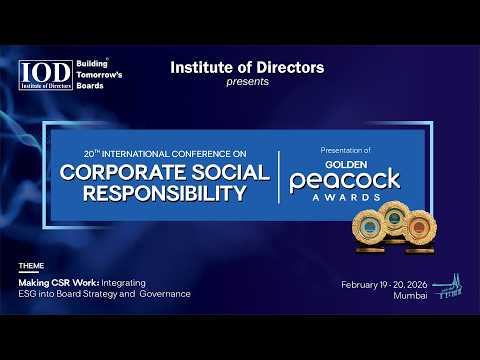
Shareholder activism is forcing companies to be more ethical, human-centric and environment protective. CSR concept embedded into ESG principles is now seen as major thrust for industries to ensure socially acceptable and environment friendly growth patterns. These trends are not speculative but evolving with time. Therefore, firm actions in CSR supported by evolving ESG approaches, can make a corporate work more efficiently and be acceptable to the society. In the 18th International Conference on Corporate Social Responsibility is appropriately focusing on CSR as a strategic imperative in board rooms and also ESG strategy for sustainability based on CSR activitities.
 Back to Home
Author

Lt. Gen. Surinder Nath, PVSM AVSM (Retd.)
President, Institute of Directors
former Chairman, UPSC
former Vice Chief of Army Staff and
former Independent Director, L&T Ltd.
He took over as the President of Institute of Directors with effect from 02 December, 2022
Owned by: Institute of Directors, India
Disclaimer: The opinions expressed in the articles/ stories are the personal opinions of the author. IOD/ Editor is not responsible for the accuracy, completeness, suitability, or validity of any information in those articles. The information, facts or opinions expressed in the articles/ speeches do not reflect the views of IOD/ Editor and IOD/ Editor does not assume any responsibility or liability for the same.