 Quick Links
 Connect us

 Directors Databank (Empannel Yourself)
 Become a
  Become a
  Blog
Blog
 Become an Awards Assessor
 Publications
 Contact Us







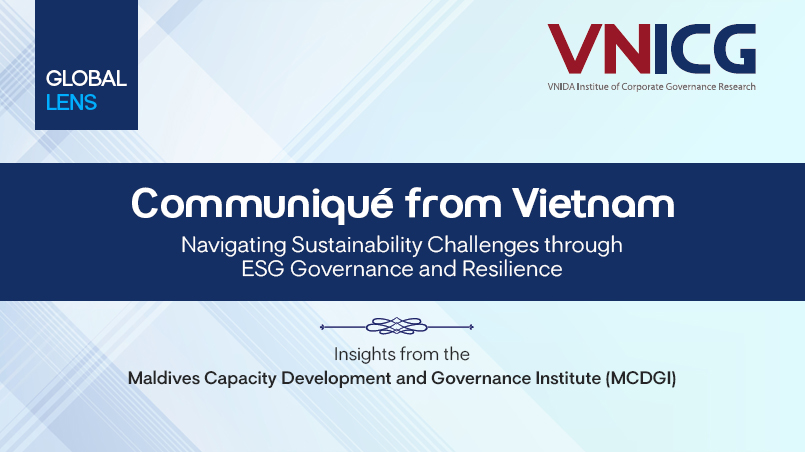
Communiqué from Vietnam: Navigating Sustainability Challenges through ESG Governance and Resilience

Vietnam's corporate sector has reached an inflection point. A decade of institutional reform - a strengthened legal framework, a national Corporate Governance (CG) Code, and rising market awareness - has pushed environmental, social, and governance (ESG) practice forward. Yet the harder transition still lies ahead: moving from "ESG for compliance" to "ESG for competitiveness and resilience."
Five Interlocking Challenges
Vietnamese businesses now operate amid genuine systemic risk: climate volatility, geopolitical shocks, supply-chain disruption, the energy transition, cybersecurity exposure, and mounting ESG expectations from international investors and buyers interact with and amplify one another, rather than arriving as isolated threats. Governance quality remains uneven - many boards still under-deliver on strategy-setting and risk oversight, independent directors carry limited influence, and internal control systems have yet to mature. ESG itself is too often treated as a compliance exercise: delegated to a dedicated department, disconnected from business strategy and enterprise risk management, and measured by disclosure volume rather than substantive change - a pattern best described as "ESG reporting without ESG management." Data and capacity gaps persist: reliable emissions data, ESG-trained talent, and experience with international frameworks such as ISSB, GRI, and TCFD remain scarce, particularly among small and mid-sized enterprises. And resilience, the capacity to absorb shocks and adapt is rarely treated as a core competency, with business-continuity planning, climate-risk assessment, and crisis governance still largely reactive.
ESG Governance as the Reconciling Mechanism
ESG governance is the mechanism that can reconcile these tensions. Aligned with OECD and IFC guidance and Vietnam's own CG Code, boards are expected to set risk appetite, embed ESG into strategy, oversee execution, and ensure transparency and accountability - turning ESG from a reporting function into a value-creation process. A parallel global trend is the integration of ESG with enterprise risk management, internal control, internal audit, and business continuity into a single governance architecture, so that climate risk is managed as strategic risk and social risk as operational risk. Transparent reporting under GRI and ISSB standards then compounds these gains: better data quality, improved access to capital, lower cost of capital, and reduced exposure to "greenwashing" accusations.
Resilience: The Missing Half
Resilience completes the picture. Where ESG governance asks how a company should be governed, resilience asks whether it can endure and grow through crisis. That means building climate, financial, operational, cyber, supply-chain, and governance resilience together, through scenario planning, stress testing, and a culture of continuous learning and adaptation - not merely control.
An Emerging Governance Ecosystem
Vietnam's emerging governance ecosystem including state regulation, the CG Code, OECD and IFC guidance, and professional bodies including VNIDA, VNICG, and IIA Vietnam, alongside market initiatives such as VLCA is steadily narrowing the gap with international practice, professionalizing boards, and spreading a culture of good governance through training and recognition.
The direction of travel is clear: ESG as a strategic capability rather than a checkbox, resilience as an explicit corporate objective, and governance as the operating system connecting both to long-term competitiveness, capital access, and sustainable growth.
Author:
Mr. Hoang Duc Hung
Chairman
VNIDA Institute of Corporate Governance Research (VNICG)
 Back to Home
Author
Institute of Directors India
Bringing a Silent Revolution through the Boardroom
Institute of Directors (IOD) is an apex national association of Corporate Directors under the India's 'Societies Registration Act XXI of 1860'. Currently it is associated with over 31,000 senior executives from Govt, PSU and Private organizations of India and abroad.
Owned by: Institute of Directors, India
Disclaimer: The opinions expressed in the articles/ stories are the personal opinions of the author. IOD/ Editor is not responsible for the accuracy, completeness, suitability, or validity of any information in those articles. The information, facts or opinions expressed in the articles/ speeches do not reflect the views of IOD/ Editor and IOD/ Editor does not assume any responsibility or liability for the same.