 Quick Links
 Connect us

 Directors Databank (Empannel Yourself)
 Become a
  Become a
  Blog
Blog
 Become an Awards Assessor
 Publications
 Contact Us






The Weight of the Seat: Expertise, Capabilities and the Readiness to Lead in a Changing Boardroom
By- Institute of Directors | Authored by- Lt. Gen. Surinder Nath, PVSM AVSM (Retd.)
Oct 15, 2026


An appointment confers a designation; it does not confer competence.
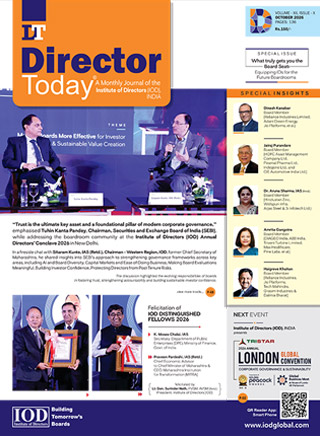
Every board position begins with an appointment. But the real work begins afterwards, quietly, in the follow-up meetings, in the papers that are actually read, the questions that are actually asked, and the courage to disagree when agreement would be easier. The October 2026 issue of Director Today, themed “What Truly Gets You the Board Seat: Equipping IDs for the Future Boardrooms,” addresses a question that every aspiring and serving Independent Director (ID) must answer squarely, “What does it take to earn a seat in an Indian boardroom, and what does it take to keep it?”
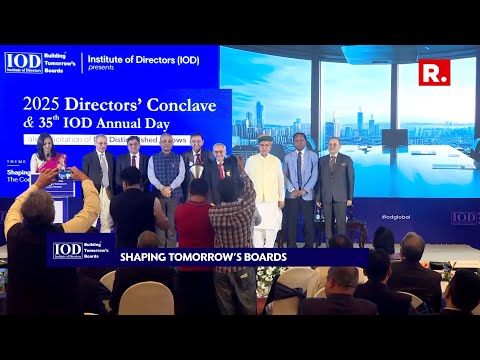
It is fitting that this Special Issue on Independent Directors follows within weeks of the IOD's Annual Directors' Conclave & 36th Annual Day in New Delhi, where nearly 400 board members, regulators and business leaders came together under the theme “Building Boards fit for Investor Confidence and Sustainable Value Creation.” Investor confidence, as the discussions made evident, is earned by boards whose members demonstrably understand their business, their risks and their responsibilities.
But what gets a director to the table is changing. Technical expertise remains the foundation, but it is no longer sufficient. In an environment being reshaped by AI, geopolitical shifts, changing stakeholder expectations and new forms of risk, five capabilities are increasingly central to the future-ready Independent Directors: Financial and risk literacy; Regulatory and legal command; Technology, cyber and data fluency; Strategic and geopolitical foresight; and Sector and institutional depth.
Professional standing and networks may open doors, but it is the ability to contribute independent judgement, informed perspective and meaningful challenge that sustains relevance once inside the boardroom. The future-ready Independent Director must therefore bring not only specialised knowledge, but also the curiosity to keep learning.
Getting the seat is not the test; remaining relevant for the seat is.
In the armed forces, no commander acts without first making an appreciation of the situation. For the director's equivalent to this is disciplined preparation; understanding the business, studying the papers, familiarising oneself with the issues and continuously building the knowledge required to exercise sound judgement. Familiarisation, committee work, continuous learning and regular evaluation are the instruments; curiosity is the motive that keeps them meaningful. Readiness is particularly important when circumstances are uncertain or disruptive. The ability to exercise conscious judgement amid disruption and chaos cannot simply be summoned when a crisis arrives. Composure is not improvised; it is rehearsed. It is built through habits of preparation, questioning, reflection and continuous engagement. The boardroom may demand a decision in an hour, but the quality of that decision is often shaped by the discipline developed long before that hour arrives.
The same demand for readiness is being made on a far larger stage. This September, New Delhi hosted the 18th BRICS Summit and its Business Forum, where concerns around supply-chain resilience, trade and tariff volatility, cross-border payments and currency risk, AI governance, and sustainability woven into growth strategy were economic in scale but unmistakably familiar to any boardroom. Read together, they suggest that the global corporate community is preparing for volatility as a permanent condition. That readiness is never a one-time achievement. It is a discipline we return to.
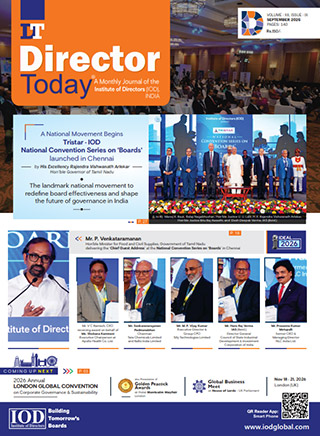
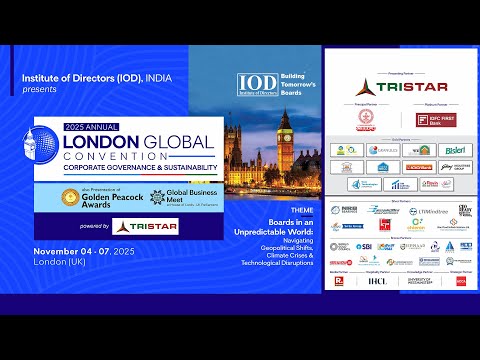
IOD will carry these questions forward on two fronts. We will soon release the second edition of the IOD Handbook on Corporate Leadership. And at the IOD's London Conclave, from 18 to 21 November 2026, on the theme “Boards at the Crossroads of Volatility and the AI Era: Shaping the Future of Corporate Governance and Sustainability,” we shall take these conversations to a global audience.
As you turn the pages of this Special Issue, through the Conclave report and the experience-worn counsel of our contributors, I ask you to read them not as a checklist for landing a board seat, but as a guide to what the seat demands once it is yours.
A board seat is not a distinction to be collected. It is a charge to be discharged. It is where the more meaningful part of the journey begins.
What an Independent Director brings to that journey, through judgement, curiosity, courage and the willingness to ask the difficult question, determines not only the strength of the boardroom, but also the resilience of the institution it serves.
 Back to Home
Author

Lt. Gen. Surinder Nath, PVSM AVSM (Retd.)
President, Institute of Directors
former Chairman, UPSC
former Vice Chief of Army Staff and
former Independent Director, L&T Ltd.
He took over as the President of Institute of Directors with effect from 02 December, 2022
Owned by: Institute of Directors, India
Disclaimer: The opinions expressed in the articles/ stories are the personal opinions of the author. IOD/ Editor is not responsible for the accuracy, completeness, suitability, or validity of any information in those articles. The information, facts or opinions expressed in the articles/ speeches do not reflect the views of IOD/ Editor and IOD/ Editor does not assume any responsibility or liability for the same.