 Quick Links
 Connect us

 Directors Databank (Empannel Yourself)
 Become a
  Become a
  Blog
Blog
 Become an Awards Assessor
 Publications
 Contact Us







The Art of Unlearning: Why Boards Must be Willing to Course-Correct

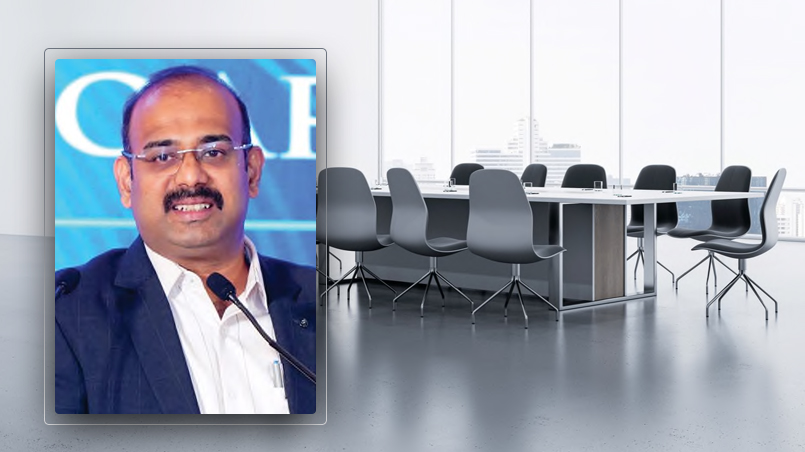
I had certain experiences as a bureaucrat where I failed, but I learned a great deal.
After my initial stint as a Sub-Collector, I was immediately given a very challenging opportunity. To be very frank, it was a newly created opportunity. It was not even a career post; it was a post created in Rameswaram as the Project Director of Palk Bay Fisheries.
This came about because, post-Civil War in Sri Lanka, fishing conflicts began rising and started creating diplomatic strains between the two countries. So, both the Government of India and the Government of Tamil Nadu were keen to resolve this issue at the earliest, in a humane way, without disturbing the livelihood of fishermen who fish in the Palk Bay region, from Vedaranyam to Dhanushkodi. Post-2009, the issues became much more serious. So, the government launched a scheme called 'Deep-Sea Fishing for Fishermen', and I was appointed as the first Project Director for that.
As I told you, I am a medical professional. I had no experience in engineering, or for that matter, shipbuilding, boat building or fisheries, nothing at all. I thought, well, it is an opportunity the government has given me. There was a huge subsidy for that project, but there was nobody to serve; nobody came forward. That was my first lesson in unlearning, because it was a supply-driven project, when unfortunately, it ought to have been a demand-driven project. We then began redrafting the entire scope of the project with the help of fishermen. I spent eight months camping there, in Rameswaram, Vedaranyam and Dhanushkodi, working alongside the fishermen.
At times, I would go out in their trawlers, sometimes as far as the IML. They would tell me how things happened out there. They gave me very candid accounts of how they went about trawling, what violations they had committed, how they were pressured into it, how the system had once supported the entire ecosystem, and how the system was now working against it.
That was a great learning experience for me, because I have constraints; I have limitations as an officer. I cannot stretch my mandate. At the same time, I had to provide a solution to this very complex problem. It was not a simple livelihood problem, nor a simple government subsidy scheme. It involved a legacy of issues, and it involved very sensitive diplomatic relations between two countries.
Finally, we devised a completely new scheme, so much so that we redesigned the subsidy pattern altogether. We provided the blueprint for the boat. Previously, everything came from New Delhi, including the boat's blueprint.
We effectively unlearned that entire process. It took me eight months, and we took the fishermen to the Cochin Shipyard, where the first engineered fishing boat in the country was built. I was very proud to say that it was the first engineered boat born of the traditional knowledge of fishermen and the engineering legacy of Cochin Shipyard.
I thought it was a failure. I thought I could not meet the benchmark, that I could not achieve break-even, that I could not show results. But results do not happen overnight.
I still have a photograph on my phone of our aircraft carrier, INS Vikrant, being built at the Cochin Shipyard before it was commissioned, with my small fishing boat in the backdrop of INS Vikrant. Our fishermen took selfies with that boat, with INS Vikrant in the background, and they put up a large flex board in Ganeshwaram declaring that this boat would be called the "Navy boat". They ended up registering the entire deep-sea fishing boat fleet as the Navy boats, because it looked like a robust Navy vessel. I thought, well, they have understood the point why we had engineered it, we had built it, the subsidy had been reorganised, but the entire ecosystem was not changing.
A few people with the appetite for risk came forward and took the boats, but what about those with medium or low risk appetite? What about the labourers in that area? There was no alternative for them. So, we then charted out a plan for livelihood change in that area, though the Cochin facilities were not adequate either.
It took 35 days of fishing and 35 days at sea. Our fishermen in Palk Bay were used to daily fishing; they did not have the endurance for that. So, the endurance training took years. The labour market was not ready for deep-sea fishing. So, long story short, the scheme was not a great success; even today, it is not a great success, to be very frank.
But at the same time, it gave me a tremendous opportunity to learn how things fail, how they can be course-corrected, and how to devise a government scheme. And now I see that, with the continuous push from both governments, the scheme is gradually taking off. There are now more than 100 boats in our exclusive economic zone, which started with just 13 boats during my tenure.
So, I thought it was a failure. I thought I could not meet the benchmark, that I could not achieve break-even, that I could not show results. But results do not happen overnight. Now, looking back, I see more than 100 boats in our exclusive economic zone. Cochin Shipyard has since provided that blueprint to many other corporates, who have started building boats along the entire coastline of our country. The issue still remains, but this is a small example of how unlearning can help you move forward.
In recent years, there has been an Urban Challenge Fund from the Government of India, and a CM Urban Transformation Mission from the Government of Tamil Nadu. Both of these missions are looking to invite market capital into urban local bodies, and we are ready to change our regulatory regime accordingly.
Most of the difficult laws have been changed, and we are inviting people to come and invest. So, 'One Chennai, One Network' is our idea. We are not thinking merely of a stretch of road, a flyover, a footpath or a pedestrian plaza. We are thinking of area-based development, where we connect schools, commercial units and business centres, where we encourage non-motorised transport and pedestrianisation, and where everything is connected.
 Back to Home
Author
Dr. G.S. Sameeran, IAS
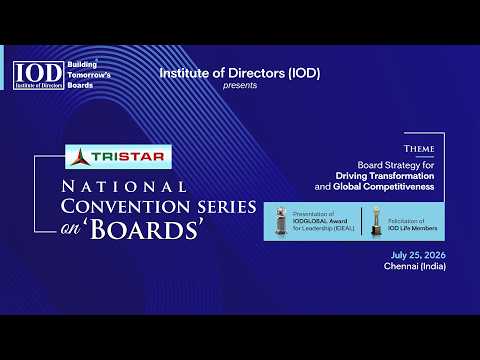
Excerpts from the 'Special Address' delivered by Dr. G.S. Sameeran, IAS, Commissioner, Greater Chennai Corporation, during the Inaugural Session of the National Convention Series on 'Boards', held on July 25, 2026 at the Taj Coromandel, Chennai.
Owned by: Institute of Directors, India
Disclaimer: The opinions expressed in the articles/ stories are the personal opinions of the author. IOD/ Editor is not responsible for the accuracy, completeness, suitability, or validity of any information in those articles. The information, facts or opinions expressed in the articles/ speeches do not reflect the views of IOD/ Editor and IOD/ Editor does not assume any responsibility or liability for the same.