 Quick Links
 Connect us

 Directors Databank (Empannel Yourself)
 Become a
  Become a
  Blog
Blog
 Become an Awards Assessor
 Publications
 Contact Us







Building the Ecosystems of Tomorrow: Redefining Competitive Advantage Through Strategic Partnerships and Innovation

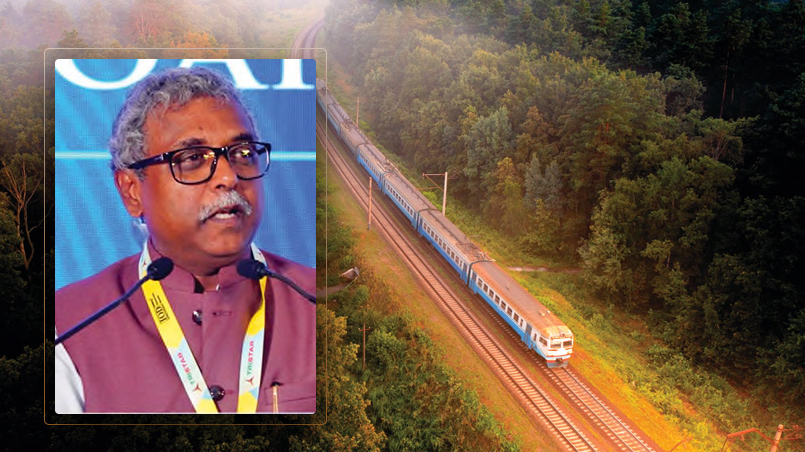
I would like to say that we are living in a period of extraordinary transformation. The traditional sources of competitive advantage, scale, capital, physical assets and access to markets, were important, but today, they are no longer sufficient; something more is required.
The new economy is increasingly driven by technology, speed, knowledge, innovation, data and, above all, the ability to collaborate. In such an environment, no organisation succeeds by working in isolation.
The winners of tomorrow will be those who can connect capabilities, build bridges, share knowledge, create ecosystems that are larger and more capable than any individual organisation, and this has an important message. The future of competition is increasingly the competition between ecosystems. Traditionally, we have viewed businesses through the lenses of competition between company versus company, product versus product, country versus country, but the nature of business is fast changing.
Today, a company may compete with another organisation in one area, collaborate with it in another and simultaneously depend on a common technology platform developed by a third organisation. Let me just use the example of the smartphone industry. The final product may carry one brand name, but its success depends upon an entire ecosystem. Semiconductor companies, software developers, cloud platforms, telecommunication networks, component manufacturers, logistics providers and, of course, content creators.
The same principle applies to energy, aerospace, defence, manufacturing and, above all, mobility, the industry I belong to. Therefore, the strategy question for leaders is no longer merely, 'How do we become better than our competitors?', but, 'How do we build an ecosystem that makes us stronger, faster and more innovative?'
Integral Coach Factory has been at the heart of India's railways manufacturing journey for nearly seven decades. Over the years, ICF has produced more than 80,000 coaches. Let me proudly tell you that this is the biggest coach manufacturing organisation in the world, and I am sure that no factory in the world produces about 3,000 coaches every year with more than 700 railways.
But the rail industry, like every other industry, has changed dramatically. Managers today expect much more than simply travelling from one destination to another. They expect safety, comfort, speed, reliability, aesthetics, accessibility and a superior travel experience.
After all, we are living in an aspirational India with growing incomes.
The introduction of Vande Bharat marked an important turning point in this journey. Vande Bharat was not merely a train. It represented a new philosophy of railway manufacturing in India. It demonstrated that Indian Railways could move towards modern design, higher speeds, improved passenger experience and advanced technology while developing substantial capabilities within the country.
But the success of such a complex product cannot be attributed to one organisation alone. It is the outcome of an ecosystem. Gone are the days when organisations like ICF would only and solely rely on in-house capabilities.
In today's economy, partnership should not be viewed merely as contractual relationships between a buyer and a supplier. A truly strategic partnership is about co-creating value. It's about bringing together complementary strengths.
The development of modern trains requires expertise across multiple domains like propulsion systems, train control systems, braking, HVAC systems, value information systems, interiors, crashworthiness, cyber security, digital technologies. No single organisation can possibly be the best in all these areas.
Therefore, the ability to identify the right partners, integrate their capabilities and create a common vision becomes a critical leadership competency. Strategic partnerships deliver value in the following multiple dimensions:
1. They accelerate innovation
2. They improve resilience
3. Improve competitiveness
When suppliers become innovation partners rather than mere vendors, they contribute ideas to reduce costs, improve quality and shorten development cycles.
I believe that in the new economy, the most important competitive advantage is not simply the ability to innovate; it is the ability to learn faster than others. Technology cycles are becoming shorter. Customer expectations are changing faster. The fallout, I should say, of a growing economy. Artificial intelligence is transforming decision-making. Digital twins, advanced analytics, robotics and automation are redefining manufacturing. Therefore, organisations must create mechanisms through which knowledge flows rapidly across institutional boundaries.
A partnership with a university can bring research capability. A partnership with a technology company can provide access to emerging technologies. A partnership with a start-up can bring agility and unconventional thinking. A partnership with global organisations can provide exposure to international best practices.
And this is a virtuous cycle.
India today has a tremendous opportunity. We should move from 'Make in India' to 'Design in India', 'Innovate in India' and compete with the world. ICF has a significant role to play in this journey.
The ability to identify the right partners, integrate their capabilities and create a common vision becomes a critical leadership competency.
When I say the board, it is the top guys who actually lead the company. The board can no longer confine themselves to financial oversight, compliance and risk management. It should also ask fundamental strategy questions like, Are we innovating fast? Are we innovating the right technologies? Are we attracting the right talent? Are we building the right partnerships? Are we prepared for technological disruptions? Are we actually making something work fast? And are we actually allocating enough resources for creating and nurturing new technologies? And perhaps, most importantly, are we building an organisation that can remain competitive, say, 10 years from now?
The winners of tomorrow will be those who can connect capabilities, build bridges, share knowledge, create ecosystems that are larger and more capable than any individual organisation.
Boards must therefore become champions of long-term innovation and ecosystem thinking. They must create an environment where partnerships are encouraged, experimentation is supported and calculated risks are accepted.
I would like to conclude with three thoughts:
1. In a new economy, innovation is no longer an option. It's a necessity.
2. Competitive advantage will increasingly come not from what an organisation can do alone, but from what it can achieve through its ecosystem of partners.
3. The role of the board is to look beyond the immediate horizon to anticipate disruptions and encourage innovation.
The future will not belong simply to the organisations that are the biggest, not necessarily to those that have the most resources. It will belong to those that learn fastest, innovate continuously, collaborate intelligently and adapt decisively.
 Back to Home
Author
U. Subba Rao
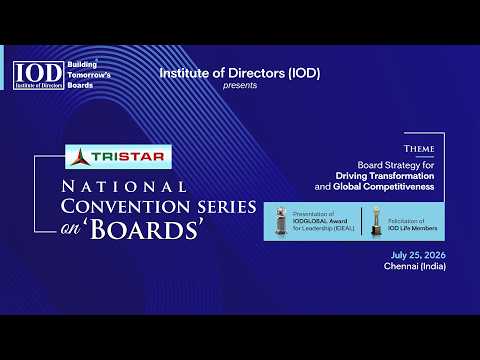
Excerpts from a 'Special Address' delivered by Mr. U. Subba Rao, General Manager, Integral Coach Factory (ICF), Indian Railways, during the Plenary Session III of the National Convention Series on 'Boards', held on July 25, 2026 at the Taj Coromandel, Chennai.
Owned by: Institute of Directors, India
Disclaimer: The opinions expressed in the articles/ stories are the personal opinions of the author. IOD/ Editor is not responsible for the accuracy, completeness, suitability, or validity of any information in those articles. The information, facts or opinions expressed in the articles/ speeches do not reflect the views of IOD/ Editor and IOD/ Editor does not assume any responsibility or liability for the same.