 Quick Links
 Connect us

 Directors Databank (Empannel Yourself)
 Become a
  Become a
  Blog
Blog
 Become an Awards Assessor
 Publications
 Contact Us







From Counsel to Independent Director: What Keeps One Relevant in the Boardroom

An experienced lawyer can make for a remarkably astute independent director. However, the journey from counsel to an effective member of any company's board is a significant one. Every lawyer who traverses this distance notices the difference right away - when a proposal is discussed, the board is not looking to them for legal inputs alone. It expects a director's judgement and, eventually, a vote.
For most of a legal career, the work centres around advice - presenting all possible options, analysing the risks, anticipating opportunities and challenges, representing clients before courts, regulators and quasi-judicial authorities, and negotiating rights and obligations with counterparties. A good lawyer does more than set out the legal position. The advice often shapes how a client sees a problem and, in turn, the ultimate decision they take. However, the final call rests with the client. On a board, that changes. A director is a fiduciary who shares responsibility for the decision itself, and for consequences that may play out well beyond the matter at hand. The move from "my advice is" to "my vote is" captures the distance between the two roles. The appointment therefore calls for a clear shift in mindset.
The lawyer's edge: Beyond legal expertise
The common assumption is that a lawyer's primary edge in the boardroom is legal knowledge backed by years of practice. That matters, but the larger advantage lies elsewhere: a temperament shaped by years of identifying risks and working through legal challenges, and a structured approach to reasoning and decision-making.
The challenge to independence in Indian boardrooms does not necessarily stem from an absence of knowledge, or even a lack of appropriate avenues to speak up. It can stem from a reluctance to interrupt consensus, friendship or hierarchy.
Lawyers are trained, over years, to raise difficult questions, flag the inconvenient issue, test the assumption everyone else has accepted at face value, and often say the unwelcome thing without making the discussion personal. That instinct aligns closely with what good independent directors (IDs) are expected to do.
The challenge to independence in Indian boardrooms does not necessarily stem from an absence of knowledge, or even a lack of appropriate avenues to speak up. It can stem from a reluctance to interrupt consensus, friendship or hierarchy. The Securities and Exchange Board of India (SEBI) Chairman, Mr. Tuhin Kanta Pandey was candid in one of his addresses when he urged that the role of IDs be redefined as that of "stewards of accountability". He further pointed out that boards should not merely process compliance packs while ignoring culture, and that a board which never disagrees is not aligned; it is asleep.
Another critical transferable skill is negotiation. An ID may need to negotiate for critical information to arrive in time, an independent valuation to be commissioned, sufficient committee time to be allocated, a conflict or recusal protocol to be followed, or a process that minority shareholders can regard as credible. Lawyers can be particularly good at asking for these things without making the request personal.
What must be unlearned
Two habits do not travel well.
The first is the advisory reflex. The instinct to frame everything as options with consequences and then step back does not work in the same way in a boardroom. A board paper cannot be answered with "it depends". A director must approve, defer, dissent or ask for more, and each is a decision with one's name on it.
The second, and more dangerous, is pure risk elimination. While a lawyer is hard-wired to minimise exposure, a director is a fiduciary participating in commercial judgement. A board that eliminates all risk has not necessarily governed well; it may simply have refused to allocate capital.
This is not to say the advisory role disappears. Independent directors often act as sounding boards for management and the executive team, even in conversations outside the meeting room. The difference is that the advice now comes from someone who must also own the eventual decision, formally, at the table.
The real test: what happens when the agenda has nothing to do with law?
The most revealing test of a lawyer-director's relevance is what happens when the agenda has nothing to do with law.
A board does not need an ID to be a permanent legal reference book. Legal expertise may be the distinctive lens a lawyer brings to the table, but it cannot become the boundary of the contribution.
Indeed, the more senior the director becomes, the less valuable it is to answer every question through a legal lens. The more valuable contribution is often to identify the question that management or the board has not yet asked.
How the role has evolved with time
Two decades ago, independence was a listing-agreement device, a composition requirement to be satisfied. The Companies Act, 2013 and the SEBI (Listing Obligations and Disclosure Requirements) Regulations, 2015 (LODR) converted it into a codified model of board accountability, and the Kotak Committee recommendations further emphasised the distinction between independence in form and independence in substance.
The role has since expanded well beyond financial reporting and related-party oversight. The Business Responsibility and Sustainability Reporting (BRSR) framework has placed sustainability-related disclosures within the board's governance and oversight architecture. Data protection, cyber risk and technology have added new dimensions to the board's responsibility for risk and organisational resilience.
Lawyers are trained, over years, to raise difficult questions, flag the inconvenient issue, test the assumption everyone else has accepted at face value, and often say the unwelcome thing without making the discussion personal. That instinct aligns closely with what good independent directors (IDs) are expected to do.
The broader lesson is that independence is not a status conferred at appointment. It has to be demonstrated continuously through the quality of information a director demands, the questions asked, the conflicts identified, the judgements made and, where necessary, the dissent expressed. The toughest challenge for a lawyer becoming a director is whether one can design an institutional framework to demonstrate that the director remains genuinely independent, the advocate remains professionally compliant, the law firm's client relationships remain conflict-safe, and unpublished price-sensitive information (UPSI) remains compartmentalised.
The discipline required of the director of tomorrow often involves tasks that may seem unglamourous, much like any other rigorous strategic approaches in businesses; attend, prepare, ask the difficult question in the meeting rather than in the corridor, insist on receiving information in time to exercise judgement, record dissent where it matters, seek independent advice when the circumstances warrant it, and recognise when the conditions necessary for independent judgement no longer exist.
The advent of AI: Awareness is the floor, fluency is the ambition
AI is changing the questions boards need to ask about technology. It is no longer simply a procurement decision or an IT project. Depending on the business, AI can affect risk assessment, customer interaction, pricing, fraud detection, workforce design and capital allocation. The governance question is therefore not whether the board understands the underlying code. It is whether the board understands enough about the deployment to exercise informed judgement.
No director needs to become an AI engineer. But every director should be able to ask the following questions with confidence: Where is AI being used? What decision is the model influencing? What data is it using? Who owns the outcome? What happens when the model is wrong? How is bias or error detected? Who can intervene? And, critically, can the system be suspended or overridden when necessary?
Recently the RBI Governor had emphasised that AI adoption must be accompanied by safeguards including human oversight, bias mitigation and data privacy, and that technology is not a substitute for human judgement.
AI awareness is therefore becoming the floor. Ease of dealing with AI, i.e., the ability to understand enough of the technology, its limitations and its business consequences to interrogate management meaningfully, may increasingly distinguish directors who are merely briefed on technology from directors who can govern it.
Conclusion: Staying relevant in the boardroom
The discipline required of the director of tomorrow often involves tasks that may seem unglamourous, much like any other rigorous strategic approaches in businesses; attend, prepare, ask the difficult question in the meeting rather than in the corridor, insist on receiving information in time to exercise judgement, record dissent where it matters, seek independent advice when the circumstances warrant it, and recognise when the conditions necessary for independent judgement no longer exist.
The relevance is not measured by how often a director speaks, disagrees or cites the law. It is measured by whether the board makes better decisions because that director is in the room.
The views expressed in this article are personal
 Back to Home
Author

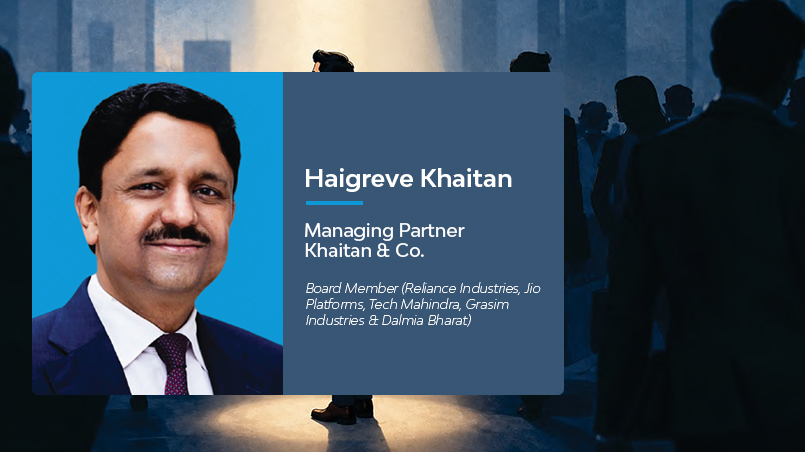
Haigreve Khaitan
Mr. Haigreve Khaitan is the Managing Partner at Khaitan & Co. and serves on the board of several top companies including Reliance Industries, Jio Platforms, Tech Mahindra, GrasimIndustries & Dalmia Bharat.
Owned by: Institute of Directors, India
Disclaimer: The opinions expressed in the articles/ stories are the personal opinions of the author. IOD/ Editor is not responsible for the accuracy, completeness, suitability, or validity of any information in those articles. The information, facts or opinions expressed in the articles/ speeches do not reflect the views of IOD/ Editor and IOD/ Editor does not assume any responsibility or liability for the same.