 Quick Links
 Connect us

 Directors Databank (Empannel Yourself)
 Become a
  Become a
  Blog
Blog
 Become an Awards Assessor
 Publications
 Contact Us







Organisational Leadership in the AI and Quantum Era

From Governance to Execution
The emergence of artificial intelligence (AI) and quantum technologies marks a profound transformation in organisational life, reshaping industries, economies, and societies in ways that demand new forms of leadership. These technologies are not incremental innovations but disruptive forces that redefine how organisations operate, compete, and create value. In this post-AI and quantum era, leadership must evolve beyond traditional commandand- control models to embrace complexity, uncertainty, and rapid innovation. Leaders are required to balance technological disruption with human-centred values, guiding organisations through ambiguity while ensuring resilience and ethical responsibility. Awareness, Opportunity, Compliance, Governance, Risk, and Collaboration are six key ingredients that can enable leaders to align vision with resilience in a rapidly changing technology landscape.
Disruptive technologies such as quantum computing and artificial intelligence are redesigning the foundations of global commerce, security, and governance, and organisational leadership must rise to meet this challenge. Boards and CXOs share collective responsibility: boards provide governance, oversight, and long-term priorities, while CXOs translate vision into execution and risk management. In this rapidly evolving technology landscape, there is a need to embed continuous risk management into every decision, recognising that digital transformation is not a one-time initiative but an ongoing journey.
Effective leadership in the post-AI and quantum era follows a continuous flow of actions and mindsets. It begins with awareness, where leaders actively scan the horizon for emerging technologies, regulatory shifts, and societal expectations. From awareness flows opportunity assessment, the ability to distinguish hype from genuine value creation and identify where AI and quantum can deliver breakthroughs.
Most boards hear about Harvest Now, Decrypt Later (HNDL). Important, but that is only 25% of the risk. The bigger danger is the collapse of trust across integrity, authenticity, and infrastructure.
Once opportunities are identified, leaders must ensure Compliance, aligning organisational practices with evolving laws, standards, and ethical norms. Compliance builds trust and protects against reputational and legal risks, but it cannot stand alone. It must be embedded within Governance, the framework that provides accountability, transparency, and ethical oversight. Governance ensures that innovation is pursued responsibly, balancing speed with safeguards.
From governance naturally follows Risk Assessment, the discipline of anticipating vulnerabilities from cybersecurity threats to workforce displacement and embedding resilience into strategy. Risk assessment is where leaders confront the moving target nature of technology and regulation, recalibrating strategies as conditions shift. Finally, the flow culminates in Collaboration, the glue that binds leadership together. Boards, CEOs, CXOs, employees, regulators, and partners must work in concert, sharing knowledge and co-creating solutions. Collaboration ensures that awareness, opportunity, compliance, governance, and risk management are not siloed but integrated into a collective posture.
Human-centred innovation is another cornerstone of leadership in this era. Technology should augment, not replace, human creativity, and leaders must foster cultures of collaboration, experimentation, and psychological safety. By enabling employees to innovate without fear of failure, leaders ensure that organisations remain adaptable and socially relevant. This humancentric approach also strengthens organisational narratives, positioning technology as a tool for empowerment rather than displacement. The competencies required of leaders in this context differ sharply from traditional models. Decision-making must be non-linear and adaptive, communication empathetic and transparent, and organisational structures networked rather than hierarchical. Innovation must be radical, experimental, and deeply human-centred, reflecting the urgency of aligning technological potential with ethical responsibility.
Navigating technological disruption is now one of the most critical roles of organisational leadership. Boards and CXOs must anticipate AI-driven automation and quantum breakthroughs, prepare organisations for workforce shifts, and invest in continuous learning ecosystems that reskill employees for hybrid human-machine collaboration. Ethical stewardship is paramount, requiring governance frameworks that prioritise transparency, fairness, and accountability, alongside advocacy for responsible innovation that aligns organisational goals with societal values. Building resilience and agility is equally essential, with decentralised decision-making empowering teams to act autonomously while remaining aligned with a shared vision. In volatile environments, leadership is about designing organisations that can pivot rapidly, absorb shocks, and leverage disruption as opportunity. Boards and CXOs, acting together, are the stewards of this transformation, ensuring that resilience, ethics, and innovation remain at the core of organisational success in the post-AI and quantum era.
Leadership competencies themselves are shifting. Decision making must evolve from linear and data driven to adaptive and paradox embracing. Vision must move beyond efficiency to become purpose driven and ethically aligned. Communication must shift from directive to empathetic, transparent, and multi perspective. Structures must decentralise, empowering networked teams, while innovation must move from incremental to radical, human centred, and experimental.
| Competency | Traditional Leadership | Post-AI & Quantum Leadership |
| Decision-making | Linear, data-driven | Non-linear, adaptive, paradox-embracing |
| Vision | Efficiency-focused | Purpose-driven, ethically aligned |
| Communication | Directive | Empathetic, transparent, multi-perspective |
| Structure | Hierarchical | Networked, decentralized |
| Innovation | Incremental | Radical, human-centred, experimental |
Balancing opportunity and risk are central to this mandate. AI enables predictive analytics, automation, and personalisation, while quantum computing promises breakthroughs in cryptography, logistics, and drug discovery.
Yet these same technologies introduce risks: AI systems can perpetuate bias, erode privacy, and create opaque decision-making processes, while quantum computing threatens current encryption standards and exposes organisations to unprecedented cybersecurity vulnerabilities. Boards and CXOs must avoid chasing hype cycles and instead focus on practical, near-term applications that strengthen operations today while preparing for long term transformation.
The challenges leaders face is formidable. AI generates vast data streams, creating risks of information overload, while quantum computing threatens existing encryption systems, demanding proactive defence strategies. Employees may resist change out of fear of displacement, requiring leaders to manage transitions with empathy and clarity. Global inequality may widen as technological advances concentrate power in certain regions or organisations, compelling leaders to champion inclusive growth. Case examples illustrate these dynamics: technology firms like Google, IBM, Amazon and Microsoft among others are investing heavily in quantum computing, requiring leaders to balance innovation with ethical responsibility; financial services organisations are integrating AI-driven trading and quantum risk modelling, demanding leadership that can align technology with regulatory compliance; and healthcare institutions are leveraging AI diagnostics and quantum drug discovery, highlighting the need for leaders to ensure patientcentred care.
The threat of Q-Day which represents the moment when quantum computers can break today's encryption standards is looming large. Q-day is often compared to the Y2K crisis, and the analogy is appropriate.
Like Y2K, Q-Day represents a systemic vulnerability, but unlike Y2k, Q-Day has an uncertain forward date: we know it will arrive, but we cannot predict exactly when.
The risks are profound; where Y2K threatened to disrupt financial systems, aviation, and utilities through date-related software failures, Q-Day could instantly render current cryptographic protections obsolete, exposing sensitive data, financial transactions, and national security systems to compromise. The challenge for leaders is similar: prepare for a disruptive event that may or may not materialise soon, balancing the cost of proactive migration against the danger of being caught unprepared. Just as Y2K demanded coordinated global action and disciplined execution, Q-Day requires organisations to reassess their posture, implement post-quantum cryptography, and craft governance systems that ensure resilience in the face of a moving target.
New dimensions of quantum risk are emerging along with a whole new taxonomy. Most boards hear about Harvest Now, Decrypt Later (HNDL). Important, but that is only 25% of the risk. The bigger danger is the collapse of trust across integrity, authenticity, and infrastructure.
Here are the four fiduciary vectors which are of immediate concern that every Risk Committee must understand:
1. HNDL- Harvest Now, Decrypt Later (Confidentiality)
Attackers stockpile encrypted data today, waiting for quantum decryption tomorrow. For example, a global bank's encrypted customer transaction logs are stolen now. Years later, once decrypted, adversaries reconstruct decades of client financial histories, thereby enabling insider trading, targeted fraud, and reputational collapse.
2. HNFL- Harvest Now, Forge Later (Integrity)
Adversaries collect your public keys now, then forge signatures later. For example, a CEO's digital signature which is faked on a merger deal, could trigger a fraudulent acquisition.
3. TNFL - Trust Now, Forge Later (Authenticity)
Records trusted today can be retroactively altered, erasing provenance. For example, if a museum's certificate of authenticity is forged, it could lead to a crisis of trust in the entire art market.
4. DNEL - Deploy Now, Exploit Later (Infrastructure)
Long-life systems built with classical crypto become unpatchable liabilities once quantum breaks them. For
Ultimately, organisational leadership in the post-AI and quantum era is not about mastering technology alone but about integrating disruption with human values, ethical responsibility, and systemic resilience. Leaders must evolve into quantum thinkers: adaptive, empathetic, and visionary. They must guide organisations through complexity, ensuring that AI and quantum innovations serve humanity rather than dominate it. The future belongs to leaders who can balance paradoxes, embrace uncertainty, and inspire collective action. In this era, leadership is not a position but a practice of continuous learning, ethical stewardship, and human-centred innovation, executed through deliberate steps that transform vision into sustainable and long-term impact.
 Back to Home
Author

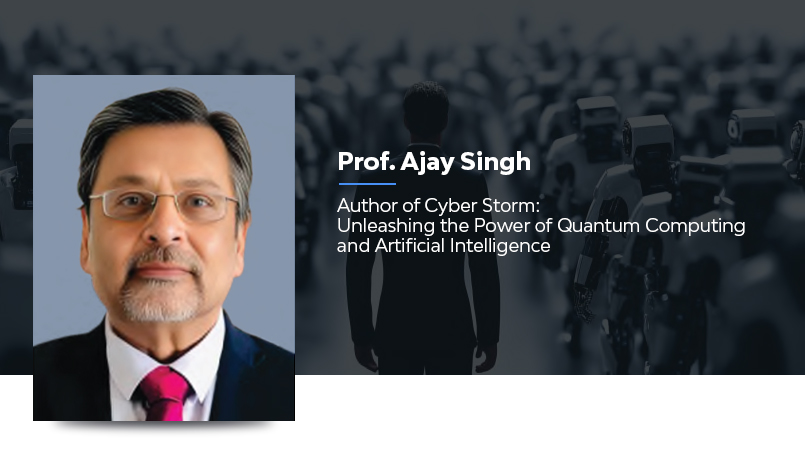
Prof. Ajay Singh
He has over 35 years' experience in the IT industry in different roles and was the CEO of an award winning fintech company for over a decade. He successfully led the development and deployment of IT products and solutions for multiple industry verticals such as banking, telecom, and government for global markets. Prof. Singh is also a certified corporate director and a Fellow of the Institute of Directors, and currently serves on multiple advisory boards.
Owned by: Institute of Directors, India
Disclaimer: The opinions expressed in the articles/ stories are the personal opinions of the author. IOD/ Editor is not responsible for the accuracy, completeness, suitability, or validity of any information in those articles. The information, facts or opinions expressed in the articles/ speeches do not reflect the views of IOD/ Editor and IOD/ Editor does not assume any responsibility or liability for the same.