 Quick Links
 Connect us

 Directors Databank (Empannel Yourself)
 Become a
  Become a
  Blog
Blog
 Become an Awards Assessor
 Publications
 Contact Us







Holistic Financial Awareness and Responsible Decision Making


Desirable dimensions of awareness for directors and boards
The financial awareness expected of company directors is one aspect of a broader perception needed to ensure the future success of entities on whose boards they serve. This and which aspects to focus upon can change over time. In the early stages of a business an entrepreneur may have to use resources wisely and closely watch cash flow to ensure it is still able to meet its financial commitments as they fall due. Success requires awareness of the value sought by prospects and the customers of a business' offerings. Income will need to be greater than the cost of their creation or production and any finance required and deliver a return to investors.
Directors vary in their consciousness, perception and comprehension of themselves, events, people and situations they encounter. These may affect them, others and entities for which they are responsible and their stakeholders. Directors' views, opinions, feelings, perspectives and priorities will often reflect their backgrounds, experience, observations, interactions and exposure to motivated and biased communications, including gossip, misinformation and disinformation from a multitude of sources. Awareness can broaden and deepen over time.
While executives could be focused on achieving targets and priorities allocated to them, the better directors are inwardly directed and curious self-starters with a holistic perspective who query, enquire, initiate, investigate and influence agendas.
Widening and Responsible Awareness
As businesses grow, their activities can have more impact upon others, whether positive or negative. Responsible directors should be aware of externalities, probabilities and uncertainty and their implications and consequences for various outcomes and stakeholders, including the environment, eco-systems, future generations and other species. There may be unwelcome costs that a business imposes upon others that are not captured by its internal records. Efforts may be made to conceal their extent. In time, an entity may be held accountable for them.
Challenges, risks and threats can have financial consequences. In due course these can escalate and may rise exponentially. They might give rise to both direct and indirect financial costs. Global warming and associated climate change may be dismissed by President Donald Trump as a hoax. However, the costs of the damage caused by extreme weather events are often considerable. Knock-on expenses such as increased premiums on any insurance that is still available, and disruption, adaptation and mitigation costs can be significant.
There are also consequences of lost revenues and missed opportunities, and greater social and infrastructure costs of public and other services to be endured and paid for, including by higher corporate and other taxation. Funding efforts and resources devoted to recovery, prevention, increased resilience and preparation for environmental, social, technological and other challenges may create business opportunities for certain companies. However, their gain might also mean less is available to purchase the offerings of many other entities.
Financial and Custodial Awareness
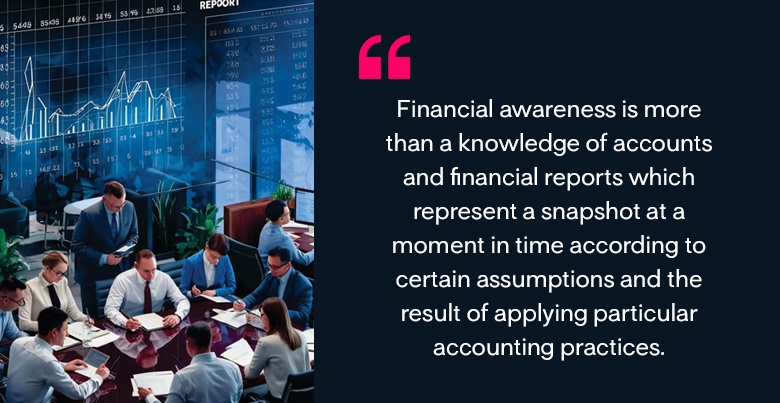
Financial awareness is more than a knowledge of accounts and financial reports which represent a snapshot at a moment in time according to certain assumptions and the result of applying particular accounting practices. They often represent a summary of past transactions, analogous to a rear-view mirror view rather than a vista ahead. Some board decisions, such as determining the rate of dividend to be paid to shareholders may be largely based on past performance, awareness of expectations and what is considered affordable.
The financial information required for many board decisions can require forward-looking estimates, forecasts or predictions. Directors should understand the requirements of long-term value investors such as a resilient balance sheet and/or recurring cash flow. Awareness of alternatives, substitutes and complements can all be helpful. Areas to question could include the importance a party attaches to an acquisition. Opportunities to explore could include how to segment a market to realise more of the surplus value area under a demand curve.
Financial awareness should include openness to possibilities and being alerted to signals that executives or board colleagues might not fully understand. It might cover a practice, model or tool they are considering or using. Ideally, it should be active rather than passive and lead to enquiry. Warning signals could include board colleagues who are not asking questions, or a CFO and team who seem unable to provide a simple explanation or an adequate response. Saying that something is too complex to explain should be a red flag and raise concerns.
Risk Awareness and Reaction
On appointment, some directors may be unaware of efforts and practices devoted to the presentation of situations and circumstances in a more favourable light. Concerns and risks are sometimes downplayed, repositioned as appendices, or expressed in small print. In comparison, advantages and other positive factors may be presented more prominently and high-lighted in an executive summary. In an era of economic warfare risks can be difficult to price and evolving. Directors should confront reality, expose spin and encourage veracity.
Directors need to be aware of the risk appetites and uncertainty tolerance of customers, investors and other stakeholders. Risk and returns are often related in that to obtain a greater level of return one may need to accept a higher degree of risk. Awareness, estimation and judgement may be needed regarding the minimum level of benefit, return or value, and the maximum amount of risk or uncertainty those targeted are prepared to accept, and how demand for different versions of an offering and margins or returns might vary with price.
There is also an arena of awareness relating to options for reducing or off-loading risks, and practices such as hedging, taking options or positions and related market trading. Some activities can involve complex models and tools, which like AI, might not be fully understood by those who use them. In some situations, and under certain conditions, their adoption and use might be disastrous and even lead to a financial crash, such as that in 2008. Self-awareness and knowing the limits of one's and colleagues' understanding can be important.
Assumption and Convention Awareness
Awareness of accounting assumptions, conventions, policies, practices and reporting requirements, alternative practices, and the extent of discretion in different areas and how it might be exercised can be helpful. Companies can vary in the discretion given to applying group accounting and financial policies and/or practices differently across business units, territories, jurisdictions, subsidiaries and joint ventures according to local conditions, requirements, competition, lifecycle of an offering or the stage of development of an entity.
Practices may also vary by sector. Efforts may be made to re-write narratives and/or revalue line items and/or their make up to meet expectations or suit the requirements for a grant, subsidy or certain tax treatment. Transactions and doing business can involve costs. Again, there may be a threshold as to the level which a potential customer might find acceptable. Negotiation practices vary from market haggling to on-line auctions. Trust should be earned rather than assumed. Directors should verify and be aware of biases in AI generated content.
A chief financial officer and team can have multiple responsibilities and particular priorities. These can change over time. One team may prioritise compliance with accounting conventions and/or reporting requirements, while another might devote more effort to information for decision making. While executives could be focused on achieving targets and priorities allocated to them, the better directors are inwardly directed and curious selfstarters with a holistic perspective who query, enquire, initiate, investigate and influence agendas.
Behavioural and Social Awareness
Corporate cultures, especially shared assumptions and how people behave, can affect accounting and financial priorities, and their focus and timing. Built in biases when decisions are taken by those in a position to advance their own interests may enable them to do so, while the interests of other parties and those affected may be overlooked, downplayed or not considered. Various people, including board colleagues might seek to influence the views and perceptions of a director in favour of their own interests.
The motivations of directors may range from absorbing, reflecting and keeping in with colleagues, to proactively challenging and making a difference. Directors should be aware of the attitudes, preferences and responses of board colleagues, whether positive or negative, proactive or reactive, cautious or bullish, resigned or non-committal, and of the games they play. 'Over-performance' might be avoided to just achieve unambitious targets. Underreporting could be used to hold back potential in order that it might benefit a subsequent year.
Similar and different games may be encountered by directors of public sector organisations. Effort is likely to be given to showing compliance with ministerial direction and progress in meeting targets. Major projects can often benefit from scrutiny. On longer-term programs, the reprofiling of expenditure and income with practices such as back-ending may be undertaken to match the availability of funding, even though this may increase risk and lead to later over-runs and higher eventual costs. Experienced directors may be aware of such gambits and ploys.
Value and Relevance Awareness
The perceived and eventual value of a transaction to various categories of customer and stakeholder groups, can differ from the purchase or sales price paid. Hence, the priority that may be given to value for money when selecting proposals. Considerable potential benefit may lie in what is relevant but unfashionable or overlooked by management. Questions could be asked about unlocking hidden value and what arrangements with other players and strategies such as divestment might unlock it. Value disappointment can harm reputation.
Where discretion exists to value assets, some entities are more cautious and prudent than others when exercising it. Dangers can lurk in the treatment of sunk and incremental costs. The value given to goodwill and price/earnings ratios can fluctuate up and down according to herd expectations and perceptions of future potential and technological breakthroughs. Valuations can soar, peak and trough in boom-and-bust succession. The value of a company may be a fraction of that which others might obtain by licensing its intellectual capital.
Crises such as pandemics, technology outages, wars and associated supply chain disruptions can have multiple and inter-related economic and other consequences. These can include the reassessment of value and priorities. Awareness of sensitivity and vulnerability to inflationary pressures and interest rate and other changes, including to important customers and business and supply chain partners, can lead to questions about preparedness and mitigation measures.
Contextual and Situational Awareness
Governments, laws and regulations, and aspirations, requirements, taxes and priorities can and do change. While their time may be limited, directors should ensure implications for the relative attractiveness of different business models and alternative approaches are monitored. Changes may affect relative competitive advantage and alternative ways of allocating responsibilities, tasks or costs, and determining who does what and where within processes and supply and/or value chains. What is expensive in one context may be cheap elsewhere.
A range of geopolitical, economic and technological factors can have consequences for a company and its stakeholders. Awareness of economic conditions and prospects, and vulnerabilities and dependencies, can be especially important. The latter might be weaponised or taken advantage of in negotiations. Cost of living pressures and reductions in after-tax incomes may result in a company finding that an offering previously regarded as a staple product is becoming increasingly seen as an unaffordable luxury.
Smarter directors look beyond implications for a company at how others could be affected by changes, developments and trends. Customers, users and/or business partners may be prepared to do either more or less for themselves. Automated responses and AI agents might enable new service and support options. Where the balance should be struck between focus and diversification may shift and be worth re-visiting. Awareness of areas in which liabilities such as those for environmental and other damage may increase can be helpful.
Awareness of Constraints and Limitations
Directors should be aware of constraints and limitations, whether real or imaginary and lasting or temporary. These can include the aspirations and ambitions of board colleagues and an executive team. Too few questions may be asked about what is missing or might make the difference. Complacency, mediocracy and resignation can lead to underperformance, stagnation and irrelevance. Some boards are themselves significant obstacles to growth.
Authoritarian and unscrupulous governments may act to make people unaware of developments with significant financial consequences. In the US, the Trump regime continues to dismantle research, monitoring and other activities concerned with climate and the environment that scientists have relied upon to measure and track what the President considers is a hoax. Across the US, government health, climate change and extreme weather event data sets that concerned individuals have not been able to save have been deleted.
How long a situation may last can be an important factor in decision making. Uncertainty and the fluidity of multiple situations may prevent the taking of decisions that can be more than a temporary accommodation with shifting realities. Planning and definitive decisions may need to be replaced by incremental steering as changes occur. Finally, directors should be aware of their exposure. They can receive advice and counsel from a host of experts, professionals and vested interests, but they and not their advisers can be liable, sued and incur penalties.
 Back to Home
Author

Prof. Colin Coulson-Thomas
Director-General of IOD India for UK and Europe operations
Prof. (Dr) Colin Coulson-Thomas, President of the Institute of Management Services and Director-General of IOD India for UK and Europe operations. He has advised directors and boards in over 40 countries.
Owned by: Institute of Directors, India
Disclaimer: The opinions expressed in the articles/ stories are the personal opinions of the author. IOD/ Editor is not responsible for the accuracy, completeness, suitability, or validity of any information in those articles. The information, facts or opinions expressed in the articles/ speeches do not reflect the views of IOD/ Editor and IOD/ Editor does not assume any responsibility or liability for the same.