 Quick Links
 Connect us

 Directors Databank (Empannel Yourself)
 Become a
  Become a
  Blog
Blog
 Become an Awards Assessor
 Publications
 Contact Us






IOD Special Talk - Board Strategy for Resource Optimisation & Operational Efficiency: Resource Efficiency & Climate Leadership


More than 53% of L&T's revenue now comes from Green Business offerings including renewable energy, water management, hydrocarbon decarbonisation, green hydrogen infrastructure, and clean mobility.
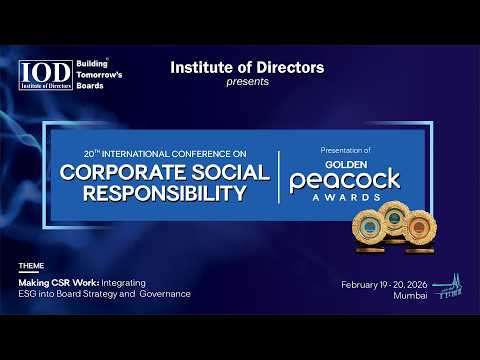
The IOD's 20th International Conference on CSR has chosen a theme that could not be more relevant to this moment:
“Integrating ESG into Board Strategy and Governance.”
Boards today are no longer debating whether sustainability drives value-they are deciding how fast they can operationalize it. We now operate in a world where resource risks, climate disruptions, and ESG expectations intersect directly with business competitiveness.
As one of India's largest engineering, procurement, and construction companies, Larsen & Toubro operates at the heart of sectors that shape national infrastructure, industrial capacity, and climate outcomes. Our commitments including achieving Carbon Neutrality by 2040 and Water Neutrality by 2035, reflects our belief: climate leadership and business leadership must advance together.
1. Why Boards Must Prioritize Resource Efficiency
Across industries, boards are asking fundamental questions:
• How do we reduce input costs and material wastage?
• How do we protect our businesses from climate and resource volatility?
• How do we drive profitability while meeting sustainability expectations?
Resource efficiency lies at the core of these questions. At L&T, it is no longer an environmental initiative-it is a strategic lever for competitiveness, cost optimization, and resilience.
• Recent performance demonstrates this clearly: We achieved a 20% reduction in emission intensity year-on-year.
• We recycled 2.6 million kL of wastewater.
• We conserved 3.2 million kL of water through efficiency programmes.
Achieving Net-Zero requires more than long term commitments and cannot depend only on off-sets or declarations.
These outcomes directly translate into business value: : reduced operating costs, reduced resource dependency, and stronger resilience across project sites and facilities.
2. Circular Economy in Action at L&T
L&T has been embedding circular principles across businesses:
a) Material Efficiency & Use of Secondary Materials
L&T uses 28% recycled and eco-friendly material, including recycled steel, fly ash, and processed aggregates. These are a major driver of cost savings in construction and manufacturing while reducing dependence on virgin raw materials and lowering emissions associated with extraction and transport.
b) Waste Reduction Through Digital Tracking
Our digital ecosystem tracks materials in real time across our projects, ensuring optimal utilisation, reduced wastage, and transparent inventory planning.
c) Circularity Through Smart Manufacturing
Our smart factories such as fully 5G-enabled facility at Hazira integrates advanced automation, robotics, and real-time analytics to reduce process waste, extend equipment life, and enhance quality.
d) Innovation-led Circularity
The 3D-printed post office in Bengaluru completed in 43 days, versus 6–8 months conventionally, demonstrates breakthrough reductions in material use, construction time, and carbon footprint. These examples demonstrate that circularity today is not a future ambition-it is a present-day commercial advantage.
3. Profitability Through Circularity
For many companies, sustainability still appears as a compliance. But at L&T tells a very different story.
“More than 53% of L&T's revenue comes from Green Business offerings now including renewable energy, water management, decarbonisation, green hydrogen infrastructure, and clean mobility.
This reinforces a simple point: Circularity strengthens EBITDA, reduces lifecycle costs, and improves business resilience.
The company has also recorded:
• 16% reduction in energy consumption intensity in Fy24–25.
• Significant savings from long-standing energy conservation measures since 2008.
These outcomes reinforce a critical insight: sustainability and profitability are not competing priorities-they are mutually reinforcing.
4. Sector-Agnostic Net-Zero Pathways
Achieving Net-Zero requires more than long term commitments and cannot depend only on off-sets or declarations. Boards must drive measurable, sectoragnostic pathways that reduce long-term risks.
L&T has laid out one of India's most comprehensive climate strategies:
• Carbon Neutrality by 2040, a decade ahead of global expectations.
• Water Neutrality by 2035,
How are we enabling this?
• Energy Transition
L&T sources 15% of its electricity from renewable sources today, a number set to grow through PPAs and on-site solar.
• Digitalised Decarbonisation
By collecting real-time data from 14,000+ machines, we eliminate idle time, optimize fuel consumption, and improve energy performance.
• Electrification & Low-Carbon Materials
Our projects incorporate low-carbon concrete, green steel, recycled aggregates, and sustainable construction technologies.
Net-zero is not a distant aspiration - it is an ongoing operational transformation.
5. Decarbonisation Opportunities Across Operations
Decarbonisation is not confined to a single lever-it is embedded across the value chain::
• Manufacturing
Through automation, robotics, and 5G integration, our smart factories reduce energy intensity and material wastage.
• Logistics & Fleet
Digitised planning, route optimisation, and fleet modernisation reduce emissions and costs.
• Energy Procurement
Transitioning to renewable energy and efficiency upgrades lowers long-term energy risks.
• Supply Chain
With sustainability embedded in procurement and vendor frameworks, L&T fosters a sustainable supply chain - a necessity given the scale of our EPC operations.
• Government Incentives
We leverage emerging incentives for clean hydrogen, renewables, and waste-to-value innovations, strengthening the business case for early adoption.
6. Sustainability as a Driver of Business Competitiveness
At L&T, sustainability and operational excellence are deeply interconnected.
The company was ranked 2nd in the global 'Top 200 Environmental Firms 2025' by ENR, the only Indian company in the top tier.
Our CSR operations reached 1.9 million beneficiaries in FY25 with a spend of C163 crore - reaffirming our commitment to inclusive growth
These recognitions are not just achievements; they are clear indicators of how sustainability contributes to:
• Stronger compliance readiness
• Lower risk exposure
• Enhanced investor confidence
• Superior brand value
• Greater talent attraction
Therefore, sustainability is embedded across board discussions at L&T - in capital allocation, procurement, risk management, and governance frameworks.
To conclude, as India builds the next generation of infrastructure and industry, the role of corporate leaders - especially board members - is pivotal. Resource efficiency, circularity, and climate leadership are not parallel priorities-they are interconnected drivers of competitiveness, resilience, and long-term shareholder value.
At L&T, we believe: Sustainability is not viewed as a constraint it is an accelerator of innovation, growth, operational excellence and long-term value creation.
 Back to Home
Author

Santosh Kumar Singh
Chief Sustainability Officer Larsen & Turbo Limited
Owned by: Institute of Directors, India
Disclaimer: The opinions expressed in the articles/ stories are the personal opinions of the author. IOD/ Editor is not responsible for the accuracy, completeness, suitability, or validity of any information in those articles. The information, facts or opinions expressed in the articles/ speeches do not reflect the views of IOD/ Editor and IOD/ Editor does not assume any responsibility or liability for the same.