 Quick Links
 Connect us

 Directors Databank (Empannel Yourself)
 Become a
  Become a
  Blog
Blog
 Become an Awards Assessor
 Publications
 Contact Us







Shubha-Labha: A Reflection on Profit with Purpose

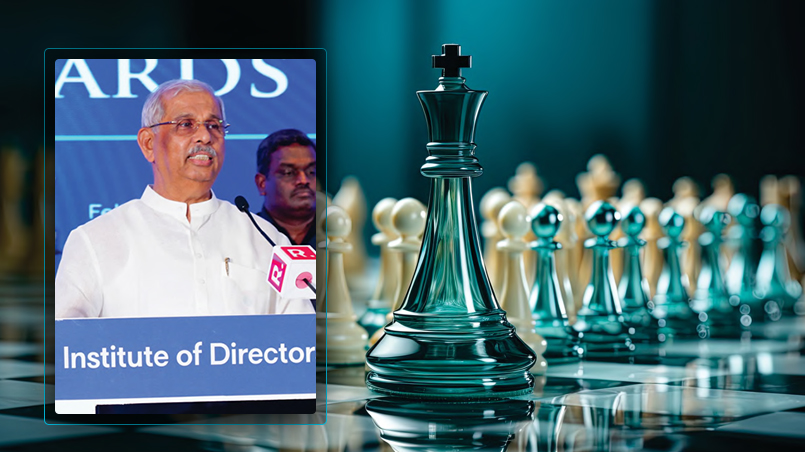
Industry is not new to our country or our culture; we have been an industrious civilisation for many centuries, indeed millennia. What has been redefined for us more recently is the question of what industry ought to be and what it ought to do. Our modern industrialisation, to some extent, has its roots in Westernisation, and it is from that tradition that we have drawn the parameters by which we now measure ourselves against the Western industrial world. Yet we must develop our own atmosphere and our own measures, for if our GDP is to have any real meaning, it must be connected to our roots and to our own way of thinking.
No nation can develop without developing its industry, and Micro, Small and Medium Enterprises have an important role to play in this. Our Honourable Prime Minister, Mr. Narendra Modi ji, has consistently underlined and emphasised the role of private entrepreneurship, and rightly so, for private enterprise has a very significant part to play in the development and the economy of our country. I confess that I was, at first, a little puzzled as to why the Prime Minister placed such emphasis on private entrepreneurship in particular. In time, however, I came to understand the reason: every government scheme and every government-led enterprise has its own limitations and cannot always be delivered in full.
Having served in government myself, I can vouch for this. Those who sit in government often have many good ideas, but such ideas do not always percolate down to those they are meant to serve. I need not name names, but many of you will have experienced for yourselves how bureaucratic behaviour can prevent good intentions from reaching those below. That behavioural and mental change must take place if we are to achieve anything for our society and our people through industry, and it is precisely for this reason that private players contribute so significantly to our economy.
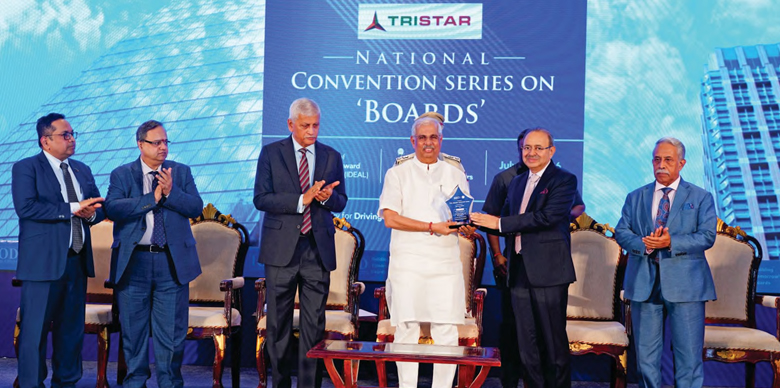
Many of you here are directors, or have been directors, and, incidentally, I too served for a few years as an Independent Director of Indian Oil Corporation. Sitting in that boardroom for the first time, observing the discussions that took place, I could see what a corporation of that scale was capable of. When the COVID crisis struck, the question of CSR contribution arose as to how IOCL and other public sector oil companies could contribute to the fight against COVID-19.
Yet I observed that, however thorough the discussion at board level, the same enthusiasm that the board possessed was not always sustained as decisions percolated downward; the thinking, the action and the practice slowed considerably. This is precisely why MSMEs and larger manufacturers matter so greatly: decisions taken by a board of directors are, in a well-run private enterprise, replicated faithfully all the way down. That is the true success of our private entrepreneurs and private players, and it is why they contribute so substantially to boosting our economy.
What our economy should become is now for us to decide. As directors, we must each ask ourselves: what will be my contribution to this board, to this enterprise, or, to put it more broadly, to society? For it is through the enterprise that I ultimately serve society, the people and the nation. What, then, will be my role?
This brings me to another dimension raised earlier today: that of Viksit Bharat, the developed nation.
What is this Viksit Bharat, and how is it to be achieved?
Allow me an example that may not entirely suit the occasion, for which I ask your indulgence in advance. The Prime Minister has placed before us the vision of a Viksit Bharat by 2047, the year in which we shall complete a century of independence. What we must consider today is how, and in what measure, each of us will contribute towards that. This is not merely the dream or vision of one man sitting in Delhi; it must be your dream and my dream as much as it is his. If we are indeed to become one of the largest economies in the world, then each of us must decide what our own contribution, and that of our enterprise, will be. And that contribution must be decided upon sound moral grounds.
My own task does not end in the boardroom; it lies equally in reaching out to the people and to the small manufacturers, and in encouraging them onward.
Everyone enters business or enterprise to make a profit, and rightly so - there would be little purpose in running a business house otherwise. It would not be out of place here to recall the Mahabharata, which comprises eighteen parvas, one of which is the Udyog Parva. In that parva, composed some five thousand years ago, it is made clear how business ought to be conducted and why it is necessary.
Business exists to make a profit; profit we must have. The real question is: profit by what means?
In North India, and often in the southern parts of our country too, we have long used two words together: Shubha Labha.
Labha means profit, but that profit must be Shubha, sacred and virtuous.
Western philosophy, by contrast, speaks only of Shuddha Labha - profit alone, pure and unqualified, with little regard for the means or the methods by which it is achieved. We, however, have never spoken of Shuddha Labha; we have always spoken of Shubha Labha. We understand the methods of making a profit, and it is precisely because our profit has always been guided by this sense of the sacred that we stand tall even within the global economy today. It is this Shubha that sets us apart, and it is this thinking that we must carry forward.
Returning to the question of Viksit Bharat and my time as a director of IOCL, our board once discussed how India might purchase crude oil from Iran, and IOCL was made the nodal agency for this negotiation. The Prime Minister's intention was that we should explore whether crude oil could be purchased from Iran in rupees rather than in dollars. Our delegation travelled to Iran to negotiate this, and I am glad to say that Iran agreed to trade with us in rupees. To this day, we continue to conduct a measure of our trade with Russia in the same way.
I shall close with one final observation. Before the arrival of the British in this country, a survey of the time recorded that England's contribution to the world economy stood at a mere 2.3 per cent, while India's stood at 32 per cent. By the time the British left this country, England's share of the world economy had risen to 22 per cent, while ours had fallen to 2.3 per cent.
We may say the British were responsible for this reversal, but we too bear our share of the responsibility. We must think, and think again, if we truly wish to become the largest economy in the world and to lead the global economy: we must strengthen our economy through every means available to us. We shall do this, and we shall continue to do it.
Our task is not confined to the boardroom alone; it is to go out to the people, to the manufacturers, the traders and the retailers, to encourage them, to inspire them, and to enlighten them towards the strengthening of our economy. My own task does not end in the boardroom; it lies equally in reaching out to the people and to the small manufacturers, and in encouraging them onward.
 Back to Home
Author
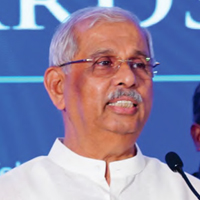
Rajendra Vishwanath Arlekar
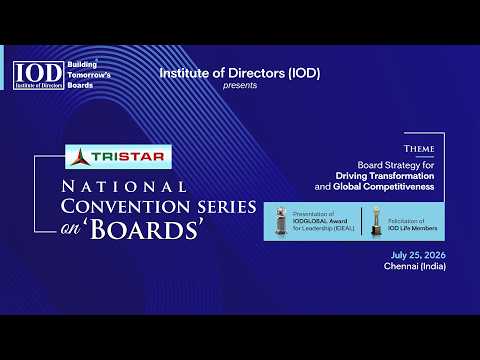
Excerpts from the 'Chief Guest Address' delivered by His Excellency Rajendra Vishwanath Arlekar, Hon'ble Governor of Tamil Nadu, during the IODGlobal Felicitation Ceremony & Banquet, of the National Convention Series on 'Boards', held on July 25, 2026 at the Taj Coromandel, Chennai.
Owned by: Institute of Directors, India
Disclaimer: The opinions expressed in the articles/ stories are the personal opinions of the author. IOD/ Editor is not responsible for the accuracy, completeness, suitability, or validity of any information in those articles. The information, facts or opinions expressed in the articles/ speeches do not reflect the views of IOD/ Editor and IOD/ Editor does not assume any responsibility or liability for the same.