 Quick Links
 Connect us

 Directors Databank (Empannel Yourself)
 Become a
  Become a
  Blog
Blog
 Become an Awards Assessor
 Publications
 Contact Us







A Culture of Science and Sustainability: Borosil's Perseverance in Transforming Climate Challenges into Opportunities

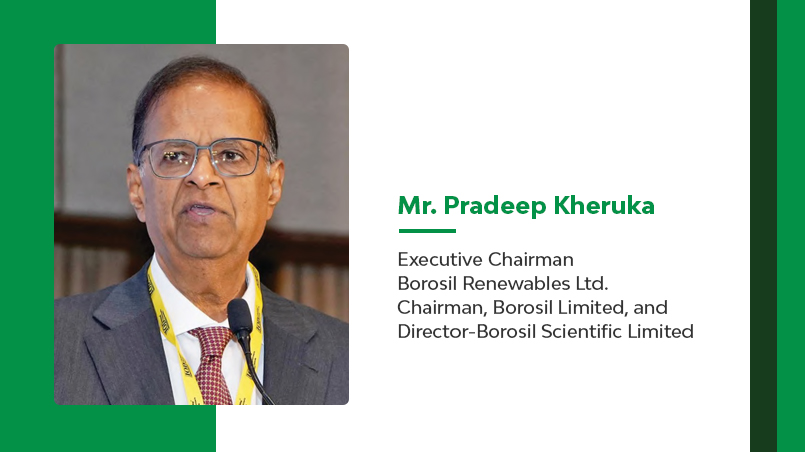
I have been listening carefully to what each of the distinguished members on the dais has shared today, and I must say that I have learnt a great deal from every one of them. Now, it is my turn to speak about what we have been doing, what I have learnt over the years, and what all of us can do as we move forward.
The immediacy of climate change is perhaps best illustrated by a statement made by my 10-year-old grandson to my wife during breakfast last Sunday.
He said, "Dadi, we will have to move from Bombay within a month."
She naturally asked, "Why, beta?"
He replied, "We are running out of water here. We are down to only sixty days, and it could soon become thirty days. July is going to be a bad month for rain, so I think we should be ready to move."
This simple statement from a 10-year-old child demonstrates that the risks of climate change have now permeated every age group and every section of society. At least we all recognise that we are facing a crisis, and naturally, that is frightening.
The two words on which I would like to focus today are Resilience and Governance.
Indians are resilient by nature. For over a millennium, we have confronted adversity with courage, determination and perseverance. Today, under the leadership of Prime Minister Shri Narendra Modi, India is moving ahead with renewed confidence and purpose. With resilience, I believe we will certainly find solutions to meet the challenge that climate change has placed before us.
Equally important is Governance. Through good governance, we can adopt disciplined and systematic approaches, embrace the latest technologies, and at the same time rediscover and implement the wisdom and knowledge that our civilisation has accumulated over centuries. All of these will be essential if we are to overcome the challenges ahead. We must encourage innovation, reward those who develop solutions, and where necessary, enforce accountability for violations.
Allow me to share a remarkable example of resilience. I refer to the extraordinary transformation that has taken place in the lives of farmers across the suicide-prone districts of Marathwada.
The year was 2017. Farmer suicides dominated newspaper headlines almost every day. It was during that period that I met Mr. Mayank Gandhi, who had just returned from Beed district in Maharashtra. He spoke not only of extreme poverty but, even more painfully, of the overwhelming despair and hopelessness that had gripped the farming community. He asked if I would join him in this effort, and I immediately agreed to do whatever I could to help.
At that point, we had no ready-made solutions. What we had was commitment, determination and the willingness to work relentlessly. 9 years later, after countless visits, enormous effort, significant financial investment and unwavering perseverance, the results have been truly remarkable.
Farmers' incomes have increased by a minimum of 10 times and, in many cases, by as much as 30 times. These dramatic improvements have largely resulted from changing cropping patterns from water-intensive crops such as cotton and soybean to fruit orchards better suited to the region. To validate these outcomes, we commissioned the Tata Institute of Social Sciences (TISS) to conduct an independent survey, and these figures are based on their findings.
Borosil has committed itself to constructing 1,000 recharge wells in Gujarat, of which nearly 400 have already been completed.
Alongside agricultural transformation, rivers were deepened and widened, initially over a stretch of 27km and, more recently, across 105km. Recharge wells were installed every hundred metres along the river belt. As a result, groundwater levels, which had fallen to nearly 450 feet below the surface, have now risen to within approximately 50 feet. There has been a remarkable restoration of the region's ecological balance, and my dear friends, this is resilience in action.
At the same time, serious scientific research is being undertaken on the use of organic manure prepared from cattle dung and gomutra. These are proving to be highly effective not only as natural fertilisers but also as bio-pesticides. I remain hopeful that champions such as Shri Gopalbhai Sutaria, who runs a Gaushala here in Ahmedabad, will continue to demonstrate the effectiveness of these approaches. Success in this area would significantly reduce our dependence on imported chemical fertilisers and pesticides. It would also help restore carbon levels in our soil and reduce the flow of urea run-off into rivers, which causes algae blooms and severely affects fish populations.
What has been particularly heartening is the way people from every walk of life have come together. Collectively, these efforts have restored not only the land but also the spirit and hope of thousands of farming families. Meanwhile, the Government has also taken decisive action. One of the major nationwide initiatives has been the construction of recharge wells across the country, under the leadership of Shri C. R. Patil, who now heads the Ministry of Jal Shakti.
I am also pleased to share that Borosil has committed itself to constructing 1,000 recharge wells in Gujarat, of which nearly 400 have already been completed. What I have just described is a powerful illustration of the true meaning of resilience. Through rational analysis of a serious problem, a disciplined and consistent approach, and genuine intent, we have found solutions to what once appeared to be an impossible challenge.
This achievement belongs not to any single organisation, but to ordinary citizens from diverse backgrounds who came together with a shared purpose and an unwavering determination to make a difference. We never looked to the Government for financial support. However, we did make effective use of initiatives such as drip irrigation. Every farm where we supported tree plantation now uses drip irrigation, which significantly reduces water consumption while also lowering the requirement for fertilisers and pesticides.
Borosil Renewables manufactures solar glass, the specialised glass used in solar modules. It is a highly sophisticated product that we have developed entirely through our own research and expertise, without relying on imported technology.
Let us briefly revisit the issue of fossil fuel-based energy.
Approximately 65 to 70% of the energy generated by burning fossil fuels is ultimately lost as waste heat. Only about 30 to 35% is put to productive use. In contrast, electricity can achieve utilisation efficiencies of nearly 70 to 90%. We are all familiar with the growing adoption of electric vehicles and how they are reducing not only monthly fuel costs but also air pollution. It is also instructive to observe what China has accomplished. Today, nearly 80% of all vehicles sold in China are electric. I foresee a similar transition taking place in India.
If we examine the installation of electricity generation capacity in China, we find that additions from fossil fuels have remained almost flat, whereas renewable energy particularly solar and wind has grown dramatically.
Another area requiring urgent attention is cooking.
LPG has undoubtedly served India well, but over time it should increasingly be replaced by electricity. Two days after the conflict in Iran began, I asked the Borosil laboratory to compare the efficiency of LPG with induction cooking. Using an induction cooker, one litre of water reached boiling point faster than it did using LPG. More importantly, it consumed significantly less energy. There is, therefore, little justification for continuing to spend precious foreign exchange on imported LPG while simultaneously emitting additional carbon, when clean electricity generated through solar energy can accomplish the same task more efficiently.
Finally, let me turn to Government policy. One of the Government's most significant achievements has been its firm commitment to protecting domestic manufacturing from unfairly dumped imports. We should be under no illusion about this.
China has pursued a deliberate strategy of undermining solar manufacturing in other countries by exporting solar equipment at prices that are often 30 to 40% below the cost of production. When we import fully assembled solar modules, the employment generated within India is limited largely to installation work, such as digging foundations and erecting support structures. In contrast, when we manufacture every component and assemble them here in India, we create employment across the entire value chain.
Therefore, evaluating policy solely on the basis of the lowest cost is extremely damaging. It does not serve the long-term interests of the nation. We need to adopt a far more holistic approach when framing public policy.
At the same time, I would like to set everyone's mind at rest regarding competitiveness.
At Borosil, we use approximately 1,200 kilocalories of energy to melt one kilogram of glass. By comparison, some of the better Chinese furnaces manufacturing solar glass consume nearly 1,650 kilocalories for the same quantity. Similarly, using identical production equipment, our manufacturing lines produce around 285 tonnes of glass per day, whereas comparable facilities in China produce approximately 200 tonnes.
So, in terms of manufacturing efficiency and competitiveness in solar glass, it is not we who need to catch up with China. It is China that must catch up with us.
When we began exporting solar glass to France, we underwent an independent assessment by a French Government inspector, who evaluated the carbon emissions associated with our manufacturing process. He was genuinely surprised to discover that our carbon footprint was nearly 22% below the international benchmark. I should also mention that our manufacturing operations depend entirely on groundwater. However, we have been recharging groundwater continuously for the past thirty years. We have always ensured that the water is properly filtered, responsibly managed and returned clean to the aquifers.
Solar glass has traditionally been manufactured using a chemical called 'Antimony', which is a toxic substance. According to the World Health Organisation, drinking water should contain no more than 10 parts per billion of arsenic, whereas the permissible limit for antimony is only 5 parts per billion. In other words, antimony is considered even more hazardous than arsenic. For many years, it continued to be used as an ingredient in solar glass because of the mistaken belief that it improved light transmission.
I was never comfortable with that.
As far back as 2015, I set a clear objective for our company: we must completely eliminate antimony from our glass composition. After extensive research and development, we succeeded. In 2016, we presented our findings at major international solar conferences and at the International Congress on Glass. Moving from antimony-based glass to antimony-free glass meant changing from an oxidising glass chemistry to a reducing glass chemistry, a major scientific challenge. During the transition, we produced nothing but defective glass for nearly fifteen days.
Yet we persevered. We approached the Government with our findings. But unfortunately, nothing happened. An activist subsequently filed a case before the NCLT. The matter was referred to the Ministry of New and Renewable Energy and then forwarded to the National Institute of Solar Energy. There, it remained pending for almost ten years. Ironically, what happened this year was quite remarkable. The voice that our own system did not hear was heard by the Government of China.
China has now prohibited the use of antimony in solar glass. In effect, that gives them a ten-year advantage to learn and implement what we had already developed a decade ago.
People often ask me, "Has anyone else in the world achieved this?"
My answer is simple: “No one else has”.
Must every major technological breakthrough necessarily come from the West?
Certainly not!
The scientific evidence has always been available. Research across the world has consistently demonstrated the harmful effects of antimony. Even IIT Bombay has shown that when crushed antimony-containing glass is immersed in clean water, nearly one hundred parts per billion of antimony can leach into the water within twenty-four hours-much like sugar dissolving from a sugar cube.
That is the reality.
The larger question, however, is this: If we truly want research and development, do we, as a nation, have the systems required to support genuine innovation?
Very often, procurement processes demand only the lowest-cost, tried-and-tested product. But the very nature of research is that it does not produce tried-and-tested products. It produces new products.
Unfortunately, we still lack institutional mechanisms to evaluate and encourage such innovation.
Years ago, India had institutions such as the Directorate General of Technical Development. While those systems eventually developed their own shortcomings, the unfortunate consequence of dismantling them was that we also weakened the ecosystem that connected science, technology and industrial policy.
Today, if one reads China's Five-Year Plans, one finds a clear technological direction. Their government specifies which chemicals should be reduced, what technologies should be adopted, and the objectives to be achieved over the coming years. We need a similar long-term scientific vision. Before anyone criticises Indian industry for not investing sufficiently in research and development, we must first ask ourselves an important question: Are we, as a nation, truly prepared to support research and development?
We need a culture that brings far more science, technology and evidence into public policy and into our national conversations. And at present, I do not believe we are having that conversation to the extent that we should.
Thank you very much.
 Back to Home
Author
Mr. Pradeep Kheruka
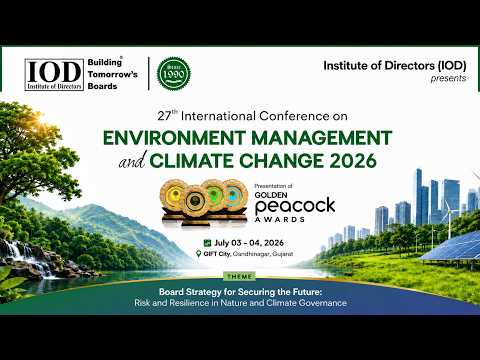
Executive Chairman, Borosil Renewables Ltd., Chairman, Borosil Limited, and Director-Borosil Scienti?c Limited, during the Inaugural Session of the 27th International Conference on Environment Management & Climate Change & Presentation of the Golden Peacock Awards, held on July 03, 2026 at the Radisson GIFT City Club, Gandhinagar, Gujarat.
Owned by: Institute of Directors, India
Disclaimer: The opinions expressed in the articles/ stories are the personal opinions of the author. IOD/ Editor is not responsible for the accuracy, completeness, suitability, or validity of any information in those articles. The information, facts or opinions expressed in the articles/ speeches do not reflect the views of IOD/ Editor and IOD/ Editor does not assume any responsibility or liability for the same.