 Quick Links
 Connect us

 Directors Databank (Empannel Yourself)
 Become a
  Become a
  Blog
Blog
 Become an Awards Assessor
 Publications
 Contact Us







From Green Cover to Green Governance: Building a climate-resilient Vadodara through sustainable urban planning

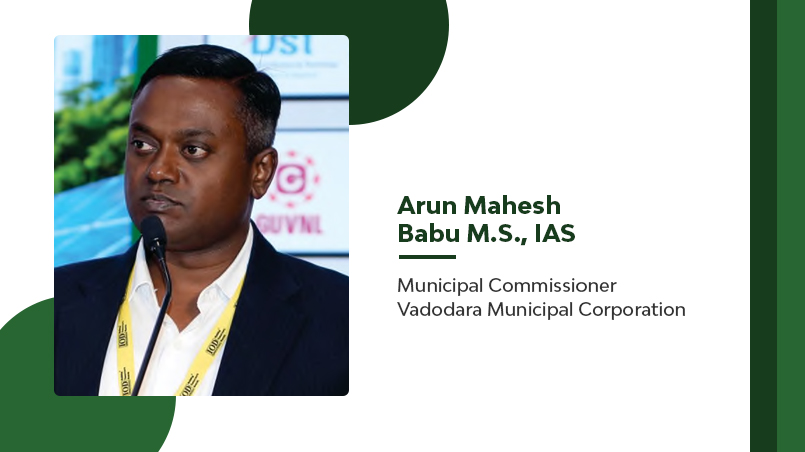
Gujarat's remarkable journey from Charanka to Khavda from 750 MW to 37 GW truly represents Gujarat's growth story and demonstrates that Gujarat means business.
Vadodara is Gujarat's third-largest city, with a population of nearly 35 to 40 lakhs within the Urban Development Authority. The aspirations of our citizens are closely aligned with the vision of Viksit Bharat, Viksit Gujarat and Viksit Vadodara by 2047. At the same time, we remain committed to combating climate change and achieving our net-zero goals. As we pursue rapid development, we must also embrace a sustainable growth model. Our endeavour is to strike the right balance between aspiration and sustainability.
Vadodara has therefore adopted a dedicated Net Zero Action Plan. Today, our city's green cover stands at 17.2%, and we aspire to increase it to 21% by 2030. We have therefore embarked upon a massive greening drive. I believe the simplest textbook definition of combating climate change begins with planting trees. We need to introduce more greenery into our cities, create more sponge parks, and develop sustainable urban models that help mitigate climate change.
For the common citizen, climate change is not understood in terms of rising temperatures or technical terminology. They want normal temperatures, and they want clean air to breathe. Those are the two most fundamental expectations. Keeping that in mind, we have launched an initiative called 'Clean and Green Vadodara', with the objective of achieving 21% green cover by 2030.
What does this mean for an ordinary citizen?
It means a better Air Quality Index.
We have therefore focused on increasing green cover along roads, canals and vacant public spaces to reduce carbon levels and lower urban temperatures. Vadodara is already a relatively green city, but we have set ourselves an ambitious target of planting 2.5 million trees, that is 25 lakh trees every year. Last year, we planted approximately 11 lakh trees, and this year we have increased our target to 25 lakhs.
Naturally, the next question is: Where do we plant so many trees?
Setting a target of 2.5 million trees is one thing; implementing it on the ground is quite another. We identified roadsides, major canals and available public land. After discussions with the concerned authorities, we cleared encroachments and initiated large-scale plantation drives. Planting such numbers through conventional methods would have been difficult. Therefore, we adopted the Miyawaki method, enabling us to create dense urban forests in relatively small spaces. We are now extending this model across another 3.5km stretch. This is where we believe meaningful carbon sequestration can take place in the fight against climate change. Vadodara already has 112 public gardens, including the iconic Kamati Baug, which is perhaps one of the largest gardens in the country. We are now developing 44 additional gardens across the city. This is not merely a Municipal Corporation initiative. We are actively encouraging Public-Private Partnerships, inviting industries to participate in the creation, maintenance and management of these green spaces. Alongside this, we are committed to protecting Vadodara's heritage structures. We are developing green shelter belts around these heritage sites, which will not only enhance their surroundings but also reduce dust and improve environmental quality.
Vadodara has therefore adopted a dedicated Net Zero Action Plan. Today, our city's green cover stands at 17.2%, and we aspire to increase it to 21% by 2030.
However, combating climate change cannot be achieved through tree plantation alone. As many of you know, Vadodara has historically faced recurring floods caused by the Vishwamitri River. Last year, we managed the floods successfully through scientific upstream water-release management. However, such measures alone are not sufficient. We must create more rainwater harvesting infrastructure and develop sponge parks that naturally absorb excess rainwater. Last year alone, we constructed 7,358 rainwater harvesting structures, helping recharge groundwater and reduce surface flooding.
We are also planning to establish two to three sponge parks across available open spaces in the city. The Vishwamitri River, which stretches for approximately 42km, is another focus area. We have undertaken extensive plantation along both riverbanks, creating shaded green corridors that will eventually evolve into public recreational spaces. We are also planning dedicated cycling tracks and walking trails.
Inspired by successful models in Hyderabad, where rooftop solar panels have been installed above cycling tracks, we are exploring similar concepts to integrate clean energy with urban mobility. At Sewasi, we have reclaimed nearly 3.3km of encroached land, where we are developing a linear garden. Simultaneously, we are aligning our development with IGBC Green Building Guidelines. We are reviewing our existing GDCR provisions to encourage green buildings and energy-efficient construction practices. We have also enforced stringent clean construction norms across all development sites.
Many cities in China use smog guns to suppress dust pollution. Ahmedabad and Gandhinagar have already begun adopting similar measures, and Vadodara is now expanding the deployment of these machines to improve air quality. We have also taken strict action on Construction and Demolition Waste, which has emerged as one of the fastest-growing waste streams in urban India. As part of our greening initiatives, and drawing upon my earlier experience in the power sector, we have set a target of generating 48 MW of clean energy for Vadodara. We also explored innovative solutions, including long-term Power Purchase Agreements and Public-Private Partnerships. As a first step, we are implementing 8 MW of rooftop solar installations across municipal buildings under the PM Surya Ghar Yojana. Beyond municipal infrastructure, we are also encouraging citizens to adopt rooftop solar and other clean energy solutions. We are simultaneously replacing conventional pumps with energy-efficient pumps, thereby reducing electricity consumption across municipal operations. In addition, we are investing in 25 MW of wind power near Mahua in Bhavnagar district, with the electricity being transmitted to Vadodara to generate long-term financial savings and cleaner energy.
Lake restoration is another priority. We are aggressively cleaning and rejuvenating the city's lakes while addressing one of the greatest urban challenges of untreated sewage entering water bodies. So far, we have successfully intercepted and treated nearly 64 MLD of wastewater, although another 26 MLD still remains to be addressed. Recently, Vadodara also introduced 250 electric buses, replacing the existing diesel fleet. The response from citizens has been overwhelmingly positive.
Climate change cannot remain a topic discussed only in boardrooms. It must translate into action on the ground. That is precisely the mindset we are trying to foster. In my capacity as Chairman of Vadodara Gas Limited, we are also aggressively expanding our CNG and PNG networks, encouraging the transition away from petrol and diesel, in line with the Government's vision. Finally, I would like to speak about our Water Reuse Policy.
Wastewater treated at our Sewage Treatment Plants is converted into secondary and tertiary treated water, which is then supplied to industries in accordance with Government and GPCB policy. While not every industry has readily embraced this transition, we continue to encourage and facilitate its adoption because this is how sustainability becomes embedded within the system. Today, all public gardens, vehicle washing and bridge cleaning in Vadodara are carried out using treated wastewater instead of freshwater. As municipalities become increasingly self-reliant, we must also innovate in financing sustainable infrastructure. Vadodara became one of the first cities in India to raise nearly 100 crore through Green Municipal Bonds, which were oversubscribed fourteen times, reflecting strong public confidence. Today, our municipal valuation stands at nearly 1,440 crore, and these resources are being invested directly into clean and sustainable urban initiatives.
We are also preparing to issue nearly 200 crore worth of Blue Bonds, further strengthening our commitment to sustainable urban development. You may recall that in the recent Union Budget, the Hon'ble Finance Minister announced that nearly 100 Indian cities would be encouraged to issue Green and Blue Bonds.
I am proud to say that Vadodara has been among the pioneers of this journey.
As we move towards the vision of Viksit Bharat and Viksit Gujarat, our collective goal should be to build cities where people can not only earn well but also live well, and cities that are sustainable, resilient and truly future-ready.
Thank you.
 Back to Home
Author
Mr. Arun Mehta, M.S., IAS
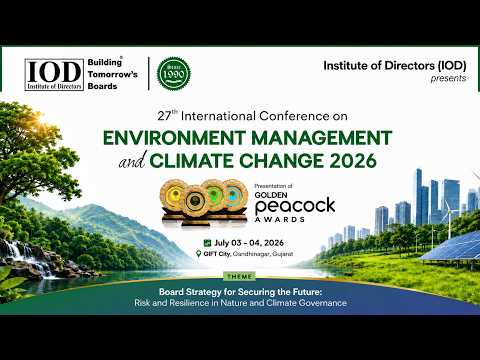
Municipal Commissioner, Vadodara Municipal Corporation, during the Plenary Session III of the 27th International Conference on Environment Management & Climate Change & Presentation of the Golden Peacock Awards, held on July 03, 2026 at the Radisson GIFT City Club, Gandhinagar, Gujarat.
Owned by: Institute of Directors, India
Disclaimer: The opinions expressed in the articles/ stories are the personal opinions of the author. IOD/ Editor is not responsible for the accuracy, completeness, suitability, or validity of any information in those articles. The information, facts or opinions expressed in the articles/ speeches do not reflect the views of IOD/ Editor and IOD/ Editor does not assume any responsibility or liability for the same.