 Quick Links
 Connect us

 Directors Databank (Empannel Yourself)
 Become a
  Become a
  Blog
Blog
 Become an Awards Assessor
 Publications
 Contact Us







Leapfrogging to Sustainability: Building India's future, Not replicating the past

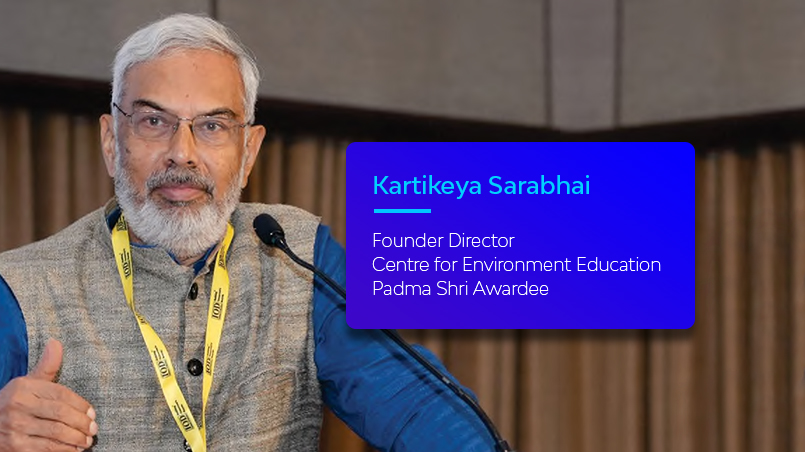
I would like to begin by referring to some of the points raised by Dr. Ajay. He brought forward several important aspects, particularly regarding the role of carbon dioxide and fossil fuels, which deserve continued debate and discussion. It also reminds us how dynamic this field truly is. New discoveries continue to emerge, some anticipated and many completely unforeseen.
As Dr. Ajay rightly asked, "Is my action going to lead to some harm?" As company directors, there are many occasions when we simply do not know the answer.
I found myself in one such difficult position when I was the Co-Chair of a company called Sarabhai Zydus. We were manufacturing animal healthcare products, one of which was diclofenac sodium for veterinary treatment. As many of you may know, India's vulture population declined by almost 98 % within a span of just three years. Nobody could understand why. After all, nobody intentionally kills vultures. Various theories emerged, was it aircraft, habitat loss, or something else? But it turned out to be none of these.
Research eventually revealed that it was diclofenac sodium accumulated in the bodies of vultures. When cattle treated with this drug died and vultures fed on their carcasses, the chemical accumulated in the birds and caused fatal kidney failure. It was a completely unintended consequence. When a drug is approved, the approval is based on its safety and efficacy for the animal being treated and not on what may happen further along the ecological chain.
As a member of the Board of the largest company manufacturing this product, I immediately told the management that this was a disaster and that we had to stop producing it. Quite rightly, the Managing Director responded by saying that if we stopped production, our competitors would simply take over the market. Apart from giving us personal satisfaction that we were no longer manufacturing the drug, it would not solve the environmental problem.
That left me with a difficult question: What should I do as a Board member?
We decided to convene a meeting of all the manufacturers producing diclofenac sodium. We presented the scientific evidence and explained that the only meaningful solution was for all of us to stop manufacturing the product together and replace it with a safer alternative.
To our surprise, every company agreed. Around the same time, the Ministry also became aware of the issue and subsequently imposed a ban. However, the point I wish to emphasise is that the Boards had already taken the decision to discontinue production before the regulatory ban came into force.
To me, that is an excellent example of what we are discussing today, 'Building Tomorrow's Boards'.
Running a company involves difficult responsibilities. Sometimes, a product that appeared perfectly acceptable yesterday suddenly presents a completely new environmental reality. Boards must be prepared to respond responsibly when that happens.
Let me share another example.
A textile company from Ahmedabad approached us when I was associated with the environmental clearance process for the Government of Gujarat. The company argued that it was establishing a factory without cutting trees, harming wildlife, or creating pollution, and therefore it should receive environmental clearance.
However, they had overlooked one critical aspect, which was the groundwater they intended to extract.
Our analysis showed that if the project proceeded as planned, groundwater levels in nearly 80 surrounding villages would decline to such an extent that their wells would eventually run dry.
Rather than rejecting the proposal outright, we placed the responsibility back on the company. We said, "You solve this problem and come back."
Three months later, they returned with an innovative solution. Nearly 90 % of their water would now be recycled within the manufacturing process. We immediately granted approval. And, being the enterprising Gujarati businessmen they were, they went one step further and established a consulting company to advise others on industrial water recycling.
That is how sustainable innovation should work. Gujarat has demonstrated this repeatedly while bringing together science, business and governance to develop practical solutions.
I believe this is precisely the direction in which corporate India must move. The responsibility of Boards is becoming increasingly significant because there will be occasions when you suddenly discover that a company on whose Board you serve is contributing, directly or indirectly, to environmental harm.
The easiest option is to resign, walk away and forget about it. The more difficult but far more responsible course of action is to remain engaged, confront the issue, and work relentlessly towards a solution.
This is one of the first Julys in Ahmedabad that I can remember without the arrival of the monsoon. Earlier, if someone told you to step outside in July without an umbrella, you would have laughed. Today, you can do exactly that.
In fact, the generation growing up today may never even know what “normal weather” once looked like.
So, what should we do?
I believe India has one enormous advantage. Much of our future infrastructure is yet to be built. As we move towards Viksit Bharat, we still have the opportunity to build it differently and build it responsibly.
When our Centre was first established at Thaltej Tekra, people used to ask us why we were moving so far outside Ahmedabad. I even had to provide vehicle loans to staff so they could commute there. Today, we find ourselves right in the heart of the city. Not only has our subject moved to the centre of public attention, but physically we too are now surrounded by the city that has expanded around us. Nearby was a completely barren piece of land. Today, look at GIFT City. Ten years from now, we may hardly recognise this place because of the pace of development.
That rapid development is our opportunity. Can we get it right from the very beginning?
The development model on which many of us grew up, the model followed by much of the developed world is no longer sustainable. Yet, we aspire to become a developed nation second to none.
So, what does responsible development actually mean?
It means adopting a model that is fundamentally different. Waste management in GIFT City, for example, is being approached in innovative ways using advanced technologies. Transportation too must be reimagined because enormous amounts of time, energy and environmental resources are lost every day.
As many of the earlier speakers have said, none of us can solve these problems alone.
India's leadership has demonstrated remarkable commitment in this regard. We are not only one of the world's fastest-growing economies but also striving to grow responsibly. Whenever we attend IPCC or COP meetings and hear India recognised among the countries that have met their climate commitments, we feel proud, not only because of our economic progress but because we are attempting to achieve it responsibly.
What does this require?
It requires 'Leapfrogging'.
My father often argued that India did not need to follow the exact development pathway taken by developed nations. He would explain how satellites could deliver education to the remotest villages, enable remote sensing, improve communications, and connect people even where roads did not exist.
At that time, many people would tell him, “Sir, aap science mein hain toh science kariye. Education aur environment mein kyun interfere kar rahe hain?"
The responsibility of Boards is becoming increasingly significant because there will be occasions when you suddenly discover that a company on whose Board you serve is contributing, directly or indirectly, to environmental harm.
Today, many children have never even experienced telephone wires because they have grown up in a wireless world. What once seemed revolutionary has now become completely ordinary. My father used to say that we do not have to repeat every stage of development that other countries went through before correcting their mistakes. We can learn from their experiences and move directly towards better solutions.
That is leapfrogging.
We do not have to build unsustainable cities before learning how to make them sustainable. We can build sustainable cities from the outset. But leapfrogging requires research. It requires modelling. And it requires education.
The future belongs to our children.
I have just returned from a workshop where we were finalising new NCERT textbooks for Classes X and XI on climate change and sustainability. For the first time, from next year, India will introduce Environmental Studies as a compulsory subject. These are remarkable steps that we are taking for the next generation.
There are, of course, many challenges ahead.
India has traditionally had a recycling mindset. I doubt there is anyone here whose household has never reused a glass bottle or stored newspapers to be sold to the kabadiwala. Recycling has always been part of our culture.
However, newer products, such as plastic bottles, present different challenges.
Here again, we are not working against industry but we are working with industry.
We had a detailed discussion with Bisleri. They explained that they are collecting more plastic than they are introducing into the market. Even then, much more research and development is needed. For instance, the bottle cap is made from a different material and cannot be recycled in the same process as the bottle itself. Every cap must first be separated at a Material Recovery Facility.
That is not merely a problem, it is an opportunity for research and innovation.
In another paper that I have written, I argue that large companies have a tremendous responsibility to educate and strengthen their supply chains. They have the resources to undertake research that smaller companies often cannot afford.
If we approach climate change not merely as a challenge but as an opportunity to fundamentally redefine how we manufacture, how we transport, and how we operate our workplaces, then we will have made a meaningful contribution, not only to the objectives of this Conference on Environment Management and Climate Change, but also to fulfilling our responsibilities as leaders and Board members, whatever capacities we may serve in.
 Back to Home
Author
Mr. Kartikeya Sarabhai
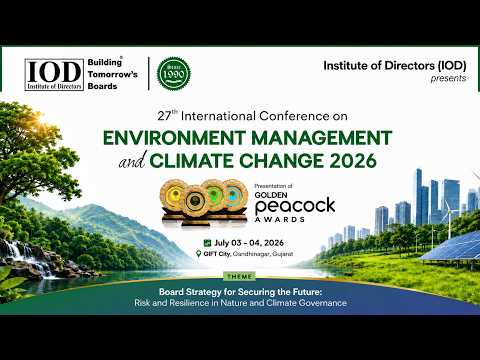
Founder Director, Centre for Environmental Education (CEE), during the Inaugural Session of the 27th International Conference on Environment Management & Climate Change & Presentation of the Golden Peacock Awards, held on July 03, 2026 at the Radisson GIFT City Club, Gandhinagar, Gujarat.
Owned by: Institute of Directors, India
Disclaimer: The opinions expressed in the articles/ stories are the personal opinions of the author. IOD/ Editor is not responsible for the accuracy, completeness, suitability, or validity of any information in those articles. The information, facts or opinions expressed in the articles/ speeches do not reflect the views of IOD/ Editor and IOD/ Editor does not assume any responsibility or liability for the same.